MCQ
A wave can transmit ...... from one place to another
  • Energy
  • B
    Amplitude
  • C
    Wavelength
  • D
    Matter

Answer

Correct option: A.
Energy
a
(a)A wave can transmit energy from one place to another.

Need a full question paper?

Generate a complete, print-ready paper with questions like this in minutes — across 16+ boards, with answer keys.

Start Generating Free

Similar questions

For the magnetic field to be maximum due to a small element of current carrying conductor at a point, the angle between the element and the line joining the element to the given point must be
The grid voltage of any triode valve is changed from –1 volt to – 3 volt and the mutual conductance is $3 \times 10^{-4}$ mho. The change in plate circuit current will be
A plane electromagnetic wave of frequency $500\, MHz$ is travelling in vacuum along $y-$direction. At a particular point in space and

time, $\overrightarrow{ B }=8.0 \times 10^{-8} \hat{ z } \;T$. The value of electric field at this point is

(speed of light $\left.=3 \times 10^{8}\, ms ^{-1}\right)$

$\hat{ x }, \hat{ y }, \hat{ z }$ are unit vectors along $x , y$ and $z$ direction.
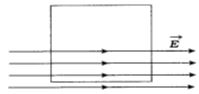
A square surface of side $L$ metres is in the plane of the paper. A uniform electric field $\vec E(V/m) $, also in the plane of the paper, is limited only to the lower half of the square surface, (see figure). The electric flux in SI units associated with the surface is
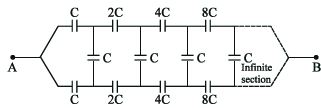
Find the equivalent capacitance of the circuit between point $A$ and $B$.
A charged particle is whirled in a horizontal circle on a frictionless table by attaching it to a string fixed at one point. If a magnetic field is switched on in the vertical direction the tension in the string.
A beam contains $2 \times 10^8$ doubly charged positive ions per cubic centimeter, all of which are moving with a speed of $10^5 \,m/s$. The current density is ............. $A/m^2$
The graph between wave number $(\bar \nu )$ and angular frequency ($\omega$) is
A substance is behaving as convex lens in air and concave in water, then its refractive index is
The time period of a particle in simple harmonic motion is equal to the time between consecutive appearances of the particle at a particular point in its motion. This point is: