MCQ
A wave of frequency 100 Hz travels along a string towards its fixed end. When this wave travels back, after reflection, a node is formed at a distance of 10 cm from the fixed end. The speed of the wave (incident and reflected) is
  • A
    $40 m / s$
  • B
    $10 m / s$
  • C
    $5 m / s$
  • D
    $20 m / s$

Need a full question paper?

Generate a complete, print-ready paper with questions like this in minutes — across 16+ boards, with answer keys.

Start Generating Free

Similar questions

An organ pipe $P_1$, closed at one end vibrating in its first harmonic and another pipe $P_2$, open at both ends vibrating in its third harmonic, are in resonance with a given tuning fork, The ratio of the lengths of $P_1$ and $P_2$ is
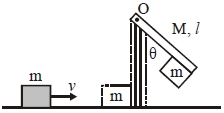
A block of mass $m =1\, kg$ slides with velocity $v=6\, m / s$ on a frictionless horizontal surface and collides with a uniform vertical rod and sticks to it as shown. The rod is pivoted about $O$ and swings as a result of the collision making angle $\theta$ before momentarily coming to rest. If the rod has mass $M =2 \,kg $ and length $l=1\, m$ the value of $\theta$ is approximately

(Take $\left.g=10 \,m / s ^{2}\right)$

The variation of density of a cylindrical thick and long rod, is $\rho  = {\rho _0}\frac{{{x^2}}}{{{L^2}}}$ , then position of its centre of mass from $x = 0$ end is
A dimensionally consistent relation for the volume $V$ of a liquid of coefficient of viscosity $\eta $ flowing per second through a tube of radius $r$ and length $l$ and having a pressure difference $p$ across its end, is
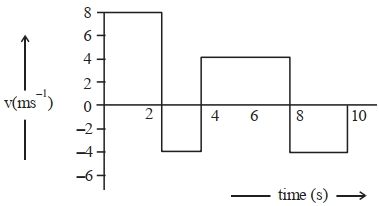
The velocity time graph of a body moving in a straight line is shown in figure.The ratio of displacement to distance travelled by the body in time $0$ to $10\,s$ is
The kinetic energy force on the particle continuously increases with time.
  1. The resultant force on the particle must be parallel to the velocity at all instants.
  2. The resultant force on the particle must be at an angle less than $90^\circ$ all the time.
  3. Its height above the ground level must continuously decrease.
  4. The magnitude of its linear momentum is increasing continuously.
A particle of mass $m$ moving with a velocity $\vec V$ makes a head on elastic collision with another particle of same mass initially at rest. The velocity of the first particle after the collision will be
A particle executes simple hormonic motion between $x =\, -A$ and $x = +A$ . It starts from $x = 0$ moves in $+x-$ direction. The time taken for it to move from $x = 0$ to $x = \frac {A}{2}$ is $T_1$ and to move from $\frac {A}{2}$ to $\frac {A}{\sqrt 2}$ is $T_2$ , then
A physical quantity $p$ is described by the relation $p\, = a^{1/2}\, b^2\, c^3\, d^{-4}$

If the relative errors in the measurement of $a, b, c$ and $d$ respectively, are $2\% , 1\%, 3\%$ and $5\%$, then the relative error in $P$ will be ........... $\%$

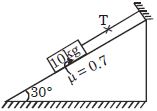
The tension $T$ in the string shown in figure is