Question
A wave $\text{Y} = \text{A}\sin(\omega\text{t} - \text{kx})$ allowed through a string gets reflected from a rigid support and forms stationary wave. Derive the expression for the standing wave.

Answer

Given wave: $\text{Y}_\text{i}=\text{A}\sin(\omega\text{t}-\text{Kx})$
Reflected wave:
$\text{Y}_\text{r}=\text{A}\sin (\omega\text{t}+\text{Kx}+\pi)$
$=-\text{A}\sin(\omega\text{t}+\text{Kx})$

Applying superposition principle,
$\text{y}=\text{Y}_\text{i}+\text{Y}_\text{r}$
$=\text{A}\sin(\omega\text{t}-\text{Kx})-\text{A}\sin(\omega\text{t}+\text{Kx})$
$\text{y}=2\text{A}\sin\text{Kx}\cos\omega\text{t}$
Since amplitude $2\text{A}\sin\text{Kx}$ varies with position, it represents a standing wave.

Need a full question paper?

Generate a complete, print-ready paper with questions like this in minutes — across 16+ boards, with answer keys.
Start Generating Free

Similar questions

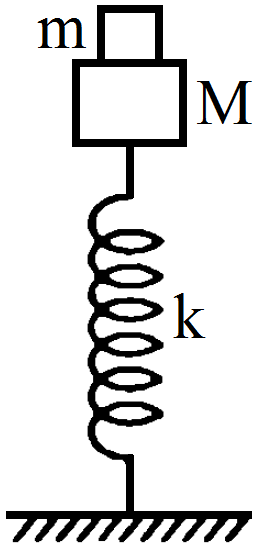
A small block of mass m is kept on a bigger block of mass M which is attached to a vertical spring of spring constant k as shown in the figure. The system oscillates vertically.
  1. Find the resultant force on the smaller block when it is displaced through a distance x above its equilibrium position.
  2. Find the normal force on the smaller block at this position. When is this force smallest in magnitude?
  3. What can be the maximum amplitude with which the two blocks may oscillate together?
A light beam of wavelength $400$ run is incident on a metal plate of work function $2.2eV$.
  1. A particular electron absorbs a photon and makes two collisions before coming out of the metal. Assuming that $10\%$ of the extra energy is lost to the metal in each collision, find the kinetic energy of this electron as it comes out of the metal.
  2. Under the same assumptions, find the maximum number of collisions the electron can suffer before it becomes unable to come out of the metal.
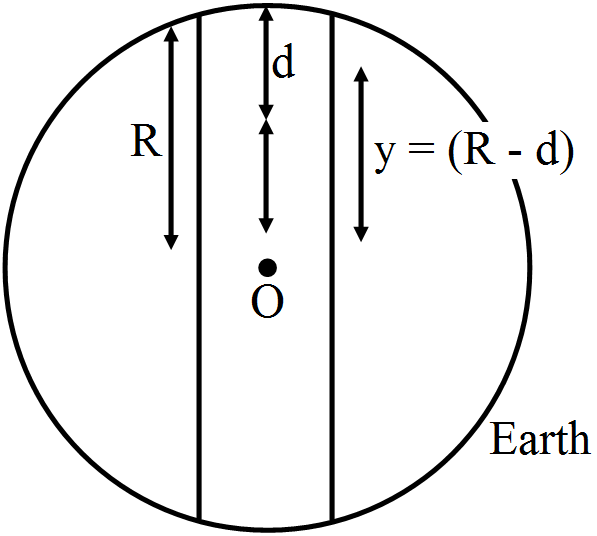
A body is dropped in a hole drilled across a diameter of the earth. Show that it executes S.H.M. Assume the earth to be homogeneous sphere of radius R.
A bullet of mass m moving at a speed v hits a ball of mass M kept at rest. A small part having mass m' breaks from the ball and sticks to the bullet. The remaining ball is found to move at a speed $v_1$ in the direction of the bullet. Find the velocity of the bullet after the collision.
A laser light bean sent to the moon takes 2.56s to return after reflection at the Moon's surface. Calculate the radius of the lunar orbit around the earth.
If c is r.m.s. speed of molecules in a gas and v is the speed of sound waves in the gas, show that c/ v is constant and independent of temperature for all diatomic gases.
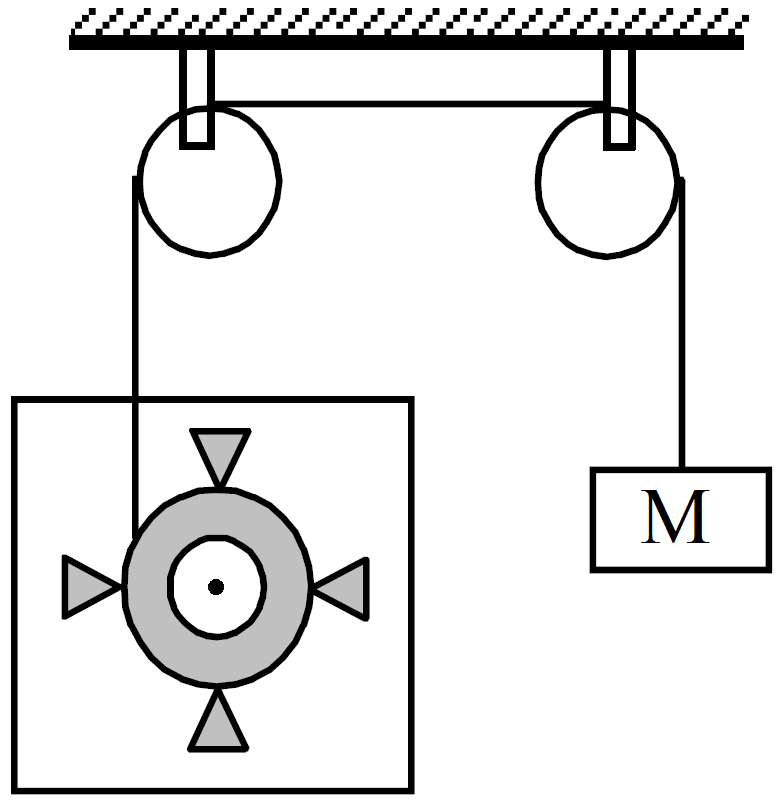
Figure, shows water in a container having $2.0mm$ thick walls made of a material of thermal conductivity $0.50\text{Wm}^{-1}{^{\circ}}\text{C}^{-1}.$ The container is kept in a melting-ice bath at $0^\circ C$. The total surface area in contact with water is $0.05m^2$. A wheel is clamped inside the water and is coupled to a block of mass M as shown in the figure. As the block goes down, the wheel rotates. It is found that after some time a steady state is reached in which the block goes down with a constant speed of $10cms^{-1}$ and the temperature of the water remains constant at $1.0^\circ C$. Find the mass M of the block. Assume that the heat flows out of the water only through the walls in contact. Take $g = 10ms^{-2}$.
Consider the situation of the previous problem. Suppose each of the blocks is pulled by a constant force F instead of any impulse. Find the maximum elongation that the spring will suffer and the distances moved by the two blocks in the process.
A wire stretched between two rigid supports vibrates in its fundamental mode with a frequency of $45Hz$. The mass of the wire is $3.5 \times 10^{–2}kg$ and its linear mass density is $4.0 \times 10^{–2}kg m^{–1}$. What is
  1. The speed of a transverse wave on the string,
  2. The tension in the string?
Two narrow bores of diameters 3.0 mm and 6.0 mm are joined together to form a U-tube open at both ends. If the Utube contains water, what is the difference in its levels in the two limbs of the tube ? Surface tension of water at the temperature of the experiment is $7.3 \times 10^{-2} \mathrm{~N} \mathrm{~m}^{-1}$. Take the angle of contact to be zero and density of water to be $1.0 \times 103 \mathrm{~kg} / \mathrm{m}^{-3}\left(\mathrm{~g}=9.8 \mathrm{~m} / \mathrm{s}^{-2}\right)$.