Question
A wave $\text{Y} = \text{A}\sin(\omega\text{t} - \text{kx})$ allowed through a string gets reflected from a rigid support and forms stationary wave. Derive the expression for the standing wave.

Answer

Given wave: $\text{Y}_\text{i}=\text{A}\sin(\omega\text{t}-\text{Kx})$
Reflected wave:
$\text{Y}_\text{r}=\text{A}\sin (\omega\text{t}+\text{Kx}+\pi)$
$=-\text{A}\sin(\omega\text{t}+\text{Kx})$

Applying superposition principle,
$\text{y}=\text{Y}_\text{i}+\text{Y}_\text{r}$
$=\text{A}\sin(\omega\text{t}-\text{Kx})-\text{A}\sin(\omega\text{t}+\text{Kx})$
$\text{y}=2\text{A}\sin\text{Kx}\cos\omega\text{t}$
Since amplitude $2\text{A}\sin\text{Kx}$ varies with position, it represents a standing wave.

Need a full question paper?

Generate a complete, print-ready paper with questions like this in minutes — across 16+ boards, with answer keys.
Start Generating Free

Similar questions

0.040g of He is kept in a closed container initially at 100.0°C. The container is now heated. Neglecting the expansion of the container, calculate the temperature at which the internal energy is increased by 12J.
Three vessels of equal capacity have gases at the same temperature and pressure. The first vessel contains neon (monatomic), the second contains chlorine (diatomic), and the third contains uranium hexafluoride (polyatomic). Do the vessels contain equal number of respective molecules? Is the root mean square speed of molecules the same in the three cases? If not, in which case is vrms the largest?
A cubical block of mass 1.0kg and edge 5.0cm is heated to 227°C. It is kept in an evacuated chamber maintained at 27°C. Assuming that the block emits radiation like a blackbody, find the rate at which the temperature of the block will decrease. Specific heat capacity of the material of the block is 400Jkg-1K-1.
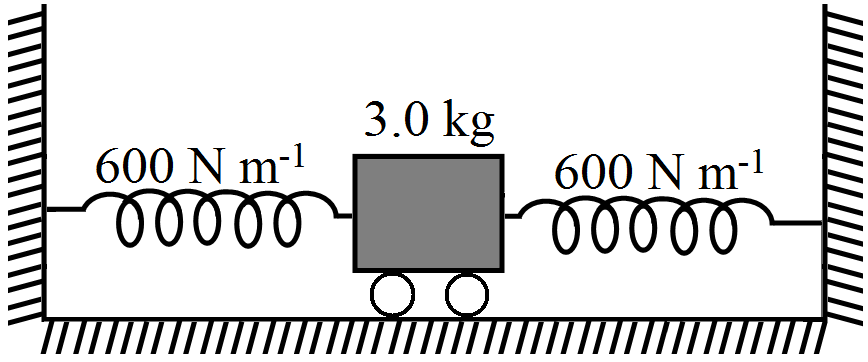
A trolley of mass 3.0kg, as shown in Figure, is connected to two springs, each of spring constant 600Nm-1. If the trolley is displaced from its equilibrium position by 5.0cm and released, what is (a) the period of ensuing oscillations, and (b) the maximum speed of the trolley? How much energy is dissipated as heat by the time trolley comes to rest due damping forces?

A glass window is to be fit in an aluminium frame. The temperature on the working day is 40°C and the glass window measures exactly 20cm × 30cm. What should be the size of the aluminium frame so that there is no stress on the glass in winter even if the temperature drops to 0°C ? Coefficients of linear expansion for glass and aluminium are 9.0 × 10⁻⁶ °C-1 and 24 × 10-6 °C-1 respectively.
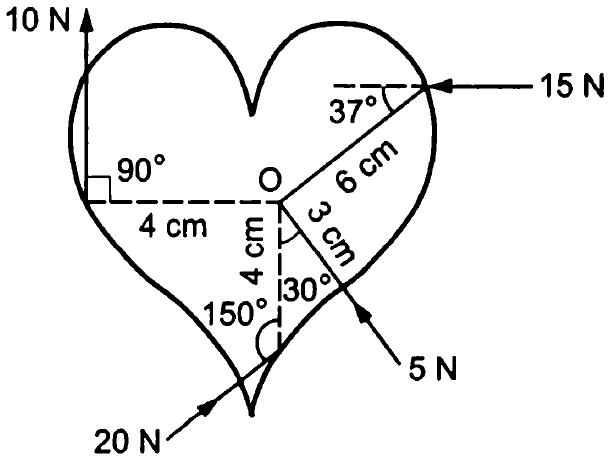
Calculate the total torque acting on the body shown in figure about the point O.

Two particles A and B, each having a charge Q, are placed a distance d apart. Where should a particle of charge q be placed on the perpendicular bisector of AB so that it experiences maximum force What is the magnitude of this maximum force?
Calculate the increase in the internal energy of 10g of water when it is heated from 0°C to 100°C and converted into steam at 100kPa. The density of steam= 0.6kg/ m-3. Specific heat capacity of water = 4200J/ kg-1°C-1 and the Jatent heat of vaporization of water = 2.25 × 10⁶J/kg-1.
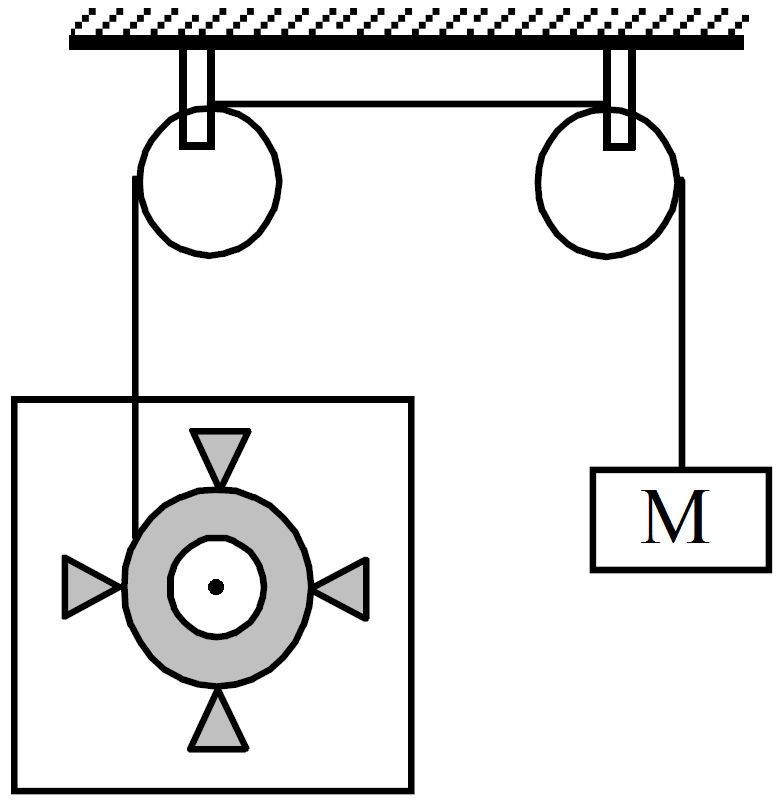
Figure, shows water in a container having 2.0mm thick walls made of a material of thermal conductivity $0.50\text{Wm}^{-1}{^{\circ}}\text{C}^{-1}.$ The container is kept in a melting-ice bath at 0°C. The total surface area in contact with water is 0.05m2. A wheel is clamped inside the water and is coupled to a block of mass M as shown in the figure. As the block goes down, the wheel rotates. It is found that after some time a steady state is reached in which the block goes down with a constant speed of 10cms-1 and the temperature of the water remains constant at 1.0°C. Find the mass M of the block. Assume that the heat flows out of the water only through the walls in contact. Take g = 10ms-2.

An aeroplane has to go from a point A to another point B, 500km away due 30° east of north. A wind is blowing due north at a speed of 20m/s. The air-speed of the
plane is 150m/s.
  1. Find the direction in which the pilot should head the plane to reach the point B.
  2. Find the time taken by the plane to go from A to B.