Question
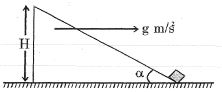
A wedge of height $H$ (fixed) and inclination $\alpha $ (variable) is moving on a smooth horizontal surface with constant acceleration $g\ m/s^2$ . A small block is placed at bottom of incline as shown in figure, slips on the smooth surface of incline . Choose $CORRECT$ statement about time taken by block to reach the top of incline
Answer

Acceleration up to incline

$a=g \cos \alpha-g \sin \alpha$

time to reach top

$\frac{\mathrm{H}}{\sin \alpha}=\frac{1}{2}(g)(\cos \alpha-\sin \alpha) \mathrm{t}^{2}$

$t^{2}=\frac{2 H}{g}=\frac{1}{\sin \alpha \cos \alpha-\cos ^{2} \alpha}$

$=\frac{4 \mathrm{H}}{\mathrm{g}} \frac{1}{\sin 2 \alpha-1+\cos ^{2} \alpha}$

$=\frac{4 \mathrm{H}}{\mathrm{g}} \frac{1}{\left(\sin 2 \alpha+\cos ^{2} \alpha\right)-1}$

so $t$ first decreases than increases.

Need a full question paper?

Generate a complete, print-ready paper with questions like this in minutes — across 16+ boards, with answer keys.

Start Generating Free

Similar questions

A Newtonian fluid fills the clearance between a shaft and a sleeve. When a force of $800$ $N$ is applied to the shaft, parallel to the sleeve, the shaft attains a speed of $1.5$ $cm/sec$. If a force of $2.4$ $kN$ is applied instead, the shaft would move with a speed of ......... $ cm/sec$
$110\; J$ of heat is added to a gaseous system, whose internal energy change is $40\; J$, then the amount of external work done is ........ $J$
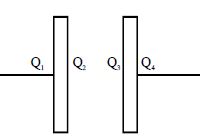
In an insulated parallel-plate capacitor of capacitance $C$, the four surfaces have charges $Q_1, Q_2, Q_3$ and $Q_4$ as shown. The potential difference between the plate is
A ground receiver station is receiving a signal at $(i)$ $5\, MHz$ and transmitted from a ground transmitter at a height of $300\, m$, located at a distance of $100\, km$ from the receiver station. The signal is coming via. Radius of earth $= 6.4 \times 10^6\, m$. Nmax of isosphere = $10^{12} m_3$
For a particular resonance tube, following are four of the six harmonics below $1000 Hz$; $300,600,750$ and $900 \,Hz$. The two missing harmonics are
An electron revolving in $\mathrm{n}^{\text {th }}$ Bohr orbit has magnetic moment $\mu_n$. If $\mu_n \alpha n^x$, the value of $x$ is:
The moment of inertia of a body does not depend on
The electric field in an electromagnetic wave is given by $E =56.5 \sin \omega( t - x / c ) \;NC ^{-1}$. Find the intensity of the wave if it is propagating along $x-$axis in the free space. (Given $\left.\varepsilon_{0}=8.85 \times 10^{-12} \;C ^{2} N ^{-1} m ^{-2}\right)$
The acceleration $a$ (in $ms ^{-2}$ ) of a body, starting from rest varies with time $t$ (in second) according to the relation $a=3 t+4$. The velocity of the body starting from rest at time $t=2 s$ will be $........ms ^{-1}$
If the two metals $A$ and $B$ are exposed to radiation of wavelength $350\,nm$. The work functions of metals $A$ and $B$ are $4.8\,eV$ and $2.2\,eV$. Then choose the correct option