Question
(a) What are products obtained when methane reacts with chlorine in diffused sunlight?
(b) Write the equation when methane reacts with chlorine in diffused sunlight.
(c) Name and define the type of above reaction.
Answer

(a) The products obtained when methane reacts with chlorine in diffused sunlight are Chloromethane, Dichloromethane, Trichloromethane and Tetrachloromethane.
(b)
$CH _4+ CI _2 \xrightarrow[\text { or } \Delta]{\text { UV light }} CH _3 Ci + HCI $
$CH _3 CI + CI _2 \longrightarrow CH _2 CI _2+ HCI $
$CH _2 CI _2+ CI _2-\cdot CHCi _3+ HCI$
$CHCI _3+ Ci _2 \longrightarrow CCI _4+ HCI$
(c) The above reaction is substitution reaction. Here the substitution of alkanes with chlorine takes place hence it is called chlorination.
The reactions in which the hydrogen of the alkane molecule is replaced by another atom or group of atoms resulting in the formation of the derivative of that hydrocarbon are called substitution reactions. Substitution by halogen atom is called halogenations.

Need a full question paper?

Generate a complete, print-ready paper with questions like this in minutes — across 16+ boards, with answer keys.

Start Generating Free

Similar questions

How is ethylene prepared in laboratory? Give balanced equation and
procedure. How is the gas prepared and dried?
Give the trivial names and $IUPAC$ names of the following:
(a) $C_3H_6$
(b) $C_2H_4$
(c) $C_2H_2$
(d) $CH_30H$
(e) $CH_3COOH$
State the factors that influence the preferential discharge of ions at the electrodes.
Which of the following methods, (a), (b), (c), (d) or (e) is generally used for preparing the chlorides listed below from (i) to (v). Answer by writing down the chloride and the letter pertaining to the corresponding method. Each letter is to be used only once.
(a) Action of an acid on a metal.
(b) Action of an acid on an oxide or carbonate.
(c) Direct combination.
(d) Neutralization of an alkali by an acid.
(e) Precipitation (double decomposition).
(i) copper(II) chloride.
(ii) iron(II) chloride.
(iii) iron(IIl) chloride.
(iv) lead (II) chloride.
(v) sodium chloride.
Draw the electron dot structure of covalent compound methane (non polar) and HCL (polar) and give two difference between them.
Give the trivial (common) names and IUPAC names of the following:
(a) $C_3H_6$
(b) $C_2H_4$
(c) $C_2H_2$
(d) $CH_3OH$
(e) $C_2H_5OH$
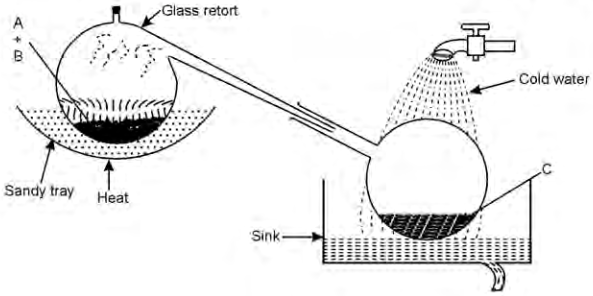
The figure given below illustrates the apparatus used in the laboratory preparation of nitric acid.
Image
(i) Name A (a liquid), B (a solid) and C (a liquid).
(ii) Write an equation to show how nitric acid undergoes decomposition.
(iii) Write the equation for the reaction in which copper is oxidised by concentrated nitric acid.
An organic compound has the following percentage composition $: C = 12.76\%, H = 2.13\%, Br = 85.11\%$. The vapour density of the compound is $94.$ Find out its molecular formula.
How would you prepare :
zinc sulphate crystals from zinc dust (powdered zinc and zinc oxide).
i. A compound has the following percentage composition by mass: carbon $14.4 \%$, hydrogen $1.2 \%$, and chlorine $84.5 \%$. Determine the empirical formula of this compound. Work correctly to $1$ decimal place.
$( H =1 ; C =12 ; Cl =35.5)$
ii. The relative molecular mass of this compound is $168,$ so what is its molecular formula?