Question
(a) What do you understand by the term hydroelectric power?
(b) Explain the energy changes taking place in a hydroelectric dam?

Answer

(a) Hydroelectric power: Hydroelectric power is the power derived from energy of
falling water or fast running water. A hydroelectric power plant is an arrangement in which the kinetic energy of flowing water is transformed into electric energy and the electric energy so generated is called hydroelectric energy.
(b) Energy changes taking place in a hydroelectric dam:
1. As the water flows into reservoir from the catchment area, the kinetic energy of flowing water changes to potential energy.
2. As the water is released through control valve, the potential energy of water changes to kinetic energy.
3. As the water flowing at a high speed strikes the blades of the turbine, its kinetic energy changes to rotational kinetic energy of the turbine.
4. As the turbine is coupled to the shaft of generator, the rotational kinetic energy of turbine changes to the rotational kinetic energy of armature.
5. As the coils of armature rotate in magnetic field, the rotational kinetic energy of armature changes to the electric energy in its coils.
Need a full question paper?

Generate a complete, print-ready paper with questions like this in minutes — across 16+ boards, with answer keys.

Start Generating Free

Similar questions

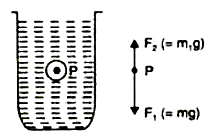
A small stone of mass $m (=200 g)$ is held underwater in a tall jar and allowed to fall as shown in the following figure. The freebody diagram of the stone is also shown.
(i) What does $F _2$ represent?
(ii) What does $m _1$ represent?
(iii) What is the net force acting on the stone?
(iv) What is the acceleration of the stone as it falls through water? Neglect the force due to viscosity. Assume that volume of stone $=80 cml$, density of water $=1.0 g cm ^{-3}$ and acceleration due to gravity $g =10 ms^{-2}$.
Derive the following equations for uniformly accelerated motion:
(i) $v = u + at$
(ii) $S = ut +\frac{1}{2} at ^2$
(iii) $v ^2= u ^2+2 aS$
where the symbols have their usual meanings.
A solid of area of cross-section $0.004 m^2$ and length 0.60 m is completely immersed in water of density 1000 kgm ${ }^3$. Calculate :
1. Wt of solid in SI system
2. Upthrust acting on the solid in SI system.
3. Apparent weight of solid in water.
4. Apparent weight of solid in brine solution of density $1050 kgm ^3$.
[Take $g =10 N / kg$; Density of solid $=7200 kgm ^3$ ]
Name the spherical mirror which (i) diverges (ii) converges the beam of light incident on it. Justify your answer by drawing a ray diagram in each case.
Describe an experiment to demonstrate that air exerts pressure.
A ball is thrown up vertically, and returns back to thrower in 6 s. Assuming there is no air friction, plot a graph between velocity and time. From the graph calculate
1. deceleration
2. acceleration
3. total distance covered by ball
4. average velocity.
Describe, how you will proceed to determine the position of the pole of a bar magnet.
An aluminium cube of side 5 cm and RD. 2.7 is suspended by a thread in alcohol of relative density 0.80 . Find the tension in thread.
Draw suitable diagrams to illustrate the action of (i) concave mirror and (ii) convex mirror on a beam of light incident parallel to the principal axis.
A boy covers half of his journey with a uniform speed of u and the other half with a uniform speed of v. What is the average speed for the whole journey?