Question
(a) What do you understand by the term lateral inversion?
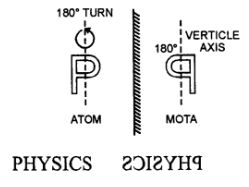
(b) A printed card has letters PHYSICS. By drawing the diagram show the appearance of the letters. (No ray diagram is required).
Answer

(a) Lateral Inversion. The phenomenon due to which the image of an object turns through an angle of $180^{\circ}$ through verticle axis rather the horizontal axis, such that right side of image appears as left or vice-versa is called Lateral Inversion. During lateral inversion the left side of object appears as right side of image and vice-versa. In a way the image turns through the angle of $180^{\circ}$ about vertical axis.
Image

Need a full question paper?

Generate a complete, print-ready paper with questions like this in minutes — across 16+ boards, with answer keys.

Start Generating Free

Similar questions

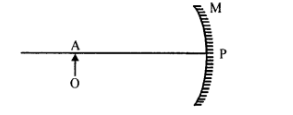
In the figure is shown a concave mirror. A is a point on the principal axis. If an object O is kept at A, image is formed on A itself. Copy the diagram. Draw the image in the diagram. Is the image real or virtual?
Image
Measure the distance PA and write it in the diagram. What is the distance PA called? Mark a point B on the principal axis, at which, if a point source of light is kept, the rays travel parallel to principal axis after reflection from M. What is point B called?
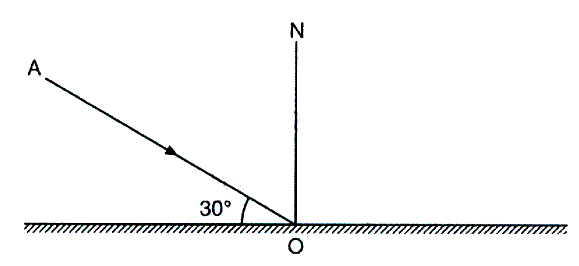
Figure shows an incident ray $AO$ and the normal $ON$ on a plane mirror. The angle which the incident ray $AO$ makes with mirror is $30^\circ$ . (a) Find the angle of incidence. (b) Draw the reflected ray and then find the angle between the incident and reflected rays.
The wavelength of the vibrations produced on the surface of water is 2 cm . If the wave velocity is $16 ms^{-1}$, calculate
1. no. of waves produced in one second
2. time required to produce one wave.
The acceleration of a moving body is constant in magnitude and direction. Must the path of the body be a straight line?
If not, given an example.
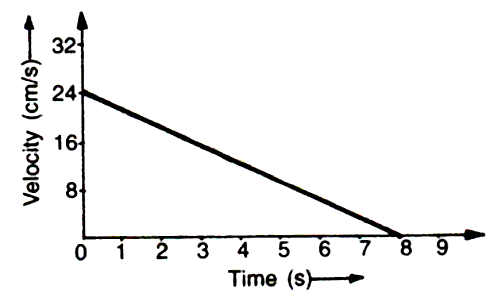
The velocity-time graph of a coin moving on a table is shown in the below figure. If the mass of the coin is $20 g$, then how much force does the table exert on the coin to bring it to rest?
Draw a neat diagram of a simple pendulum. Show on it the effective length of the pendulum and its one oscillation .
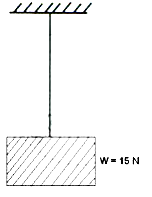
In the Figure a block of weight 15 N is hanging from a rigid support by a string. What force is exerted by (a) a block on the string and (b) a string on the block? Name and show them in the diagram.
You are provided a convex mirror, a concave mirror and a plane mirror. How will you distinguish between them, without touching or using any other apparatus?
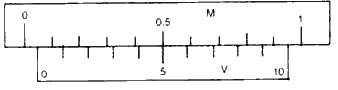
Consider the following case where the zero of vernier scale and the zero of the main scale are clearly seen. If L.C. of the vernier calipers is $0.01 \ cm$, write the zero error and zero correction of the following.
A cricket ball of mass $500 \ g$ moving at a speed of $30$ ms $1$ is brought to rest by a player in $0.03 \ s$. Find the average force applied by the player.