MCQ
  A wheel is rotating with an angular speed of $20\,rad/sec$. It is stopped to rest by applying a constant torque in $4\ s$. If the moment of inertia of the wheel about its axis is $0.20\ kg-m^2$, then the work done by the torque in two seconds will be .......... $J$
  • A
    $10$
  • B
    $20$
  • $30$
  • D
    $40$

Answer

Correct option: C.
$30$
c
${\omega _1} = 20$ $rad/sec$,

${\omega _2} = 0,\,t = 4sec.$

So angular retardation $\alpha  = \frac{{{\omega _1} - {\omega _2}}}{t} = \frac{{20}}{4} = 5\ rad/se{c^2}$

Now angular speed after $2\ sec$,         

${\omega _2} = {\omega _1} - \alpha t$$ = 20 - 5 \times 2$ = $10\,$$rad/sec$

Work done by torque in $2\ sec$ = loss in kinetic energy = $\frac{1}{2}I\,\left( {\omega _1^2 - \omega _2^2} \right)$$ = \frac{1}{2}(0.20)\,({(20)^2} - {(10)^2})$

$ = \frac{1}{2} \times \,\,0.2 \times 300$= $30\ J.$

Need a full question paper?

Generate a complete, print-ready paper with questions like this in minutes — across 16+ boards, with answer keys.

Start Generating Free

Similar questions

The force required to take away a flat circular plate of radius $2\, cm$ from the surface of water, will be (the surface tension of water is $70\, dyne/cm$)
Two moles of an ideal monoatomic gas at ${27^o}C$ occupies a volume of $V.$ If the gas is expanded adiabatically to the volume $2V,$ then the work done by the gas will be ....... $J$ $[\gamma = 5/3,\,R = 8.31J/mol\,K]$
At a given temperature, the pressure of an ideal gas of density $\rho $ is proportional to
Under a constant pressure head, the rate of flow of liquid through a capillary tube is $V$. If the length of the capillary is doubled and the diameter of the bore is halved, the rate of flow would become
If the density of the material increases, the value of Young's modulus
If three uniform spheres, each having mass $M$ and radius $r,$ are kept in such a way that each touches the other two, the magnitude of the gravitational force on any sphere due to the other two is:
At the same temperature and pressure and volume of two gases, which of the following quantities is constant
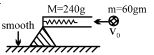
$A$ ball of mass $m = 60gm$ is shot with speed $v_0 = 22m/s$ into the barrel of spring gun of mass $M = 240g$ initially at rest on $a$ frictionless surface. The ball sticks in the barrel at the point of maximum compression of the spring. What fraction of initial kinetic energy of the ball is now stored in the spring?
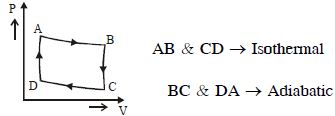
The $P-V$ diagram of a certain process (carnot cycle) is as shown. The process is also represent as
If a cycle wheel of radius $4 \,m$ completes one revolution in two seconds. Then acceleration of a point on the cycle wheel will be