MCQ
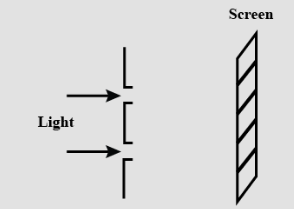
A white light is passed through the two narrow slits and produced a pattern of alternating bright and dark lines on the screen as shown above. What will effects on the central bright band , if the distance between screen and slits are increased?
  • Become wider
  • B
    Become narrower
  • C
    Remain unchanged
  • D
    Disappear completely

Answer

Correct option: A.
Become wider

The setup shown is that of Young's Double Slit Experiment.
The fringe width in the experiment is given as $\beta=\frac{\text{D}\lambda}{\text{d}}​$
where d is the distance between the slits, $D$ is the distance between screen and slits.
Hence the central fringe also widens when distance between screen and slits increases.

Need a full question paper?

Generate a complete, print-ready paper with questions like this in minutes — across 16+ boards, with answer keys.

Start Generating Free

Similar questions

The constant $k$ in Coulomb's law depends upon:
Our eye is most sensitive for which of the following wavelength.......$\mathop A\limits^o $
A wire when connected to 220V mains supply has power dissipation $P_1$. Now the wire is cut into two equal pieces which are connected in parallel to the same supply. Power dissipation in this case is $P_2$. Then $P_2:P_1$ is 
When a voltage $V=V_0 \cos \omega t$ is applied across a resistor of resistance $R$, the average power dissipated per cycle in the resistor is given by
A hollow conducting sphere of radius $R$ has a charge $( + Q)$ on its surface. What is the electric potential within the sphere at a distance $r = \frac{R}{3}$ from its centre
The image formed by a concave mirror:
A current of $2\, amp$. flows in a long, straight wire of radius $2\, mm$. The intensity of magnetic field on the axis of the wire is
Electrons with energy 80 keV are incident on the tungsten target of an X-ray tube. K shell electrons of tungsten have ionization energy 72.5 keV. X-rays emitted by the tube contain only
Radiations of monochromatic waves of wavelength $400\  nm$ are incident on the surface of metals $Zn$, $Fe$ and $Ni$ of work functions $3.4\  eV$, $4.8\  eV$ and $5.9\  eV$ respectively. (Take $hc = 1242\  eV\  nm$)

$(a)$ Maximum $KE$ associated with photoelectrons from the surface of any metal is $0.3\  eV$

$(b)$ No photoelectrons are emitted from the surface of $Ni$

$(c)$ If the frequency of the source of radiation is doubled then $KE$ of photoelectrons is also doubled

$(d)$ Photoelectrons will be emitted from the surfaces of all the three metals if the wavelength of the incident radiation is less than $200\  nm$

Correct statements are

The number of electrons to be put on a spherical conductor of radius $0.1\,m$ to produce an electric field of $0.036\, N/C$ just above its surface is