MCQ
A winding wire which is used to frame a solenoid can bear a maximum $10\, A$ current. If length of solenoid is $80\,cm$ and it's cross sectional radius is $3\, cm$ then required length of winding wire is $(B = 0.2\,T)$
  • A
    $1.2 \times {10^2}\,m$
  • B
    $4.8 \times {10^2}\,m$
  • $2.4 \times {10^3}\,m$
  • D
    $6 \times {10^3}\,m$

Answer

Correct option: C.
$2.4 \times {10^3}\,m$
c
(c) $B = \frac{{{\mu _0}Ni}}{l}$ where $N =$ Total number of turns, $l =$ length of the solenoid
$ \Rightarrow 0.2 = \frac{{4\pi \times {{10}^{ - 7}} \times N \times 10}}{{0.8}} \Rightarrow N = \frac{{4 \times {{10}^4}}}{\pi }$
Since $N$ turns are made from the winding wire so length of the wire $(L)$ $ = 2\pi r \times N$ [ $2\pi r = $ length of each turns]
$ \Rightarrow L = 2\pi \times 3 \times {10^{ - 2}} \times \frac{{4 \times {{10}^4}}}{\pi } = 2.4 \times {10^3}\,m$

Need a full question paper?

Generate a complete, print-ready paper with questions like this in minutes — across 16+ boards, with answer keys.

Start Generating Free

Similar questions

Two very long, straight and parallel wires carry steady currents $I$ and $I$ respectively. The distance between the wires is $d$. At a certain instant of time, a point charge $q$ is at a point equidistant from the two wires in the plane of the wires. Its instantaneous velocity $v$ is perpendicular to this plane. The magnitude of the force due to the magnetic field acting on the charge at this instant is
A radioactive reaction is $_{92}{U^{238}}{ \to _{82}}P{b^{206}}$. How many $\alpha $ and $\beta $  particles are emitted
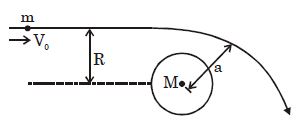
A mass $m$ , travelling at speed $V_0$ in a straight line from far away is deflected when it passes near a black hole of mass $M$ which is at a perpendicular distance $R$ from the original line of flight. $a$ , the distance of closest approach between the mass and the black hole is given by the relation 
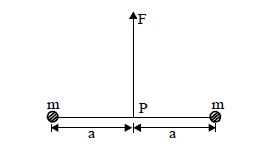
Two particles of mass $m$ each are tied at the ends of a light string of length $2a$ . The whole system is kept on a frictionless horizontal surface with the string held tight so that each mass is at a distance $'a'$ from the centre $P$ (as shown in the figure). Now, the mid-point of the string is pulled vertically upwards with a small but constant force $F$ . As a result, the particles move towards each other on the surface. The magnitude of acceleration, when the separation between them becomes $2x$ , is
If luminous efficiency of a lamp is $2$ lumen/watt and its luminous intensity is $42  $ candela, then power of the lamp is.......$W$
Find the bindng energy per nucleon for $\frac{50}{120}\, Sn$. Mass of proton $m _{ P }=1.00783\, U ,$ mass of $m _{ n }=1.00867\, U$ and $mass$ of tin nucleus $m _{ Sn }=119.902199$ $U.$$......MeV$

(take $1 U =931\, MeV )$

Which of the following process will give maximum amount of heat to surrounding when volume becomes half of initial
A force of $- P \hat{k}$ acts on the origin of the coordinate system. The torque about the point $(2,-3)$ is $P(a \hat{i}+b \hat{j})$, the ratio of $\frac{a}{b}$ is $\frac{x}{2}$. The value of $x$ is
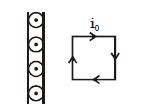
Figure shows a cross-section of a large-section of an infinite metal sheet carrying an electric current along its surface. The current per unit length is $J$ . A current carrying square loop is placed nearby the metal sheet such that the plane of square is perpendicular to the plane of sheet then 
A particle covers half of its total distance with speed $v_1$ and the rest half distance with speed $v_2 .$ Its average speed during the complete journey is