Question
A wire carries an alternating current $\text{i}=\text{i}_0\sin\omega\text{t}.$ Is there an electric field in the vicinity of the wire?

Answer

When an alternating current passes through a conductor, the changing magnetic field create a changing electric field outside it. An electromagnetic field is radiated from the surface of the conductor. There is a time-varying electric ield outside the conductor. Hence, there is a time-varying electric field in the vicinity of the wire.

Need a full question paper?

Generate a complete, print-ready paper with questions like this in minutes — across 16+ boards, with answer keys.
Start Generating Free

Similar questions

The band gap for silicon is 1.1eV.
  1. Find the ratio of the band gap to kT for silicon at room temperature 300K.
  2. At what temperature does this ratio become one tenth of the value at 300K?
(Silicon will not retain its structure at these high temperatures.)
Define the terms threshold frequency and stopping potential in relation to the phenomenon of photoelectric effect. How is the photoelectric current affected on increasing the (1) frequency (2) intensity of the incident radiations and why?
If $\vec{\text{A}},\vec{\text{B}},\vec{\text{C}}$ are mutually perpendicular, show that $\vec{\text{C}}\times(\vec{\text{A}}\times\vec{\text{B}})=0.$ Is the converse true?
A charge q is placed at the centre of the line joining two equal charges Q.
Show that the system of three charges will be in equilibrium if $\text{q}=-\frac{\text{Q}}{4}.$

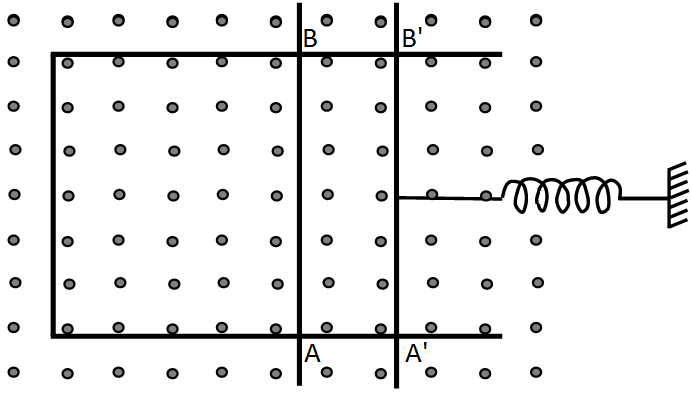
A rectangular wire frame, shown below, is placed in a uniform magnetic field directed upward and normal to the plane of the paper. The part AB is connected to a spring. The spring is stretched and released when the wire AB has come to the position A′ B′ (t = 0) How would the induced emf vary with time? Neglect damping.
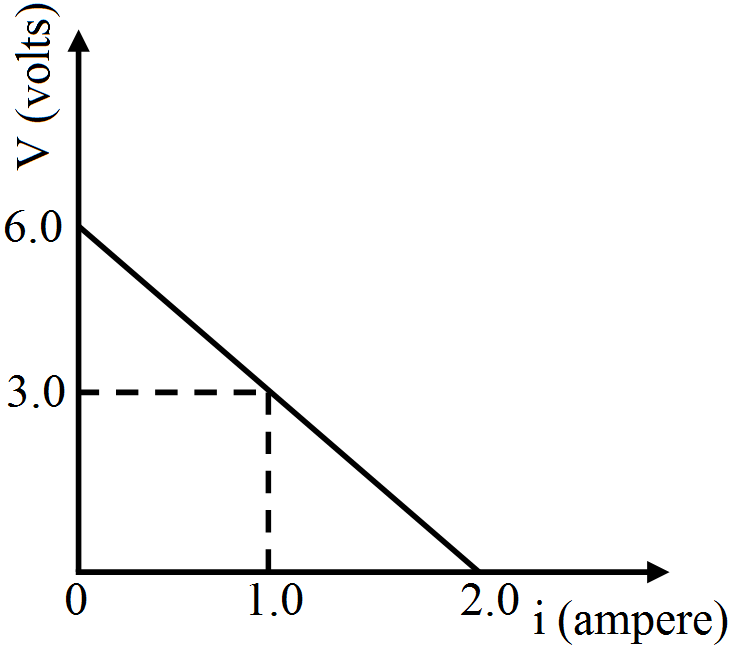
The graph shown here shows the variation of terminal potential difference V, across a combination of three cells in series to a resistor, versus current i:
  1. Calculate the emf of each cell.
  2. For what current i, will the power dissipation of the circuit be maximum?
  1. Monochromatic light of wavelength 589 nm is incident from air on a water surface. If $\mu$ for water is 1.33, find the wavelength, frequency and speed of the refracted light.
  2. A double convex lens is made of a glass of refractive index 1.55, with both faces of the same radius of curvature. Find the radius of curvature required, if the focal length is 20 cm.
What potential difference should be applied across an X-ray tube to get X-ray of wavelength not less than 0.10nm? What is the maximum energy of a photon of this X-ray in joule?
It is said that any charge given to a conductor comes to its surface. Should all the protons come to the surface? Should all the electrons come to the surface? Should all the free electrons come to the surface?
A charge Q is uniformly distributed over a rod of length l. Consider a hypothetical cube of edge l with the centre of the cube at one end of the rod. Find the minimum possible flux of the electric field through the entire surface of the cube.