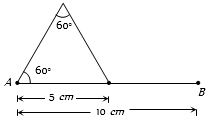
A wire has resistance of $24\,\Omega$ is bent in the following shape. The effective resistance between $A$ and $B$ is .............. $\Omega$
Medium
Download our app for free and get started
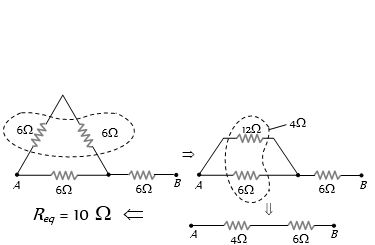
(b) Given resistance of each part will be

Download our appand get started for free
Experience the future of education. Simply download our apps or reach out to us for more information. Let's shape the future of learning together!No signup needed.*
Similar Questions
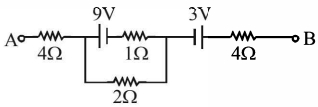
- 1In the circuit shown in figure potential difference between points A and $B$ is $16\,V$. the current passing through $2 \Omega$ resistance will be $...........\,A$View Solution
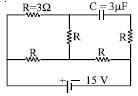
- 2In the circuit shown, the cell is ideal, with $emf$ $=$ $15$ $V$. Each resistance is of $3 $ $\Omega$ . The potential difference across the capacitor is.....$V$View Solution
- 3Drift speed of electrons, when $1.5\, A$ of current flows in a copper wire of cross section $5\, mm^2$, is $v$. If the electron density in copper is $9 \times 10^{28}\, m^3$ the value of $v$ in $mm/s$ is close to (Take charge of electron to be $= 1.6 \times 10^{-19}\, C$)View Solution
- 4In a region $10^{19}$ $\alpha -$ particels and $10^{19}$ protons per second move to the left, while $10^{19}$ electrons moves to the right per second. The current isView Solution
- 5An electric bulb rated $50 \mathrm{~W}-200 \mathrm{~V}$ is connected across a $100 \mathrm{~V}$ supply. The power dissipation of the bulb is :View Solution
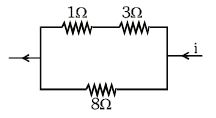
- 6Power dissipated across the $8\,\Omega $ resistor in the circuit shown here is $2\, watt$. The power dissipated in watt units across the $3\,\Omega $ resistor isView Solution
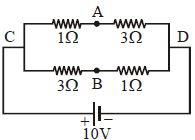
- 7A battery of $emf$ $10\,V$ is connected to resistances as shown in the figure. The potential difference between $A$ and $B,\,\,(V_A -V_B)$ is ................ $V$View Solution
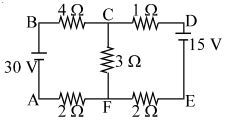
- 8The figure shows a network of five resistances and two batteries The current through the $15\,V$ battery is .............. $A$View Solution
- 9A cell of $e.m.f.$ $1.5\,V$ having a finite internal resistance is connected to a load resistance of $2\,\Omega $. For maximum power transfer the internal resistance of the cell should be ............. $ohm$View Solution
- 10View SolutionThe equivalent resistance of resistors connected in series is always