MCQ
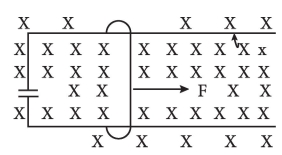
A wire having mass $m$ and length $1$ can freely slide on a pair or parallel smooth horizontal rails placed in vertical magnetic field $B$. The rails are connected by a capacitor of capacitance $C$. The electric resistance of the rails and the wire is zero. If a constant force $F$ acts on the wire as shown in the figure. Then, the acceleration of the wire can be given as
  • $a=\frac{F}{m+C^2 F ^2}$
  • B
    $a=\frac{F}{m+C B 1}$
  • C
    $a=\frac{F^2 B^2 1}{m}$
  • D
    $a=\frac{F}{m+C^2 B^2 1}$

Answer

Correct option: A.
$a=\frac{F}{m+C^2 F ^2}$
a
(a)

Due to the movement of rail with instantaneous velocity $v$, the e.m.f produced across the capacitor, $V = Bv l$

Charge stored in the capacitor $=q= CV = CBvl$

Therefore the current through the capacitor, $i =\frac{ dq }{ dt }= CBl \frac{ dv }{ dt }= CBla$

This same current passes through the wire

Hence the magnetic force on it, $F = Bil = CB ^2 I ^2 a$

Hence, $ma = F - F$

$\Rightarrow ma = F - CB ^2 l ^2 a$

$\Rightarrow a=\frac{F}{m+C^2 F ^2}$

Need a full question paper?

Generate a complete, print-ready paper with questions like this in minutes — across 16+ boards, with answer keys.

Start Generating Free

Similar questions

By photoelectric effect, Einstein, proved
$A$ long metal bar of $30\,cm$ length is aligned along a north south line and moves eastward at a speed of $10\, ms^{-1}$. $A$ uniform magnetic field of $4.0\,T$ points vertically downwards. If the south end of the bar has a potential of $0\,V$, the induced potential at the north end of the bar is.....$V$
An electric bulb is rated 60W, 220V. The resistance of its filament is
$^{22}$Ne nucleus, after absorbing energy, decays into two $\alpha-$particles and an unknown nucleus. The unknown nucleus is:
A square shaped wire loop of mass $m$, resistance $R$ and side $a$ moving speed $v_{0}$, parallel to the $X$-axis, enters a region of uniform magnetic field $B$, which is perpendicular to the plane of the loop. The speed of the loop changes with distance $x(x < a)$ in the field, as
A nucleus with mass number $240$ breaks into two fragments each of mass number $120 ,$ the binding energy per nucleon of unfragmented nuclei is $7.6 \,\mathrm{MeV}$ while that of fragments is $8.5\, \mathrm{MeV}$. The total gain in the Binding Energy in the process is : (In $\mathrm{MeV}$)
No current flows between two charged bodies connected together when they have the same
Which of the following form(s) a virtual and erect image for all positions of the object
If the longest wavelength in the ultraviolet region of hydrogen spectrum is $\lambda_{0}$ then the shortest wavelength in its infrared region is
If radius of first orbit of hydrogen atom is $5.29 \times 10^{-11} \,m$, the radius of fourth orbit will be ......... $\mathring A$