A wire of length $100\, cm$ is connected to a cell of emf $2\,V$ and negligible internal resistance. The resistance of the wire is $3\,\Omega $. The additional resistance required to produce a potential difference of $1\, mV/cm$ is ............. $\Omega$
Medium


Download our appand get started for free
Experience the future of education. Simply download our apps or reach out to us for more information. Let's shape the future of learning together!No signup needed.*
Similar Questions
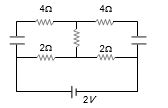
- 1Find the power of the circuit ............ $W$View Solution
- 2The electromotive force of a primary cell is $2\, volts$. When it is short-circuited it gives a current of $4$ amperes. Its internal resistance in $ohms$ isView Solution
- 3A wire of length $10 \mathrm{~cm}$ and radius $\sqrt{7} \times 10^{-4} \mathrm{~m}$ connected across the right gap of a meter bridge. When a resistance of $4.5 \ \Omega$ is connected on the left gap by using a resistance box, the balance length is found to be at $60 \mathrm{~cm}$ from the left end. If the resistivity of the wire is $\mathrm{R} \times 10^{-7} \Omega \mathrm{m}$, then value of $\mathrm{R}$ is :View Solution
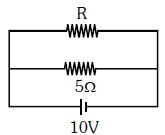
- 4The power dissipated in the circuit shown in the figure is $30\, Watts$. The value of $R$ is ............. $\Omega$View Solution
- 5View SolutionWhich of the following statement is correct
- 6View SolutionGiven three equal resistors, how many different combination of all the three resistors can be made
- 7Two wires of same material have length $L$ and $2L $ and cross-sectional areas $4A$ and $A$ respectively. The ratio of their specific resistance would beView Solution
- 8Four resistances are connected in a circuit in the given figure. The electric current flowing through $4\, ohm$ and $6\, ohm$ resistance is respectivelyView Solution
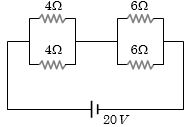
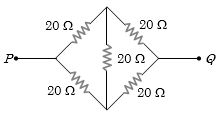
- 9The equivalent resistance between $P$ and $Q$ in the given figure, is ............... $\Omega$View Solution
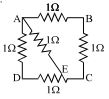
- 10$ABCD$ is a square where each side is a uniform wire of resistance $1\,\Omega$ . $A$ point $E$ lies on $CD$ such that if a uniform wire of resistance $1\,\Omega$ is connected across $AE$ and constant potential difference is applied across $A$ and $C$ then $B$ and $E$ are equipotential.View Solution