- The central fringe will be white.
- There will not be a completely dark fringe.
- The fringe next to the central will be red.
- The fringe next to the central will be violet.
The central fringe will be white.
There will not be a completely dark fringe.
The fringe next to the central will be violet.
Explanation:
The superposition of all the colours at the central maxima gives the central band a white colour. As we go from the centre to corner, the fringe colour goes from violet to red. There will not be a completely dark fringe, as complete destructive interference does not take place.
Generate a complete, print-ready paper with questions like this in minutes — across 16+ boards, with answer keys.
An electron and a proton enter region of uniform magnetic field in a direction at right angles to the field with the same kinetic energy. They describe circular paths of radius and
respectively. Then
|
(a) |
|
(b) |
|
(c) |
|
(d) |
What happens to the fringe pattern when the Young’s double slit experiment is performed in water instead or air then fringe width
|
(a) Shrinks |
(b) Disappear |
(c) Unchanged |
(d) Enlarged |
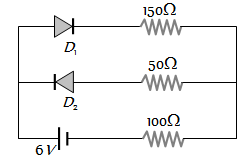
The circuit shown in following figure contains two diode D1 and D2 each with a forward resistance of 50 ohms and with infinite backward resistance. If the battery voltage is 6 V, the current through the 100 ohm resistance (in amperes) is

| (a) Zero | (b) 0.02 | (c) 0.03 | (d) 0.036 |
Which of the following statement is incorrect
|
(a) Both ac and dc dynamo have a field magnet |
|
(b) Both ac and dc dynamo have an armature |
|
(c) Both ac and dc dynamo convert mechanical energy into electrical energy |
|
(d) Both ac and dc dynamo have slip rings |
Length of a hollow tube is 5m, it’s outer diameter is 10 cm and thickness of it’s wall is 5 mm. If resistivity of the material of the tube is 1.7 ×
W × m then resistance of tube will be
|
(a) 5.6 × 10⁻⁵ W |
(b) 2 × 10⁻⁵ W |
(c) 4 × 10⁻⁵ W |
(d) None of these |