Question
A zero vector has:
  1. Any direction
  2. No direction
  3. Many direction
  4. None of these

Answer

  1. Any direction

Solution:

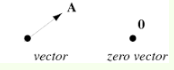
Zero vector, is a vector of length 0, and thus has all components equal to zero. It is the additive identity of the additive group of vectors.

Thus, it has zero magnitude and arbitrary direction.

Need a full question paper?

Generate a complete, print-ready paper with questions like this in minutes — across 16+ boards, with answer keys.

Start Generating Free

Similar questions

If $f(x) = \left\{ \begin{array}{l}\frac{x}{{{e^{1/x}} + 1}},\,\,{\rm{when\,\,}}\,\,x \ne 0\\\,\,\,\,\,\,\,\,\,\,\,\,\,\,0,\,\,{\rm{when \,\,}}x = 0\end{array} \right.$, then
Solution of the differential equation, $y\,dx - x\,dy + x{y^2}dx = 0$ can be
If $\vec a = \hat i - 2\hat j + 3\hat k,\,\,\vec b = 2\hat i + 3\hat j - \hat k\,$ and $\vec c = r\hat i + \hat j + (2r - 1\hat k)\,$ are three vectors such that $\vec c$ is parallel to the plane of $\vec a$ and $\vec b ,$ then $r$ is equal to
Find adjoint of each of the matrices $\left[\begin{array}{ccc}1 & -1 & 2 \\ 2 & 3 & 5 \\ -2 & 0 & 1\end{array}\right]$
Q+ is the set of all positive rational numbers with the binary operation * defined by $\text{a}*\text{b}=\frac{\text{ab}}2\ \forall\text{ a, b}\in\text{Q}^+$. The inverse of an element $\text{a}\in\text{Q}^+$ is:
  1. $\text{a}$
  2. $\frac{1}{\text{a}}$
  3. $\frac{2}{\text{a}}$
  4. $\frac{4}{\text{a}}$
In the function $f(x) = \frac{{2x - {{\sin }^{ - 1}}x}}{{2x + {{\tan }^{ - 1}}x}},\;(x \ne 0)$ is continuous at each point of its domain, then the value of $f(0)$ is
Consider $f(x) = [x] + \sqrt {\left\{ X \right\}}$ where $[.]$ denotes greatest integer function and $\{.\}$ denotes fractional part function. Identify the correct statement-
A function $f$ satisfying $f ‘ \,(sin\, x)$ $= cos^2 x$ for all $x$ and $f(1) = 1$ is :
If the curves y = 2ex and y = ae−x intersect orthogonally, then a =

  1. $\frac{1}{2}$

  2. $\frac{-1}{2}$

  3. $2$

  4. $2\text{e}^2$

The solution of ${e^{dy/dx}} = (x + 1)$, $y(0) = 3$ is