Question
A zinc plate was kept in a glass container having $CuSO_4$ solution. On examining it was found that the blue colour of the solution is getting lighter and lighter. After a few days, when the zinc plate was taken out of the solution, a number of small holes were noticed in it. State the reason and give chemical equation of the reaction involved.
Answer

Zinc is more reactive than copper and hence zinc displaces copper from copper sulphate solution to form zinc sulphate solution, which is of green colour, and copper. It is due to formation of the green zinc sulphate solution that the blue colour of copper sulphate gets lighter and lighter.
Zinc from the rod reacts with the solution to form zinc sulphate solution. So the plate has a number of small holes in it.
$Zn(s) + CuSO_4(aq) \rightarrow ZnSO_4(aq) + Cu(s)$

Need a full question paper?

Generate a complete, print-ready paper with questions like this in minutes — across 16+ boards, with answer keys.

Start Generating Free

Similar questions

State the limitations of Dobereiner’s law of triads.
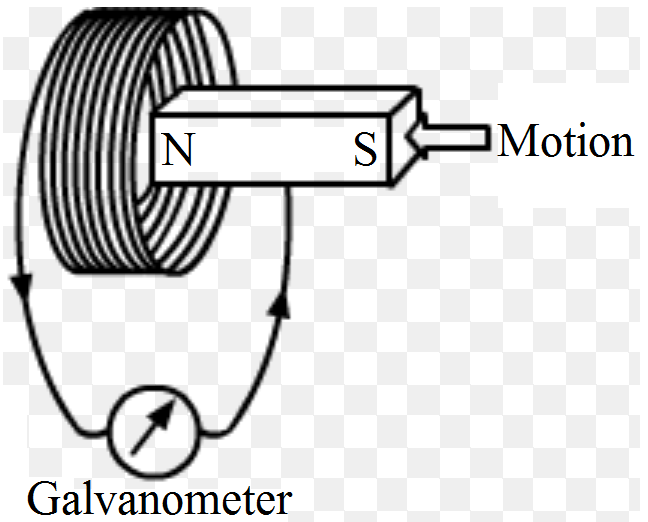
When the magnet shown in the diagram below is moving towards the coil, the galvanometer gives a reading to the right.
  1. What is the name of the effect being produced by the moving magnet?
  2. State what happens to the reading shown on the galvanometer when the magnet is moving away from the coil.
  3. The original experiment is repeated. This time the magnet is moved towards the coil at a great speed. State two changes you would notice in the reading on the galvanometer.
Explain the structure of benzene.
Equal heat is given to two objects $A$ and $B$ of mass $1g.$ Temperature of $A$ increases by $3^\circ C$ and $B$ by $5^\circ C$ Which object has more specific heat? And by what factor?
An object is placed at a distance of 100cm from a converging lens of focal length 40cm.
  1. What is the nature of image?
  2. What is the position of image?
A convex lens produces an inverted image magnified three times of an object placed at a distance of 15cm from it. Calculate focal length of the lens.
The non - metal A is an important constituent of our food and most of the fuels around us. A forms two oxides B and C. The oxide B is poisonous whereas oxide C causes global warming.
  1. Identify A, B and C.
  2. To which group of periodic table does A belong?
  3. Name another element which is placed in the same group as A.
Which precautions are necessary for proper decomposition of domestic waste?
A ray of light travelling in air is incident on a rectangular glass block and emerges out into the air from the opposite face. Draw a labelled ray diagram to show the complete path of this ray of light. Mark the two points where the refraction of light takes place. What can you say about the final direction of ray of light?
How does the tendency to lose electrons change as we go down in group 1 of the periodic table? Why does it change this way?
What is Ohm’s law? Explain how it is used to define the unit of resistance.