Question
A1. Simple Factual Activities:
Complete the following sentences using the information given in the passage:
(1) The langur baby was listless and _______________.
(2) The writer's parents and sisters had come out on the veranda and _______________.

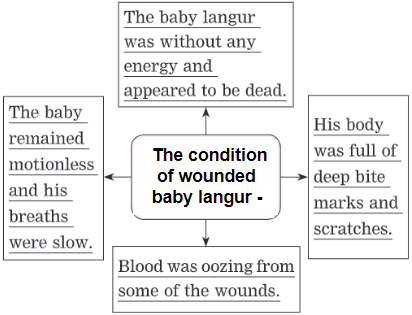
    The changed circumstances and the sudden unexpected attack from unknown quarters forced the langur to drop the baby from the sloping roof over the veranda. The baby was listless and appeared to be dead. As its body started to slide down, the excitement of the pack of dogs grew manifold at the prospect of a good kill and meal. Keeping the dogs at bay with the stick, I managed to catch hold of the baby langur’s tail just as it tipped over the edge of the tiled roof. The baby appeared inert and lifeless. It was indeed a male baby.
   By this time, my parents and sisters had come out on to the veranda and were witnessing my rescue operation. Some of our neighbours had also gathered in the distance.
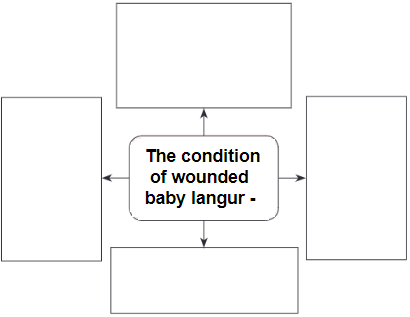
    I took the baby langur to our backyard and gently laid him on the floor inside the poultry coop. His body was full of deep bite marks and scratches. Blood was oozing from some of the wounds. The baby remained motionless. My father provided first aid to clean the wounds and stop the bleeding. I was relieved to find out that the baby was breathing, even though his breaths were shallow.
   Splashes of cold water made the baby stir and after a few shaky attempts, he sat up. He was in state of shock and started trembling like a leaf in the wind. His two little twinkling eyes welled up with tears and he started to sob with a muffled cry - just like a human child would after experiencing trauma. I offered him a peeled banana which he
accepted with his unsteady hand and began taking hesitant bites.

A2. Complex Factual Activities:
Complete the following web and describe the condition of wounded baby langur:
 Image
A3. Activities based on Vocabulary:
Find from the passage present participles and past participles used as adjectives:
(1) Present Participles: __________ roof, __________ eyes.
(2) Past Participles: __________ attack, __________ quarter, __________ cry, __________ banana.
A4. Activities based on Contextual Grammar:
(1) They were witnessing my rescue operation. (Simple Past Tense.)
(2) He was in a state of shock. (Past Perfect Tense.)
A5. Personal Response:
(1) Have you ever saved a puppy/dog or any other animal from naughty children who were throwing stones at him? Write about your experience.
Answer

A1. Simple Factual Activities:
(1) The langur baby was listless and appeared to be dead.
(2) The writer's parents and sisters had come out on the veranda and were witnessing his rescue operation.
A2. Complex Factual Activities:
Image
A3. Activities based on Vocabulary:
(1) Present Participles: sloping roof, twinkling eyes.
(2) Past Participles: unexpected attack, unknown quarter, muffled cry, peeled banana.
A4. Activities based on Contextual Grammar:
(1) They witnessed my rescue operation.
(2) He had been in a state of shock.
A5. Personal Response:
(1) Yes, I have saved a dog who was in such a situation. Though the stones thrown by the urchins did not hit the dog very much, he was frightened to death and was running helter skelter. I gathered a long stick and shouted at them. Then I hit one of the boys with the stick and they ran away. The dog had gratitude in his eyes for me.

Need a full question paper?

Generate a complete, print-ready paper with questions like this in minutes — across 16+ boards, with answer keys.

Start Generating Free

Similar questions

A1. Simple Factual Activities:
Complete the following sentences with the correct alternatives: 
(1) After her victory in the Manipur State, Mary Kom's career started in _______________.
(a) 2001 (b) 2009 (c) 2005 (d) 2000
(2) Mary Kom made her International debut in _______________.
(a) United Kingdom (b) U.S.A (c) United States (d) Manipur

   There had to be one successful story if Indians were to survive in sports and we have that story now. Enough has been said about this great warrior who conquered the world. This warrior is none other than Mary Mangte Kom-the Komqueror and the Komrade. She is famed as a five times World Boxing Champion and the only boxer to win a medal in every one of the six world championships. In the 2012 Olympics, she became the first Indian woman boxer to qualify and win a bronze medal in the 51
kg flyweight category of Boxing.
     Kom was born in Kangthei village, Moirang Lamkhai in Churachandpur district of rural Manipur in eastern India. She came from a poor family. Her parents, Mangte Tonpa Kom and Mangte Akham Kom were tenant farmers who worked in jhum fields.
Kom grew up in humble surroundings, helping her parents with farm related chores, going to school and learning athletics initially and later boxing simultaneously. Her father was a keen wrestler in his younger age.
     She had an eager interest in athletics since childhood and the success of Dingko Singh a fellow Manipuri returned from the 1998 Bangkok Asian games with a gold medal, Kom recollects, had inspired many youngsters in Manipur to try boxing
and she too thought of giving it a try.
     Mary Kom’s career started in 2000 after her victory in the Manipur State women’s boxing championship and the regional championship in West Bengal. In 2001, she started competing at international level. She was only 18 years old when she made her
international debut at the first AIBA Women’s World Boxing Championship in United States, winning a silver medal in the 48 kg weight category. Her greatness is reinforced by the way she apoligized to the whole nation for not being able to win the Gold. She is a legend for sure and an idol for all the sportswomen to look up to.

A2. Complex Factual Activities:
Arrange the following sentences as per their sequence occurred in the passage: 
(a) Mary Kom made her international debut when she was 18 years old.
(b) Dingko Singh won gold medal in 1998 Bangkok Asian games.
(c) Mary Kom started her career after winning Manipur State Women's Boxing Championship.
(d) Mary Kom is a legend for sure.
A3. Activities based on Vocabulary:
Match the following with their opposites:

WordsOpposites
 (1) success (a) young
 (2) winning (b) unable
 (3) old  (c) failure
 (4) able (d) losing

A4. Activities based on Contextual Grammar:
Do as directed:
(1) She is a legend for sure.
(a) is she? (b) does she? (c) isn't she? (d) doesn't she?
(2) She was 18 years old. (Frame 'Wh' question to get the underlined part as an answer) 
A5. Personal Response:
(1) What makes the writer call Mary Kom 'a legend'?

A1. Simple Factual Activity:
(1) Dr Hawking is a very humble man, though he is considered _______________ .
(2) Dr Hawking expressed his thoughts with the help of his _______________.

    Though confined to a wheel chair with no control over his body save a finger and with
a computer to help him express his thoughts. Dr Hawking is an authority on profound subjects of science. Numerous honorary doctorates and awards have been bestowed
on him. He is a Fellow of The Royal Society and a Member of the US National Academy of Sciences.
     In spite of being considered Einstein’s equal in intelligence, Dr. Hawking is a very humble man. A simple, down to earth man, he has authored many books dealing with his awesome ideas keeping a layman in mind. His writing is full of wit and humour. His style is so lucid that non-scientists can also understand him. His book, “A Brief History of Time” is one of the best selling books of our times.
     On being asked, how he feels about having the dreadful ALS, Dr Hawking, the quintessence of optimism and hope, says, “Not very different from the rest. I try and lead as normal a life as possible, and not think about my condition or regret the things it prevents me from doing, which are not many.”
      Dr Hawking firmly believes that in the next millenium, science will discover the core secrets of the universe, its origin, its history and maybe even predict its ultimate demise.
      Like Dr Hawking, there are many people who display exemplary courage in their lives. Let us salute all those brave people, who in spite of being disabled strive to do their best.

A2. Complex Factual Activity:
(1) What does the writer say about the books authored by Dr Hawking? 
A3. Activities based on Vocabulary:
Match the words in Column 'A' with their meanings in Column 'B':

Column 'A'Column 'B'
 (1) profound (a) a person without any special skill
 (2) awesome (b) a perfect example
 (3) layman (c) showing very great (knowledge) 
 (4) quintessence (d) very impressive

A4. Activities based on Contextual Grammar:
Convert the following to Interrogative (Question) Form:
(1) The prognosis was bad.
(2) Stephen decided to continue his research.
A5. Personal Response:
(1) How do you know that Dr Hawking is a perfect example of optimism and hope?

A1. Simple Factual Activity:
Who said to whom?
(1) "The bird has flown!"
(2) "The Pipalnagar Bank is about to collapse."

     ‘What’s that?’ said Kamal Kishore, sitting up suddenly. ‘Which bank?’
     ‘Why the Pipalnagar bank of course. I hear they have stopped paying employees. Don’t tell me you have an account there, Mr. Kishore?’
     ‘No, but my neighbour has!’ he exclaimed; and he called out over the low partition to the keeper of the barber shop next door. ‘Deep Chand, have you heard the latest? The Pipalnagar Bank is about to collapse. You’d better get your money out as soon as you can!’
     Deep Chand who was cutting the hair of an elderly gentleman, was so startled that his hand shook and he nicked his customer’s right ear. The customer yelped with pain and distress: pain, because of the cut and distress because of the awful news he
had just heard. With one side of his neck still unshaven, he sped across the road to the general merchant’s store where there was a telephone. He dialled Seth Govind Ram’s number. The Seth was not at home. Where was he, then? The Seth was holidaying in Kashmir. Oh, was that so? The elderly gentleman did not believe it. He hurried back to the barber’s shop and told Deep Chand: ‘The bird has flown! Seth Govind Ram has left town. Definitely, it means a collapse.’ And then he dashed out of the shop, making a beeline for his office and chequebook.
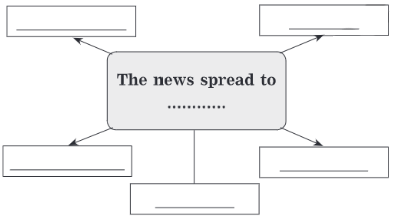
    The news spread through the bazaar with the rapidity of forest fire. From the general merchant’s it travelled to the shop, circulated amongst the customers, and then spread with them in various directions, to the betel-seller, the tailor, the free vendor, the jeweller, the beggar sitting on the pavement.   

A2. Complex Factual Activity:
Complete the web :
Image
A3. Activities based on Vocabulary:
Match the column with their meanings:

WordsMeanings
 (1) beeline (a) state of being upset
 (2) pavement (b) the direct route
 (3) nicked (c) the road for the people to walk
 (4) distress (d) cut slightly

A4. Activities based on Contextual Grammar:
Do as directed:
(1) Mr Kishore said, "Deep Chand, have you heard the latest?" (Change into indirect speech.)
(2) The bird has flown. (Rewrite the sentence using Past Perfect Tense)
A5. Personal Response:
(1) Do you think that rumour spreads faster than fire? Support your answer in two to three lines.

A1. Simple Factual Activity:
Complete the sentences with the help of the information in the passage:
(1) The quality and quantity of energy we put forth, _______________.
(2) _______________ is a walk in the dark.

    Time-bound: Establish time parameters around each goal, as it will help increase focus and accountability. To reduce weight we know how to go about it. But without consistent time - bound action, it never becomes a reality. It may be exercise, diet and stress-free thoughts. All these have to be practised and implemented without hesitation, doubt or indifference, but within a deadline.
    Visions, wishes, intentions and dreams are all valuable. They spark off imagination and encourage us to define where we want to reach. In order to get there, however, we need to bring life images, down to earth and plan to execute our strategies. The quality and quantity of energy we put forth, directly impact the results. Life is something like a trumpet. If we don’t put anything in, we can’t get anything out.
     Success is a walk in the dark. Finding the right footing, precisely mastering the skills and getting to the next place, all depend on how we approach and
tackle the problem. The best way to get from where we are, to where we want to be is to find the footing of our next step. When we take the next step, it should support and hold us without a crack.

A2. Complex Factual Activity:

Pick out examples from the passage that support each of the following facts:
(a) Good results depend upon the quality and quantity of work put in.
(b) A time-limit should be set to achieve goals.
A3. Activities based on Vocabulary:
Classify the following words in their respective columns: 
ah, of, if, and, oh, from, we, but, it, hurrah

PronounPrepositionConjunctionInter- jection
    

A4. Activities based on Contextual Grammar:
(1) We need to bring life images. (Underline the infinitive.) 
(2) The next step should support and hold us without a crack.
(Choose the correct question tag.)
(a) should it? (b) don't it? (c) shouldn't it?
A5. Personal Response:
(1) 'If we don't put anything in, we can't get anything out.' Explain.

A1. Simple Factual Activities:
Who said to whom:
(1) "Come with me. I will take you to school."
(2) "What is your name, little one?"

     The next day Ramlal caught Bholi by the hand and said. ‘‘Come with me. I will take you to school.’’ Bholi was frightened. She did not know what a school was like. She remembered how a few days ago their old cow. Lakshmi had been turned out of
the house and sold.
     ‘‘N-n-n-n No. no-no-no’’ she shouted in terror and pulled her hand away from her father’s grip.
     ‘‘What’s the matter with you, you fool?’’ shouted Ramlal, ‘‘I am only taking you to school.’’ Then he told his wife. ‘‘Let her wear some decent clothes today. Or else what will the teachers and the other schoolgirls think of us when they see her?’’
      New clothes had never been made for Bholi. The old dresses of her sisters were passed on to her. No one cared to mend or wash her clothes. But today she was lucky to receive a clean dress which had shrunk after many washing and no longer fitted
Champa. She was even bathed and oil was rubbed into her dry and matted hair. Only then did she begin to believe that she was being taken to a place better than her home!
      When they reached the school, the children were already in their classrooms. Ramlal handed over his daughter to the headmistress. Left alone, the poor girl looked about her with fear laden eyes. There were several rooms. And in each room girls like her squatted on mats, reading from books or writing on slates. The headmistress asked        Bholi to sit down in a corner in one of the classrooms. Bholi did not know what exactly a school was like and what happened there. But she was glad to find so many girls almost of her own age present there. She hoped that one of these girls might become her friend.
      The lady teacher who was in the class was saying something to the girls but Bholi could understand nothing. She looked at the pictures on the wall. The colours fascinated her. The horse was brown just like the horse on which the Tehsildar had come to visit their village : the goat was black like the goat of their neighbour: the parrot was green like the parrots she had seen in the mango orchard : and the cow was just like their Lakshmi. And suddenly Bholi noticed that the teacher was standing by her
side, smiling at her.
      “What’s your name. little one?’’
      ‘‘Bh-Bho-Bho.’’ She could stammer no further than that.
       Then she began to cry and tears flowed from her eyes in a helpless flood. She kept her head down as she sat in her corner, not daring to look up at the girls who, she knew were still laughing at her.

A2. Complex Factual Activities:
(1) What shows that Bholi was unwilling to go to school? 
A3. Activities based on Vocabulary:
Complete the following sentences using words given in the brackets:
(disfigured, matted, fascinated)
(1) After the accident Juhi's face was _______________.
(2) It took a long time to straighten the _______________ bundle of wool.
A4. Activities based on Contextual Grammar:
(1) Change into indirect speech:
Ramlal's wife said to him, "I will tell you what to do."
(2) Rewrite as an exclamatory sentence:
The child was very fair and pretty.
A5. Personal Response:
(1) "If girls go to school, who will marry them?"-Why, do you think, that Bholi's mother thought so? 
A1. Simple Factual Activities:
State whether you Agree or Disagree with the following statements: 
Statements
(1) The narrator was fifty-five years old when this incident occurred.
(2) Even today, the narrator cannot forget that look in the mother langur's eyes.

    For a few seconds, the mother langur looked straight into my eyes. Even today, I cannot forget that look in her eyes, showering silent gratitude on me for saving her child. I was overwhelmed by the emotion, the sentiment and the way she said thanks to me. There sat a universal mother holding a stricken child in her lap.
    Then, in a flash, she jumped with her baby clinging to her belly and reached our kitchen roof. She surveyed the area for the vicious male langur and then leapt away in the direction opposite to the place of the violent encounter.
    The brief meeting with the mother and the baby langur convinced me that interspecies communication and mutual trust is indeed a reality and should anyone strike the right chord, the relationship hums into action. The mother langur showed me that food was not the only means of communication between man and animal but that there were other means of establishing a bond through trust, compassion and mutual understanding.
     Fifty-five years have passed since that day. I am now seventy years old. But I still fondly remember that ‘encounter of a special kind’.

A2. Complex Factual Activities:
Complete the web:
Image
 
A3. Activities based on Vocabulary:
Find the words from the passage for the following meanings:
(1) held closely
(2) moved downwards
(3) think very deeply
(4) comfort and peace
A4. Activities based on Contextual Grammar:
Do as directed:
(1) I cannot forget that look in her eyes. (Add a question tag.)
(2) I was overwhelmed by the emotion.
(Write the sentence in Active voice. Begin with The emotion....)
A5. Personal Response:
(1) What opinion do you form about the writer from the story?
A1. Simple Factual Activities:
Choose the correct alternatives and complete the following sentences:
(1) In the cold winter month, the tree was _______________ of all leaves.
(a) full (b) withdrew (c) bare (d) short
(2) We find innunerable _______________ in the infinite sky.
(a) clouds (b) crowds (c) stars (d) moons.

     We saw small bits of grass peeping through the small cracks in a concrete pavement. It left us thinking : however impossible things may look, there is always an opening...
     We saw a tree bare of all leaves in the cold winter months. We thought its chapter was over. But three months passed, spring set in and the tree was back to its green majesty once again, full of leaves, flowers, birds and life. What if we too had the conviction that, however difficult things are right now, it will not remain so for ever. Remember, this too shall pass.
     We saw an army of ants lugging a fly which was at least ten times the ant’s size. The ants organized themselves around the fly, lifted it on frail feelers and carried it to quite a distance. Their teamwork and perseverance were impressive. What if we too are consistent, organized, focused...Spider webs are delicate, yet very strong. A rainbow colours the entire sky. Oysters take in a grain of sand they open up with a pearl. Innumerable stars shine across the infinite sky. Clouds take new shapes with every passing moment. The wind makes trees dance with unhindered passion. Water, without hint of ego, changes its form according to the dictates of the sun and the wind. When we see a caterpillar turn into a butterfly, a flower turn into a fruit, we experience the alchemy of nature... we touch it and become gold ourselves.

A2. Complex Factual Activities:
Complete the following web :
Image
A3. Activities based on Vocabulary:
Find out synonyms from the text for the following words/phrases:
(1) to peer through
(2) easily broken or damaged
(3) mysterious power
(4) drag with great efforts
A4. Activities based on Contextual Grammar:

Do as directed:
(1) We saw an army of ants. (Choose the correct sentence of passive voice.)
(a) An army of ants was seen by us.
(b) An army of ants were seen by us.
(c) An army of ants is seen by us.
(d) An army of ants are seen by us.
(2) We touch it. (Rewrite the sentence in 'Past Perfect Tense.')
A5. Personal Response:
(1) How can learning from nature help human beings?
A1. Simple Factual Activities:
State whether the following statements are Right or Wrong. Correct the wrong ones:
(1) The author and Meena were great enemies.
(2) Meena was a very cheerful person initially.

     Meena is a good friend of mine. She is an LIC officer earning a good salary. But there was always something strange about her. She was forever unhappy. Whenever I met her, I would start to feel depressed. It was as though her gloom and cynicism had a way of spreading to others. She never had anything positive to say on any subject or about any person.      
     For instance, I might say to her, ‘Meena, did you know Rakesh has come first in his school ?’     
     Meena’s immediate response would be to belittle the achievement. ‘Naturally, his father is a school teacher’, she would say.      
     If I said, ‘Meena, Shwetha is a very beautiful girl, isn’t she ?’ Meena would be pessimistic. ‘When a pony is young, he looks handsome. It is age that matters. Wait for some time. Shwetha will be uglier than anyone you know.’      
     ‘Meena, it’s a beautiful day. Let’s go for a walk’. 
     ‘No, the sun is too hot and I get tired if I walk too much. Besides, who says walking is good for health ? There’s no proof.’
     That was Meena. She stayed alone in an apartment as her parents lived in Delhi. She was an only child and had the habit of complaining about anything and everything. Naturally, she wasn’t a very pleasant company and nobody wanted to visit her. Then one day, Meena was transferred to Bombay and soon we all forgot about her.
     Many years later, I found myself caught in the rain at Bombay’s Flora Fountain. It was pouring and I didn’t have an umbrella. I was standing near Akbarallys, a popular department store, waiting for the rain to subside. Suddenly, I spotted Meena. My first reaction was to run, even in that pouring rain. I was anxious to avoid being seen by her, having to listen to her never-ending complaints. However, I couldn’t escape. She had already seen me and caught hold of my hand warmly. What’s more, she was very cheerful.
     ‘Hey ! I am really excited. It’s nice to meet old friends. What are you doing here ?’
     I explained that I was in Bombay on an official work.

A2. Complex Factual Activities:
Choose the correct alternative and rewrite the sentences:
(1) Meena who is an LIC officer, is _______________.
(a) a pessimistic person
(b) an optimistic person
(c) a disabled person.
(2) The writer was standing near Akbarallys, a popular department store because _______________.
(a) she was waiting for her friend Meena.
(b) she was waiting for the rain to stop.
(c) she wanted to buy something in Akbarallys.
A3. Activities based on Vocabulary:
Match the words with their meanings:

Group 'A'Group 'B'
 (1) gloom (a) to abate
 (2) cynicism (b) expecting the worst
 (3) subside (c) feeling of sadness
 (4) pessimistic (d) a distrustful attitude

A4. Activities based on Contextual Grammar:
(1) Choose the correct alternative of affirmative sentence:
She wasn't a very pleasant company.
(a) She was a very unpleasant company.
(b) She wasn't a very unpleasant company.
(c) She was a very pleasant company.
(d) She was a very beautiful company.
(2) Do as directed:
Meena is a LIC Officer.
(Frame a wh-question to get the underlined part as an answer)
A5. Personal Response:
(1) If you have a friend like Meena, what would be your attitude towards her?

A1. Simple Factual Activities:
State whether the following statements are True or False:
(1) Monsieur de Poulengey and Monsieur de Metz want to go with Joan.
(2) Chinon is one of the cities in England.
(3) Poulengey was sure that only miracle can save them.
(4) Joan's words have put fire into Robert.

Robert : (To the steward) Is this true about Monsieur de Poulengey ?
Steward : (Eagerly) Yes, sir, and about Monsieur de Metz too. They both want to go with her.
Robert : (Goes to the window, and shouts into the court-yard) Send Monseiur de Poulengey to me, will you ? (He turns to Joan) Get out and wait in the yard.
Joan : (Smiling brightly at him) Right, squire. (She goes out).
Robert : (To the steward) Go with her. Stay within call and keep your eye on her. I shall have her up here again. (The steward retreats hastily. Bertran de Poulengey, a French guard, enters, salutes and stands waiting.)
Robert : She says you, Jack and Dick have offered to go with her. What for ? Do you take her crazy idea of going to the Dauphin seriously ?
Poulengey : (Slowly) There is something about her. It may be worth trying.
Robert : Oh, come on Polly! You must be out of your mind !
Poulengey : (Unmoved) What is wrong with it ? The Dauphin is in Chinon, like a rat in a corner, except that he won’t fight. The English will take Orleans. He’ll not be able to stop them.
Robert : He beat the English the year before last at Montargis. I was with him. Poulengey : But this time, his men are cowed and now he can’t work miracles. And I tell you that nothing can save our side now but a miracle.
Robert : Miracles are all right, Polly. The only difficulty about them is that they don’t happen nowadays.
Poulengey : I used to think so. I’m not so sure now. There is something about her. I think the girl herself is a bit of a miracle. Anyhow, this is our lastchance. Let’s see what she can do.
Robert : (Wavering) You really think that ?
Poulengey : (turning) Is there anything else left for us to think? Let’s take a chance. Her words have put fire into me.
Robert : (Giving up) Whew! You’re as mad as she is.
Poulengey : (Obstinately) We want a few mad people now. See where the sane ones have landed us !
Robert : I feel like a fool. Still, if you feel sure... ?
Poulengey : I feel sure enough to take her to Chinon unless you stop me.
Robert : Do you think I ought to have another talk with her ?

A2. Complex Factual Activities:
Answer the following:
(1) Was the Dauphin fit to be a Prince and heir?
(2) What was the Squire's opinion about miracles? 
A3. Activities based on Vocabulary:
(1) Find out two adjectives and two adverbs from the passage:
A4. Activities based on Contextual Grammar:
Make it affirmative:
(1) I am not sure, now.
(2) He will not be able to stop them.
A5. Personal Response:
(1) What is your opinion about Joan? 
A1. Simple Factual Activities:
Pick out from the passage 2 lines each that prove the following: 
(1) Her (Joan's) confidence
(2) Her courage

    The war fought between England and France from 1337 to 1453 has come to be known as the Hundred Years War. Joan was a peasant girl born in eastern
France who led the French army to several victories during this war.
    This play begins at the time when all of northern France and some parts of the south-west were under foreign control. The English controlled some parts and the Burgundians controlled the others. The city of New Orleans, one of the few remaining French cities was held by the English. The year is 1429. Captain Robert de Baudricourt, a military officer is seated at the table. His steward stands facing him.
Robert : I told you to throw the girl out. You have fifty armed soldiers and dozens of strong servants to carry out my orders. Are they afraid of her ?
Steward : No sir, we are afraid of you, but she puts courage in us. She really doesn’t seem to be afraid of anything. Perhaps you could frighten her, sir.
Robert : (grimly) Perhaps, where is she now ?
Steward : Down in the courtyard, sir.
(Robert goes to the window and asks the soldiers to send the girl up)
(The girl enters. She is a well-built, strong country girl of 17 to 18 years. The squire’s glare neither frightens her nor stops her. She speaks confidently.)
Joan : Good morning, captain squire. You are to give me a horse and armour and some soldiers, and send me to the Dauphin.
Robert : This girl is mad. Why didn’t you tell me so, you blockhead ?
Steward : Sir, do not anger her. Give her what she wants.
Robert : I shall send you back to your father with orders to put you under lock and
key.
Joan : You think you will, squire. But it won’t happen that way. You said you would not see me. But here I am.
Robert : So, you are assuming that I’ll give
you what you want.
Joan : Yes, squire. (Continues busily) A horse will cost sixteen francs. It is a big
amount of money. But I can save it on the armour. I don’t need beautiful armour made to my measure. I can find a soldier’s armour that will fit me well enough. I shall not want many soldiers. The Dauphin will give me, all I need, to free Orleans.
Robert : (Shocked) To free Orleans !
Joan : (Simply) Yes, squire. Three men will be enough for you to send with me.
Polly and Jack have promised to come with me.
Robert : You mean Monsieur de Poulengey ?
Joan : Yes, Squire Jack will come willingly. He is a very kind gentleman, and gives me money to give to the poor. I think John Godsave will come, and Dick the Archer, and their servants, John of Honecourt and Julian. There will be no trouble for you, squire. I have arranged it all. You have only to give the order.

A2. Complex Factual Activities:
(1) Why did Joan not ask for many soldiers from the Captain Squire? 
A3. Activities based on Vocabulary:
Give one word for the following:
(1) A person of high rank
(2) A stupid person
(3) To take for granted
(4) Military unit consisting of armoured fighting vehicles
A4. Activities based on Contextual Grammar:
Make the following sentences affirmative without any change of meaning:
(1) Sir, do not anger her.
(2) I shall not want many soldiers.
A5. Personal Response:
(1) Describe any brave lady as Joan of Arc, from India who fought for her nation.