Question
✓
Answer
A1. Simple Factual Activity:
(1) Sitaram was looking out for any job that might suit Nathu.
(2) The lady of the house was in need of a sweeper.
A2. Complex Factual Activity:
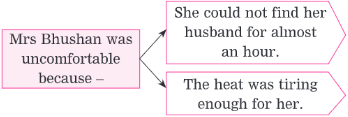
A3. Activities based on Vocabulary:
(1) photography shop
(2) midday meal
(3) customary tour
(4) large shady tamarind tree
A4. Activities based on Contextual Grammar:
(1) Mrs Bhushan went in search of her husband who was sitting in front of Kamal Kishore's photography shop.
(2) No other summer in the history of Pipalnagar was so hot as that.
A5. Personal Response:
(1) Yes, I think Mr Bhushan was absolutely right to compare his wife with a bee in flower garden. We know that bees buzz from flower to flower in gardens for collecting honey. He knew that his wife similarly used to visit many shops for selecting her clothes or only to have a look at them.
(1) Sitaram was looking out for any job that might suit Nathu.
(2) The lady of the house was in need of a sweeper.
A2. Complex Factual Activity:
A3. Activities based on Vocabulary:
(1) photography shop
(2) midday meal
(3) customary tour
(4) large shady tamarind tree
A4. Activities based on Contextual Grammar:
(1) Mrs Bhushan went in search of her husband who was sitting in front of Kamal Kishore's photography shop.
(2) No other summer in the history of Pipalnagar was so hot as that.
A5. Personal Response:
(1) Yes, I think Mr Bhushan was absolutely right to compare his wife with a bee in flower garden. We know that bees buzz from flower to flower in gardens for collecting honey. He knew that his wife similarly used to visit many shops for selecting her clothes or only to have a look at them.
Need a full question paper?
Generate a complete, print-ready paper with questions like this in minutes — across 16+ boards, with answer keys.
Explore more
Similar questions
A1. Simple Factual Activity:
(1) He was bestowed with numerous honorary doctorates and awards.
(2) Dr Hawking's 'A Brief History of Time' is one of the best selling books of our time.
Though confined to a wheel chair with no control over his body save a finger and with
a computer to help him express his thoughts. Dr Hawking is an authority on profound subjects of science. Numerous honorary doctorates and awards have been bestowed
on him. He is a Fellow of The Royal Society and a Member of the US National Academy of Sciences.
In spite of being considered Einstein’s equal in intelligence, Dr Hawking is a very humble man. A simple, down to earth man, he has authored many books dealing with his awesome ideas keeping a layman in mind. His writing is full of wit and humour. His style is so lucid that non-scientists can also understand him. His book, “A Brief History of Time” is one of the best selling books of our times.
On being asked, how he feels about having the dreadful ALS, Dr Hawking, the quintessence of optimism and hope, says, “Not very different from the rest. I try and lead as normal a life as possible, and not think about my condition or regret the things it prevents me from doing, which are not many.”
Dr Hawking firmly believes that in the next millenium, science will discover the core secrets of the universe, its origin, its history and maybe even predict its ultimate demise.
Like Dr Hawking, there are many people who display exemplary courage in their lives. Let us salute all those brave people, who in spite of being disabled strive to do their best.
A2. Complex Factual Activity:
(1) Which of Dr Hawking's achievements are mentioned in this passage?
A3. Activities based on Vocabulary:
Write the adjectives for the following nouns from the passage:
(1) ideas
(2) style
(3) courage
(4) secrets.
A4. Activities based on Contextual Grammar:
Do as directed:
(1) His writing is full of wit and humour.
(Rewrite the sentence using Past Perfect Tense.)
(2) He is a fellow of the Royal Society and a member of the US National Academy of Science.(Use not only but also.)
A5. Personal Response:
(1) How do you know that Dr Hawking is a perfect example of optimism and hope?
(1) He was bestowed with numerous honorary doctorates and awards.
(2) Dr Hawking's 'A Brief History of Time' is one of the best selling books of our time.
Though confined to a wheel chair with no control over his body save a finger and with
a computer to help him express his thoughts. Dr Hawking is an authority on profound subjects of science. Numerous honorary doctorates and awards have been bestowed
on him. He is a Fellow of The Royal Society and a Member of the US National Academy of Sciences.
In spite of being considered Einstein’s equal in intelligence, Dr Hawking is a very humble man. A simple, down to earth man, he has authored many books dealing with his awesome ideas keeping a layman in mind. His writing is full of wit and humour. His style is so lucid that non-scientists can also understand him. His book, “A Brief History of Time” is one of the best selling books of our times.
On being asked, how he feels about having the dreadful ALS, Dr Hawking, the quintessence of optimism and hope, says, “Not very different from the rest. I try and lead as normal a life as possible, and not think about my condition or regret the things it prevents me from doing, which are not many.”
Dr Hawking firmly believes that in the next millenium, science will discover the core secrets of the universe, its origin, its history and maybe even predict its ultimate demise.
Like Dr Hawking, there are many people who display exemplary courage in their lives. Let us salute all those brave people, who in spite of being disabled strive to do their best.
A2. Complex Factual Activity:
(1) Which of Dr Hawking's achievements are mentioned in this passage?
A3. Activities based on Vocabulary:
Write the adjectives for the following nouns from the passage:
(1) ideas
(2) style
(3) courage
(4) secrets.
A4. Activities based on Contextual Grammar:
Do as directed:
(1) His writing is full of wit and humour.
(Rewrite the sentence using Past Perfect Tense.)
(2) He is a fellow of the Royal Society and a member of the US National Academy of Science.(Use not only but also.)
A5. Personal Response:
(1) How do you know that Dr Hawking is a perfect example of optimism and hope?
A1. Simple Factual Activities:
State whether the following statements are True or False:
(1) Pitchblende is a black, very hard and cheap substance.
(2) Men could see many substances through the powerful rays of Uranium.
(3) The emperor of Austria gifted a ton of pitchblende to the Curies
(4) The Curies sacrificed all their luxuries of life to save money to buy pitchblende.
Marie was specially interested in a substance called uranium which was obtained from pitchblende, a black, very hard and very expensive substance. Uranium was known to give off very powerful rays by which men could see through many substances. Now Marie discovered that what was left after obtaining uranium was even more powerful. Later on, Pierre and Marie found that there was not one, but two new substances giving off these rays although they had not yet been able to obtain either of them. They called one of them Polonium, in honour of her country. Poland and the other was called Radium. Radium is the most powerful of the radio-active elements. And radio-active elements can give off rays which can penetrate substances that are opaque to light. There was another French scientist called Henri Becquerel, who in 1896 had discovered that uranium possessed this property. But Polonium and Radium possessed radio-active in much higher degree.
The Curies now began to work with greater enthusiasm, but they were poor and pitchblende itself was an extremely expensive substance, which they could not afford to buy in large quantity. They, however, sacrificed all the luxuries of life to save money to buy whatever little amount of pitchblende they could. They lived in utter penury, not buying costly food and warm clothes for the extremely cold Parisian winter. Often they could not sleep during the cold nights due to lack of warmth. Overwork seriously affected Madame Curie’s health. Often she was forced to leave the laboratory to take a much needed rest. Her husband begged her to give up the struggle, but she resolutely refused. Marie was driven by a mad determination to discover the mystery of radium. With courage she faced all the miseries of a life of poverty and carried on with her research along with her husband who loved and supported her.
Luck, however, favoured the Curies and a windfall came to them. It was a gift of a ton of pitchblende from the emperor of Austria, who was an admirer of the Curies. It was the most precious gift the Curies had received and in their shabby laboratory they toiled along, boiled and burnt, overpowered by heat in summer and frozen with cold in winter.
A2. Complex Factual Activities:
(1) What proves Marie's strong will power?
A3. Activities based on Vocabulary:
Find out antonyms for the following from the passage:
(1) economical ×
(2) poverty ×
(3) chill ×
(4) worthless ×
A4. Activities based on Contextual Grammar:
Change the degree:
(1) Pitchblende was the most precious gift the Curies had received.
A5. Personal Response:
(1) What qualities, do you think, are important to get success in our life?
State whether the following statements are True or False:
(1) Pitchblende is a black, very hard and cheap substance.
(2) Men could see many substances through the powerful rays of Uranium.
(3) The emperor of Austria gifted a ton of pitchblende to the Curies
(4) The Curies sacrificed all their luxuries of life to save money to buy pitchblende.
Marie was specially interested in a substance called uranium which was obtained from pitchblende, a black, very hard and very expensive substance. Uranium was known to give off very powerful rays by which men could see through many substances. Now Marie discovered that what was left after obtaining uranium was even more powerful. Later on, Pierre and Marie found that there was not one, but two new substances giving off these rays although they had not yet been able to obtain either of them. They called one of them Polonium, in honour of her country. Poland and the other was called Radium. Radium is the most powerful of the radio-active elements. And radio-active elements can give off rays which can penetrate substances that are opaque to light. There was another French scientist called Henri Becquerel, who in 1896 had discovered that uranium possessed this property. But Polonium and Radium possessed radio-active in much higher degree.
The Curies now began to work with greater enthusiasm, but they were poor and pitchblende itself was an extremely expensive substance, which they could not afford to buy in large quantity. They, however, sacrificed all the luxuries of life to save money to buy whatever little amount of pitchblende they could. They lived in utter penury, not buying costly food and warm clothes for the extremely cold Parisian winter. Often they could not sleep during the cold nights due to lack of warmth. Overwork seriously affected Madame Curie’s health. Often she was forced to leave the laboratory to take a much needed rest. Her husband begged her to give up the struggle, but she resolutely refused. Marie was driven by a mad determination to discover the mystery of radium. With courage she faced all the miseries of a life of poverty and carried on with her research along with her husband who loved and supported her.
Luck, however, favoured the Curies and a windfall came to them. It was a gift of a ton of pitchblende from the emperor of Austria, who was an admirer of the Curies. It was the most precious gift the Curies had received and in their shabby laboratory they toiled along, boiled and burnt, overpowered by heat in summer and frozen with cold in winter.
A2. Complex Factual Activities:
(1) What proves Marie's strong will power?
A3. Activities based on Vocabulary:
Find out antonyms for the following from the passage:
(1) economical ×
(2) poverty ×
(3) chill ×
(4) worthless ×
A4. Activities based on Contextual Grammar:
Change the degree:
(1) Pitchblende was the most precious gift the Curies had received.
A5. Personal Response:
(1) What qualities, do you think, are important to get success in our life?
A1. Simple Factual Activities:
Name the following:
(1) The greatest personalities from the great land-India.
(2) The American politician, attorney and author mentioned in the speech -e help beggars?
My dear children of the world ... Your Majesties, Your Royal Highnesses, Excellencies, distinguished members of the Norwegian Nobel Committee, dear brother Tom Harkin, brothers and sisters, and my dear daughter Malala.
From this podium of peace and humanity, I am deeply honoured to recite a mantra from the ancient texts of wisdom, Vedas. This mantra carries a prayer, an aspiration and a resolve that has the potential to liberate humanity from all man-made crises.
Let’s walk together. In the pursuit of global progress, not a single person should be left out or left behind in any corner of the world, from East to West, from South to North. Let’s speak together, let our minds come together! Learning from the experiences of our ancestors, let us together create knowledge for all that benefits all.
I bow to my late parents, to my motherland India, and to the mother earth.
With a warm heart I recall how thousands of times, I have been liberated, each time I have freed a child from slavery. In the first smile of freedom on their beautiful faces, I see the Gods smiling.
I give the biggest credit of this honour to my movement’s Kaalu Kumar, Dhoom Das and Adarsh Kishore from India and Iqbal Masih from Pakistan who made the supreme sacrifice for protecting the freedom and dignity of children. I humbly accept this award on behalf of all such martyrs, my fellow activists across the world and my countrymen.
My journey from the great land of Lord Buddha, Guru Nanak and Mahatma Gandhi; India to Norway is a connect between the two centres of global peace and brotherhood, ancient and modern.
Friends, the Nobel Committee has generously invited me to present a “lecture.” Respectfully, I am unable to do that. Because, I am representing here - the sound of silence. The cry of innocence. And, the face of invisibility. I represent millions of those children who are left behind and that’s why I have kept an empty chair here as a reminder.
A2. Complex Factual Activities:
Complete the following sentences:
(1) We can create knowledge for all that benefits all by _______________.
(2) The mantras that carries a prayer has the potential to _______________.
A3. Activities based on Vocabulary:
Find out the describing words used for the following nouns and make your own sentences using any one combinations:
(1) sacrifice (2) faces
A4. Activities based on Contextual Grammar:
Name the tense:
(1) The Nobel committee has generously invited ine to present a 'Lecture.'
(2) I am representing the millions of children.
A5. Personal Response:
(1) What do you know about Kailash Satyarthi?
Name the following:
(1) The greatest personalities from the great land-India.
(2) The American politician, attorney and author mentioned in the speech -e help beggars?
My dear children of the world ... Your Majesties, Your Royal Highnesses, Excellencies, distinguished members of the Norwegian Nobel Committee, dear brother Tom Harkin, brothers and sisters, and my dear daughter Malala.
From this podium of peace and humanity, I am deeply honoured to recite a mantra from the ancient texts of wisdom, Vedas. This mantra carries a prayer, an aspiration and a resolve that has the potential to liberate humanity from all man-made crises.
Let’s walk together. In the pursuit of global progress, not a single person should be left out or left behind in any corner of the world, from East to West, from South to North. Let’s speak together, let our minds come together! Learning from the experiences of our ancestors, let us together create knowledge for all that benefits all.
I bow to my late parents, to my motherland India, and to the mother earth.
With a warm heart I recall how thousands of times, I have been liberated, each time I have freed a child from slavery. In the first smile of freedom on their beautiful faces, I see the Gods smiling.
I give the biggest credit of this honour to my movement’s Kaalu Kumar, Dhoom Das and Adarsh Kishore from India and Iqbal Masih from Pakistan who made the supreme sacrifice for protecting the freedom and dignity of children. I humbly accept this award on behalf of all such martyrs, my fellow activists across the world and my countrymen.
My journey from the great land of Lord Buddha, Guru Nanak and Mahatma Gandhi; India to Norway is a connect between the two centres of global peace and brotherhood, ancient and modern.
Friends, the Nobel Committee has generously invited me to present a “lecture.” Respectfully, I am unable to do that. Because, I am representing here - the sound of silence. The cry of innocence. And, the face of invisibility. I represent millions of those children who are left behind and that’s why I have kept an empty chair here as a reminder.
A2. Complex Factual Activities:
Complete the following sentences:
(1) We can create knowledge for all that benefits all by _______________.
(2) The mantras that carries a prayer has the potential to _______________.
A3. Activities based on Vocabulary:
Find out the describing words used for the following nouns and make your own sentences using any one combinations:
(1) sacrifice (2) faces
A4. Activities based on Contextual Grammar:
Name the tense:
(1) The Nobel committee has generously invited ine to present a 'Lecture.'
(2) I am representing the millions of children.
A5. Personal Response:
(1) What do you know about Kailash Satyarthi?
A1. Simple Factual Activities:
Choose the correct alternative for each of the following questions:
(1) What does the word 'Bholi' mean?
(a) angry (b) foolish (c) simpleton (d) sad.
(2) At what age Bholi had an attack of smallpox?
(a) six (b) two (c) ten (d) nine.
Her name was Sulekha but since her childhood everyone had been calling her Bholi the simpleton.
She was the fourth daughter of Numberdar Ramlal. When she was ten months old, she had fallen off the cot on her head and perhaps it had damaged some part of her brain. That was why she remained a backward child and came to be known
as Bholi, the simpleton.
At birth the child was very fair and pretty. But when she was two years old, she had an attack of small pox. Only the eyes were saved. But the entire body was permanently disfigured by deep black pockmarks. Little Sulekha could not speak till she was five and when at last she learnt to speak, she stammered. The other children often made fun of
her and mimicked her. As a result, she talked very little.
Ramlal had seven children, three sons and four daughters and the youngest of them was Bholi. It was a prosperous farmer’s household and there was plenty to eat and drink. All the children except Bholi were healthy and strong. The sons had been sent to
the city to study in schools and later in colleges. Of the daughters Radha, the eldest had already been married. The second daughter Mangla’s marriage had also been settled Ramlal would think of third Champa. They were good looking, healthy girls. And
it was not difficult to find bridegrooms for them.
But Ramlal was worried about Bholi. She had neither good looks nor intelligence.
Bholi was seven years old when Mangla was married. The same year a primary school for girls was opened in their village. The Tehsildar sahib came to perform its opening ceremony. He said to Ramlal, ‘‘As a revenue official you are the representative of the government in the village and so you must set an example to the villagers. You
must send your daughter to school.’’
That night when Ramlal consulted his wife. She cried, ‘‘Are you crazy? If girls go to school, who will marry them?’’
But Ramlal had not the courage to disobey the Tehsildar. At last his wife said, ‘‘I will tell you what to do. Send Bholi to school. As it is there is little chance of her getting married, with her ugly face and lack of sense. Let the teachers at school worry about her.’’
A2. Complex Factual Activities:
(i) Complete the reasons:
Ramlal decided to send Bholi to school because -
A3. Activities based on Vocabulary:
Use the following phrases in the following sentences by making certain changes:
(to shout in terror, to pass on, to look up at.)
(1) Ruta _______________ when she saw a cobra in front of her.
(2) The world _______________ Dr Kalam as a great visionary.
A4. Activities based on Contextual Grammar:
Correct the errors in the following sentences. Focus on verbs and subject:
(1) All children, except Bholi, was healthy and strong.
(2) Since childhood, everyone will have calling her Bholi.
A5. Personal Response:
(1) Explain the following statement:
Choose the correct alternative for each of the following questions:
(1) What does the word 'Bholi' mean?
(a) angry (b) foolish (c) simpleton (d) sad.
(2) At what age Bholi had an attack of smallpox?
(a) six (b) two (c) ten (d) nine.
Her name was Sulekha but since her childhood everyone had been calling her Bholi the simpleton.
She was the fourth daughter of Numberdar Ramlal. When she was ten months old, she had fallen off the cot on her head and perhaps it had damaged some part of her brain. That was why she remained a backward child and came to be known
as Bholi, the simpleton.
At birth the child was very fair and pretty. But when she was two years old, she had an attack of small pox. Only the eyes were saved. But the entire body was permanently disfigured by deep black pockmarks. Little Sulekha could not speak till she was five and when at last she learnt to speak, she stammered. The other children often made fun of
her and mimicked her. As a result, she talked very little.
Ramlal had seven children, three sons and four daughters and the youngest of them was Bholi. It was a prosperous farmer’s household and there was plenty to eat and drink. All the children except Bholi were healthy and strong. The sons had been sent to
the city to study in schools and later in colleges. Of the daughters Radha, the eldest had already been married. The second daughter Mangla’s marriage had also been settled Ramlal would think of third Champa. They were good looking, healthy girls. And
it was not difficult to find bridegrooms for them.
But Ramlal was worried about Bholi. She had neither good looks nor intelligence.
Bholi was seven years old when Mangla was married. The same year a primary school for girls was opened in their village. The Tehsildar sahib came to perform its opening ceremony. He said to Ramlal, ‘‘As a revenue official you are the representative of the government in the village and so you must set an example to the villagers. You
must send your daughter to school.’’
That night when Ramlal consulted his wife. She cried, ‘‘Are you crazy? If girls go to school, who will marry them?’’
But Ramlal had not the courage to disobey the Tehsildar. At last his wife said, ‘‘I will tell you what to do. Send Bholi to school. As it is there is little chance of her getting married, with her ugly face and lack of sense. Let the teachers at school worry about her.’’
A2. Complex Factual Activities:
(i) Complete the reasons:
Ramlal decided to send Bholi to school because -
A3. Activities based on Vocabulary:
Use the following phrases in the following sentences by making certain changes:
(to shout in terror, to pass on, to look up at.)
(1) Ruta _______________ when she saw a cobra in front of her.
(2) The world _______________ Dr Kalam as a great visionary.
A4. Activities based on Contextual Grammar:
Correct the errors in the following sentences. Focus on verbs and subject:
(1) All children, except Bholi, was healthy and strong.
(2) Since childhood, everyone will have calling her Bholi.
A5. Personal Response:
(1) Explain the following statement:
A1. Simple Factual Activities:
State whether you agree or disagree with the following statements:
State whether you agree or disagree with the following statements:
| Group 'A' | Group 'B' |
| (1) A small, skinny child labourer | (a) to care for our children |
| (2) A Sudanese child- soldier | (b) children's frightened and exhausted eyes |
| (3) Satyarthi had looked into | (c) was forced to kill his friends and family |
| (4) The great religions teach us | (d) The world forced me to take a gun or a tool |
I have come here only to share the voices and dreams of our children - because they are all our children - [gesture to everyone in the audience]. I have looked into their frightened and exhausted eyes. I have held their injured bodies and felt their broken spirits.
Twenty years ago, in the foothills of the Himalayas, I met a small, skinny child labourer. He asked me: “Is the world so poor that it cannot give me a toy and a book, instead of forcing me to take a gun or a tool?”
I met with a Sudanese child-soldier. He was kidnapped by an extremist militia. As his first training lesson, he was forced to kill his friends and family. He asked me: “What is my fault?”
Friends, all the great religions teach us to care for our children. Jesus said: “Let the children come to me; do not hinder them, for the kingdom of God belongs to them.” The Holy Quran says: “Kill not your children because of poverty.”
Friends! There is no greater violence than to deny the dreams of our children. Therefore ... I refuse to accept that all the temples and mosques and churches and prayer houses have no place for the dreams of our children.
I refuse to accept that the world is so poor, when just one week of global military expenditure can bring all the children to classrooms. I refuse to accept that all the laws and constitutions, police and judges are unable to protect our children.
I refuse to accept that the shackles of slavery can ever be stronger than the quest for freedom. I REFUSE TO ACCEPT here.
My only aim in life is that every child is free to be a child,
- free to grow and develop,
- free to eat, sleep, and see daylight,
- free to laugh and cry,
- free to play and learn,
- free to go to school, and above all,
- free to dream.
I have the privilege of working with many courageous people who have the same aim. We have never given up against any threat or attack and we never will.
A2. Complex Factual Activities:
Complete the following diagram/chart :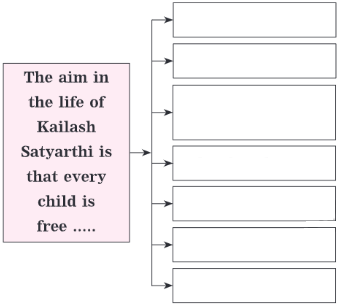
A3. Activities based on Vocabulary:
Choose the correct option and write in front of the given word :
(1) extremist: _______________
(A) militant (B) robber (C) spy
(2) courageous: _______________
(A) cowards (B) brave (C) friendly
A4. Activities based on Contextual Grammar:
Rewrite the following into indirect speech:
(1) A skinny child labourer asked Satyarthi, "Is the world so poor that it cannot give me a toy and a book, instead of forcing me to take a gun or a tool?"
A5. Personal Response:
What will you do in the following situations?
(1) If you find a child working on a brickwork site.
(2) If you come across a beggar child.
A1. Simple Factual Activities:
Make a list of the problems that we are facing and creating violence against children -
I call upon all the governments, intergovernmental agencies, businesses, faith leaders, workers, teachers and NGOs, and each one of us, to put an end to all forms of violence against children. Slavery, trafficking, child marriages, child labour, sexual abuse, and illiteracy these things have no place in any civilised society.
Friends, we can do this. Governments must make child - friendly policies, and invest in education and young people. Businesses must be more responsible, accountable and open to innovative partnerships.Intergovernmental agencies must work together to accelerate action. Global civil society must rise above the business-as-usual and fragmented agendas. Faith leaders and institutions, and all of us must stand with our children.
We must be bold, we must be ambitious, and we must have the will. We must keep our promises. Over fifty years ago, on the first day of my school, I met a cobbler boy, my age sitting outside the gate of my school. I asked my teachers: “Why is he working outside? Why is he not with us in the school?” My teachers had no answer. One day, I
gathered the courage to ask the boys’ father. He said: “Sir, I have never thought about it. We are born to work.”
His answer made me angry. It still makes me angry.
A2. Complex Factual Activities:
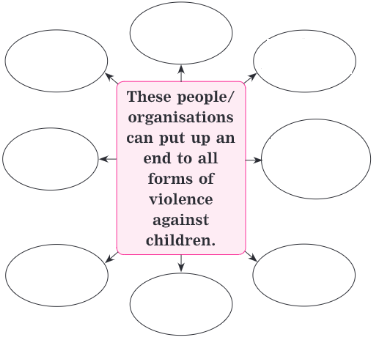
A3. Activities based on Vocabulary:
Find out the describing words used for the following noun and make your own sentences by using any combination:
(1) _______________ agencies
(2) _______________ partnership
A4. Activities based on Contextual Grammar:
Make the sentences affirmative:
(1) My teacher had no answer.
(2) I have never thought about it.
A5. Personal Response:
(1) Why should we stop 'Child labour'?
Make a list of the problems that we are facing and creating violence against children -
I call upon all the governments, intergovernmental agencies, businesses, faith leaders, workers, teachers and NGOs, and each one of us, to put an end to all forms of violence against children. Slavery, trafficking, child marriages, child labour, sexual abuse, and illiteracy these things have no place in any civilised society.
Friends, we can do this. Governments must make child - friendly policies, and invest in education and young people. Businesses must be more responsible, accountable and open to innovative partnerships.Intergovernmental agencies must work together to accelerate action. Global civil society must rise above the business-as-usual and fragmented agendas. Faith leaders and institutions, and all of us must stand with our children.
We must be bold, we must be ambitious, and we must have the will. We must keep our promises. Over fifty years ago, on the first day of my school, I met a cobbler boy, my age sitting outside the gate of my school. I asked my teachers: “Why is he working outside? Why is he not with us in the school?” My teachers had no answer. One day, I
gathered the courage to ask the boys’ father. He said: “Sir, I have never thought about it. We are born to work.”
His answer made me angry. It still makes me angry.
A2. Complex Factual Activities:
A3. Activities based on Vocabulary:
Find out the describing words used for the following noun and make your own sentences by using any combination:
(1) _______________ agencies
(2) _______________ partnership
A4. Activities based on Contextual Grammar:
Make the sentences affirmative:
(1) My teacher had no answer.
(2) I have never thought about it.
A5. Personal Response:
(1) Why should we stop 'Child labour'?
A1. Simple Factual Activities:
Write one sentence each, why the following years were landmarks in the lives of Pierre and Marie Curie:
(1) 1902 -
(2) 1903 -
The Curies continued their work for four more years. Wearing an acid stained, dust covered mask, Marie toiled along stirring large pots of pitchblende ensuring that the fires beneath were active throughout the day and the night. Then in 1902, success finally came. On a September night the Curies, after a day’s tiresome work, went home. Then just as they were about to go to bed they went to the laboratory to have another look at the hundreds of small bowls into which they had poured filtered pitchblende. In the dark laboratory as they moved cautiously forward there were all around them rays of soft, bluish purple light coming from the small, glass covered bowls. Radium had been discovered ! Marie said to her husband, ‘Do you remember the day when you told me that you wanted radium to have a beautiful colour? Look …. look!’’
Actually, what they had produced was just a tiny pinch of white powder that looked like salt. But it was to become one of the wonders of the world. With its rays people would be able to see through the hardest of substances except lead.
The benefits of radium in the world of medicine are incalculable. It has been used with great effect in the treatment of cancer. The bacteria of such diseases as typhus, cholera and anthrax can also be killed by radium.
In 1903 the Curies along with Henry Becquesel, were awarded the Nobel Prize for physics for the discovery of Radium and Polonium. They wished, they could have patented their discovery and become rich, but this noble woman refused to do so and gave it free to the world to be used properly.
In 1906, Pierre was knocked down and killed by a horse-drawn wagon. Marie clung to his lifeless body and remained disconsolate.
In 1911, Marie was awarded the Nobel prize for the second time and this was for Chemistry. Madame Curie remained comparatively poor and when asked why she did not make money by her discoveries, she replied, ‘‘I am working for science. Radium belongs to the people, not to me.’’
In 1934, the health of Marie Curie failed and in the July of that year this great scientist, who had given her life for the cause of science and humanity, died. In every great man and woman there is a compulsive desire to discover the truth. Madame Curie, who pursued her life’s goal with great courage, endurance, dedication and strength of character, is a living example of this statement.
There are also men and women who show extreme courage when they are face to face with great danger. But greater is the courage of men and women who display a strength of mind that is not defeated by extremely hostile and unfavourable conditions of life. Madame Curie certainly belongs to this latter group.
A2. Complex Factual Activities:
(1) How is radium used in the medical field?
A3. Activities based on Vocabulary:
Write down the describing words used for the following nouns :
(1) _______________ work
(2) _______________ pitchblende
(3) _______________ colour
(4) _______________ desire.
A4. Activities based on Contextual Grammar:
Change the voice:
(1) In 1906, Pierre was knocked down by a horse- drawn wagon.
(Begin the sentence with 'A horse-drawn wagon'.)'
(2) In 1911, Marie was awarded the Nobel Prize.
(Begin the sentence with 'They'.)
A5. Personal Response:
(1) Why are awards and prizes given to the people in different fields?
Write one sentence each, why the following years were landmarks in the lives of Pierre and Marie Curie:
(1) 1902 -
(2) 1903 -
The Curies continued their work for four more years. Wearing an acid stained, dust covered mask, Marie toiled along stirring large pots of pitchblende ensuring that the fires beneath were active throughout the day and the night. Then in 1902, success finally came. On a September night the Curies, after a day’s tiresome work, went home. Then just as they were about to go to bed they went to the laboratory to have another look at the hundreds of small bowls into which they had poured filtered pitchblende. In the dark laboratory as they moved cautiously forward there were all around them rays of soft, bluish purple light coming from the small, glass covered bowls. Radium had been discovered ! Marie said to her husband, ‘Do you remember the day when you told me that you wanted radium to have a beautiful colour? Look …. look!’’
Actually, what they had produced was just a tiny pinch of white powder that looked like salt. But it was to become one of the wonders of the world. With its rays people would be able to see through the hardest of substances except lead.
The benefits of radium in the world of medicine are incalculable. It has been used with great effect in the treatment of cancer. The bacteria of such diseases as typhus, cholera and anthrax can also be killed by radium.
In 1903 the Curies along with Henry Becquesel, were awarded the Nobel Prize for physics for the discovery of Radium and Polonium. They wished, they could have patented their discovery and become rich, but this noble woman refused to do so and gave it free to the world to be used properly.
In 1906, Pierre was knocked down and killed by a horse-drawn wagon. Marie clung to his lifeless body and remained disconsolate.
In 1911, Marie was awarded the Nobel prize for the second time and this was for Chemistry. Madame Curie remained comparatively poor and when asked why she did not make money by her discoveries, she replied, ‘‘I am working for science. Radium belongs to the people, not to me.’’
In 1934, the health of Marie Curie failed and in the July of that year this great scientist, who had given her life for the cause of science and humanity, died. In every great man and woman there is a compulsive desire to discover the truth. Madame Curie, who pursued her life’s goal with great courage, endurance, dedication and strength of character, is a living example of this statement.
There are also men and women who show extreme courage when they are face to face with great danger. But greater is the courage of men and women who display a strength of mind that is not defeated by extremely hostile and unfavourable conditions of life. Madame Curie certainly belongs to this latter group.
A2. Complex Factual Activities:
(1) How is radium used in the medical field?
A3. Activities based on Vocabulary:
Write down the describing words used for the following nouns :
(1) _______________ work
(2) _______________ pitchblende
(3) _______________ colour
(4) _______________ desire.
A4. Activities based on Contextual Grammar:
Change the voice:
(1) In 1906, Pierre was knocked down by a horse- drawn wagon.
(Begin the sentence with 'A horse-drawn wagon'.)'
(2) In 1911, Marie was awarded the Nobel Prize.
(Begin the sentence with 'They'.)
A5. Personal Response:
(1) Why are awards and prizes given to the people in different fields?
A1. Simple Factual Activities:
State whether the following statements are Right or Wrong. Correct the wrong ones:
(i) The beggar and the young girl were playing on the road because there was a lot of traffic.
(ii) The scene of the beggar and the girl made Meena peep into her own life.
(iii) The beggar became Meena's role model.
(iv) It took Meena almost two years to put the change into effect.
‘Yes, a beggar,’ she repeated, as if to reassure me. ‘He was old and used to stay in front of my house with his five-year old granddaughter. As you know, I was a chronic pessimist. I used to give my leftovers to this beggar every day. I never spoke to him. Nor did he speak to me. One monsoon day, I looked out of my bedroom window and started cursing the rain. I don’t know why I did that because I wasn’t even getting wet. That day I couldn’t give the beggar and his granddaughter their daily quota of leftovers. They went hungry, I am sure.
‘However, what I saw from my window surprised me. The beggar and the young girl were playing on the road because there was no traffic. They were laughing, clapping and screaming joyously, as if they were in paradise. Hunger and rain did not matter.They were totally drenched and totally happy. I envied their zest for life.
‘That scene forced me to look at my own life. I realized I had so many comforts, none of which they had. But they had the most important of all assets, one which I lacked. They knew how to be happy with life as it was. I felt ashamed of myself. I even started to make a list of what I had and what I did not have. I found I had more to be grateful for than most people could imagine. That day, I decided to change my attitude towards life, using the beggar as my role model.’
After a long pause, I asked Meena how long it had taken her to change.
‘Once this realization dawned’, she said, ‘it took me almost two years to put the change into effect. Now nothing matters. I am always happy. I find happiness in every small thing, in every situation and in every person.’
‘Did you give any gurudakshina to your guru ?’ I asked.
‘No. Unfortunately, by the time I understood things, he was dead. But I sponsored his granddaughter to a boarding school as a mark of respect to him.’
A2. Complex Factual Activities:
(1) Meena sponsored the granddaughter of the beggar because _______________.
(a) she was alone in her life after his death.
(b) it was a token of respect to the beggar.
(c) she was rich and so she wanted to help.
(2) _______________ was the most important of all assets, that the beggar and his granddaughter had but the writer was lacking.
(a) Attitude towards life
(b) So many comforts
(c) Hunger.
A3. Activities based on Vocabulary:
Match the synonyms:
State whether the following statements are Right or Wrong. Correct the wrong ones:
(i) The beggar and the young girl were playing on the road because there was a lot of traffic.
(ii) The scene of the beggar and the girl made Meena peep into her own life.
(iii) The beggar became Meena's role model.
(iv) It took Meena almost two years to put the change into effect.
‘Yes, a beggar,’ she repeated, as if to reassure me. ‘He was old and used to stay in front of my house with his five-year old granddaughter. As you know, I was a chronic pessimist. I used to give my leftovers to this beggar every day. I never spoke to him. Nor did he speak to me. One monsoon day, I looked out of my bedroom window and started cursing the rain. I don’t know why I did that because I wasn’t even getting wet. That day I couldn’t give the beggar and his granddaughter their daily quota of leftovers. They went hungry, I am sure.
‘However, what I saw from my window surprised me. The beggar and the young girl were playing on the road because there was no traffic. They were laughing, clapping and screaming joyously, as if they were in paradise. Hunger and rain did not matter.They were totally drenched and totally happy. I envied their zest for life.
‘That scene forced me to look at my own life. I realized I had so many comforts, none of which they had. But they had the most important of all assets, one which I lacked. They knew how to be happy with life as it was. I felt ashamed of myself. I even started to make a list of what I had and what I did not have. I found I had more to be grateful for than most people could imagine. That day, I decided to change my attitude towards life, using the beggar as my role model.’
After a long pause, I asked Meena how long it had taken her to change.
‘Once this realization dawned’, she said, ‘it took me almost two years to put the change into effect. Now nothing matters. I am always happy. I find happiness in every small thing, in every situation and in every person.’
‘Did you give any gurudakshina to your guru ?’ I asked.
‘No. Unfortunately, by the time I understood things, he was dead. But I sponsored his granddaughter to a boarding school as a mark of respect to him.’
A2. Complex Factual Activities:
(1) Meena sponsored the granddaughter of the beggar because _______________.
(a) she was alone in her life after his death.
(b) it was a token of respect to the beggar.
(c) she was rich and so she wanted to help.
(2) _______________ was the most important of all assets, that the beggar and his granddaughter had but the writer was lacking.
(a) Attitude towards life
(b) So many comforts
(c) Hunger.
A3. Activities based on Vocabulary:
Match the synonyms:
| Column 'A' | Column 'B' |
| (1) paradise | (a) enthusiasm |
| (2) zest | (b) valuable thing |
| (3) asset | (c) wet |
| (4) drenched | (d) heaven |
A4. Activities based on Contextual Grammar:
(1) Do as directed:
He used to stay in front of my house.
(Rewrite the sentence by using 'would'.)
(2) Change the voice:
That scene forced me to look at my own life.
(Begin the sentence with "I .....)
A5. Personal Response:
(1) According to you, how can we help beggars?
A1. Simple Factual Activities:
State whether you Agree or Disagree with the following statements:
(1) 'There is always an opening even in impossible things' - we learn it from small bits of grass.
(2) Our difficult time never changes.
(3) The team work and perseverance of the ants were impressive.
(4) Clouds take new shapes with every passing moment.
We saw small bits of grass peeping through the small cracks in a concrete pavement. It left us thinking : however impossible things may look, there is always an opening...
We saw a tree bare of all leaves in the cold winter months. We thought its chapter was over. But three months passed, spring set in and the tree was back to its green majesty once again, full of leaves, flowers, birds and life. What if we too had the conviction that, however difficult things are right now, it will not remain so for ever. Remember, this too shall pass.
We saw an army of ants lugging a fly which was at least ten times the ant’s size. The ants organized themselves around the fly, lifted it on frail feelers and carried it to quite a distance. Their teamwork and perseverance were impressive. What if we too are consistent, organized, focused...Spider webs are delicate, yet very strong. A rainbow colours the entire sky. Oysters take in a grain of sand they open up with a pearl. Innumerable stars shine across the infinite sky. Clouds take new shapes with every passing moment. The wind makes trees dance with unhindered passion. Water, without hint of ego, changes its form according to the dictates of the sun and the wind. When we see a caterpillar turn into a butterfly, a flower turn into a fruit, we experience the alchemy of nature... we touch it and become gold ourselves.
A2. Complex Factual Activities:
(1) What are the alchemies of nature mentioned in the extract?
A3. Activities based on Vocabulary:
Frame meaningful sentences by using the given words:
(1) impressive
(2) passion
A4. Activities based on Contextual Grammar:
Identify the tenses:
(1) It will not remain so forever
(2) Ants were lugging a fly.
A5. Personal Response:
(1) Impossible itself says 'I M possible'. Do you agree? Justify your answer by citing some examples from the text and some that you have experienced or heard from someone.
State whether you Agree or Disagree with the following statements:
(1) 'There is always an opening even in impossible things' - we learn it from small bits of grass.
(2) Our difficult time never changes.
(3) The team work and perseverance of the ants were impressive.
(4) Clouds take new shapes with every passing moment.
We saw small bits of grass peeping through the small cracks in a concrete pavement. It left us thinking : however impossible things may look, there is always an opening...
We saw a tree bare of all leaves in the cold winter months. We thought its chapter was over. But three months passed, spring set in and the tree was back to its green majesty once again, full of leaves, flowers, birds and life. What if we too had the conviction that, however difficult things are right now, it will not remain so for ever. Remember, this too shall pass.
We saw an army of ants lugging a fly which was at least ten times the ant’s size. The ants organized themselves around the fly, lifted it on frail feelers and carried it to quite a distance. Their teamwork and perseverance were impressive. What if we too are consistent, organized, focused...Spider webs are delicate, yet very strong. A rainbow colours the entire sky. Oysters take in a grain of sand they open up with a pearl. Innumerable stars shine across the infinite sky. Clouds take new shapes with every passing moment. The wind makes trees dance with unhindered passion. Water, without hint of ego, changes its form according to the dictates of the sun and the wind. When we see a caterpillar turn into a butterfly, a flower turn into a fruit, we experience the alchemy of nature... we touch it and become gold ourselves.
A2. Complex Factual Activities:
(1) What are the alchemies of nature mentioned in the extract?
A3. Activities based on Vocabulary:
Frame meaningful sentences by using the given words:
(1) impressive
(2) passion
A4. Activities based on Contextual Grammar:
Identify the tenses:
(1) It will not remain so forever
(2) Ants were lugging a fly.
A5. Personal Response:
(1) Impossible itself says 'I M possible'. Do you agree? Justify your answer by citing some examples from the text and some that you have experienced or heard from someone.
A1. Simple Factual Activities:
Answer in few words:
(1) The age in which we live -
(2) The serious disconnect of the world -
(3) We can unite the world through -
(4) Children are questioning and watching our-
We can do it ...
You may ask that - what can one person do? I would recall a story of my childhood: A heavy fire had broken out in the forest. All the animals were running away, including lion, the king of the forest. Suddenly, then he saw a tiny bird rushing towards the fire. He asked the bird, “What are you doing?” To the lion’s surprise, the bird replied “I am going to extinguish the fire.” The lion laughed and said, “How can you do it keeping just one drop of water, in your beak?” The bird was adamant, and she said, “I am doing my bit.”
Eighteen years ago, millions of individuals marched across the globe. And demanded a new international law for the abolition of worst form of child labour, and it has happened, we did it, millions of individuals did it.
Friends! We live in an age of rapid globalisation. We are connected through high-speed Internet. We exchange our goods and services in one single global market. Thousands of flights every day connect us from one corner to another corner of the globe. But there is one serious disconnect and there is a lack of compassion. Let us inculcate and transform these individuals’ compassion into a global compassion.
Let us globalise compassion.
Mahatma Gandhi said, “If we are to teach real peace in this world... we shall have to begin with the children.” I humbly add, let us unite the world through the compassion for our children.
I ask - Whose children are they who stitch footballs, yet never played with one?
Whose children are they who harvest cocoa, yet have never tasted chocolate?
Whose children are they who are dying of Ebola?
Whose children are they who are kidnapped and held hostage?
They are all our children.
I remember an eight-year-old girl we rescued from intergenerational forced labour from stone quarries. When she was sitting in my car right after her rescue, she asked me: “Why did you not come earlier?”
Her angry question still shakes me – and has the power to shake the whole world. Her question is for all of us. What are we doing? What are we waiting for? How many girls will we allow to go without rescue?
Children are questioning our inaction and watching our actions. We need collective actions with a sense of urgency.
Every single minute matters, every single child matters, every single childhood matters.
Therefore, I challenge the passivity and pessimism surrounding our children. I challenge this culture of silence and this culture of passivity, this culture of neutrality.
A2. Complex Factual Activities:
Complete the following web:
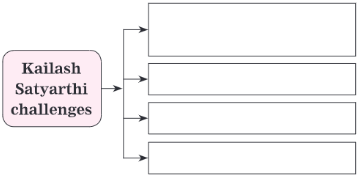
A3. Activities based on Vocabulary:
Find out the describing words used for the following nouns and make your own sentence by using any one combination:
(1) _______________ globalisation
(2) _______________ compassion
A4. Activities based on Contextual Grammar:
Change these sentences into indirect speech:
(1) The lion asked the bird, "What are you doing?"
(2) The bird said to the lion, "I am going to extinguish the fire."
A5. Personal Response:
(1) What will you do for our country?
Answer in few words:
(1) The age in which we live -
(2) The serious disconnect of the world -
(3) We can unite the world through -
(4) Children are questioning and watching our-
We can do it ...
You may ask that - what can one person do? I would recall a story of my childhood: A heavy fire had broken out in the forest. All the animals were running away, including lion, the king of the forest. Suddenly, then he saw a tiny bird rushing towards the fire. He asked the bird, “What are you doing?” To the lion’s surprise, the bird replied “I am going to extinguish the fire.” The lion laughed and said, “How can you do it keeping just one drop of water, in your beak?” The bird was adamant, and she said, “I am doing my bit.”
Eighteen years ago, millions of individuals marched across the globe. And demanded a new international law for the abolition of worst form of child labour, and it has happened, we did it, millions of individuals did it.
Friends! We live in an age of rapid globalisation. We are connected through high-speed Internet. We exchange our goods and services in one single global market. Thousands of flights every day connect us from one corner to another corner of the globe. But there is one serious disconnect and there is a lack of compassion. Let us inculcate and transform these individuals’ compassion into a global compassion.
Let us globalise compassion.
Mahatma Gandhi said, “If we are to teach real peace in this world... we shall have to begin with the children.” I humbly add, let us unite the world through the compassion for our children.
I ask - Whose children are they who stitch footballs, yet never played with one?
Whose children are they who harvest cocoa, yet have never tasted chocolate?
Whose children are they who are dying of Ebola?
Whose children are they who are kidnapped and held hostage?
They are all our children.
I remember an eight-year-old girl we rescued from intergenerational forced labour from stone quarries. When she was sitting in my car right after her rescue, she asked me: “Why did you not come earlier?”
Her angry question still shakes me – and has the power to shake the whole world. Her question is for all of us. What are we doing? What are we waiting for? How many girls will we allow to go without rescue?
Children are questioning our inaction and watching our actions. We need collective actions with a sense of urgency.
Every single minute matters, every single child matters, every single childhood matters.
Therefore, I challenge the passivity and pessimism surrounding our children. I challenge this culture of silence and this culture of passivity, this culture of neutrality.
A2. Complex Factual Activities:
Complete the following web:
A3. Activities based on Vocabulary:
Find out the describing words used for the following nouns and make your own sentence by using any one combination:
(1) _______________ globalisation
(2) _______________ compassion
A4. Activities based on Contextual Grammar:
Change these sentences into indirect speech:
(1) The lion asked the bird, "What are you doing?"
(2) The bird said to the lion, "I am going to extinguish the fire."
A5. Personal Response:
(1) What will you do for our country?