Question
A1. Simple Factual Activity:
State whether the following statements are True or False:
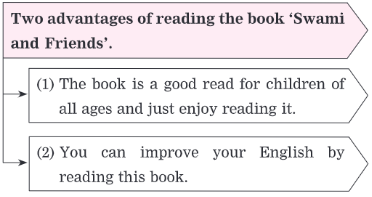
(1) R. K. Narayan's 'Swami and Friends' is a good read for the kids and teens alike.
(2) Mischievous kids are not as sensitive as other people.

     Significance of the book...
    ‘Swami and Friends’ by R. K. Narayan is not merely an interesting read that could be enjoyed from top to bottom, but the work attributes a lot of literary values even if it is a teen book ‘Swami and Friends’ is a good read for the kids and teens alike. Also the book is widely used in the Asian continent as a study text for the students who study literature as a subject at schools. This does not mean that the book is filled with heavy grammar and technical jargon. Actually the truth is in contrary to this.
     Swami and Friends is written in such simple English it is hard to imagine that it is a work of such a literary genius like R. K. Narayan. The English used in the book is both plain and simple, without any troubling words for the kids. Also the use of simple and short sentences adds to the simplicity of the book.
      It is mentioned in the description that the book is about a mischievous ten year old Indian boy, and some parents may be concerned about the influence this will have on their already mischievous children. But the book is as such, that it encompasses the
mischief of the kids in a view of the kid which is harmless and pure in his perspective. Also amidst all the mischief and naughtiness, we actually find that Swami is a loving and a tender kid who's actually very sensitive. It is also a known fact that mischievous
kids are the most sensitive and loving people of all. And R. K. Narayan does a great job conveying that to all of us.

A2. Complex Factual Activity:
Complete the following web:
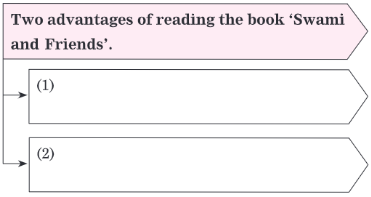
Image
A3. Activities based on Vocabulary:
Find the following from the passage:
(i) Noun forms of : conclude, rule
(ii) Verb forms of : improvement, inclusion
A4. Activities based on Contextual Grammar:
Do as directed:
(1) The author is one of the greatest authors of all the time.
(Change the sentence into positive degree.)
(2) R. K. Narayan is responsible for many of the outstanding literary works.
(Frame a Wh-question to get the underlined as answer.)
A5. Personal Response:
(1) What difference do you find between the children of Swami's days and today's children?
Answer

A1. Simple Factual Activity:
(1) False
(2) False
(3) True
(4) True
A2. Complex Factual Activity:
Image
A3. Activities based on Vocabulary:
(i) conclude - conclusion, rule - rule/ruling
(ii) improvement - improve, inclusion - include
A4. Activities based on Contextual Grammar:
(1) Very few (Not many) authors of all the time are so (as) great as him. (the author).
(2) What is R. K. Narayan responsible for?
A5. Personal Response:
(1) I like the magazine 'Tin-Tin' the most. I like it because it provides all kinds of literature the children like. It gives fairy tales, mythological stories, historical stories, jokes and vivid information related to every field of children's It also gives cartoons for the kids in view of the kids which are harmless and pure. It is a priceless gift for me, every month.

Need a full question paper?

Generate a complete, print-ready paper with questions like this in minutes — across 16+ boards, with answer keys.

Start Generating Free

Similar questions

A1. Simple Factual Activities:
Complete the following sentences:
(1) Soldiers called Joan _______________.
(2) Joan wanted _______________.
(3) The shortest way to save your skin is to _______________.
(4) According to Joan, their soldiers are always beaten because they fight _______________.

Poulengey : (Going to the window) Yes! Joan, come up. (Joan enters.)
Poulengey : (Gravely) Be seated, Joan.
Robert : What is your name ?
Joan : They always called me Jenny, in Lorraine. Here in France, I am Joan. The soldiers call me the Maid.
Robert : How old are you ?
Joan : Seventeen, so they tell me. It might be nineteen. I don’t remember.
Robert : I suppose you think raising a siege is as easy as chasing a cow out of a meadow. You think soldiering is anybody’s job ?
Joan : I don’t think it can be very difficult if God is on your side.
Robert : (Grimly) Have you ever seen English soldiers fighting? Have you ever seen them plundering, burning, turning the countryside into a desert ? Have you heard no tales of their prince who is the devil himself, or of the English king’s father ?
Joan : You do not understand, squire. Our soldiers are always beaten because they are fighting only to save their skins and the shortest way to save your skin is to run away. But I will teach them all to fight for France. Then, they will drive the soldiers before them like sheep. You and Polly will live to see the day when there will not be a single English soldier on the soil of France.
Robert : (To Poulengey) This may all be nonsense, Polly. But the troops might just be inspired by it though nothing that we say seems to put any fire into them. Even the Dauphin might believe it. And if she can put some fire into him, she can put it into anybody.
Robert : (Turning to Joan) Now you, listen to me and don’t cut in before I have time to think. Your orders are that you are to go to Chinon under the escort of this gentleman and three of his friends.
Joan : (Radiant, clasping her hands) Oh, thank you, squire !
Poulengey : How is she to get into the royal presence ?
Robert : I don’t know. How did she get into my presence ? I will send her to Chinon and she can say I sent her. Then, let come what may. I can do no more.
Joan : And the dress ? I may have a soldier’s dress, squire ?
Robert : Take what you please. I wash my hands off it.
Joan : (Wildly excited by her success) Come, Polly. (She dashes out.)
Robert : (Shaking Poulengey’s hand) Goodbye, old man, I am taking a big chance. Few other men would have done it.

A2. Complex Factual Activities:
(1) What shows Joan was a person of immense faith?
A3. Activities based on Vocabulary:
Find out synonyms:
(1) looting - 
(2) seriously - 
(3) following - 
(4) hayfield - 
A4. Activities based on Contextual Grammar:
Rewrite as affirmative sentences:
(1) I don't remember.
(2) YYou do not understand Squire.
A5. Personal Response:
(1) Do you love your country? Why? 
A1. Simple Factual Activity:
Complete the following sentences with the help of the passage:
(1) Specific goals make it easier to _______________.
(2) It is important to create goals that are _______________.

SMART goals have a specific rubric:
    Specific: Involves identifying a specific area for improvement. The more specific the area, the more refined the achievement of one’s goal can be. It makes it easier to set parameters and work towards the goal. For exaxmple, if it is building a house, what exactly is the capacity required and how long can it stretch ?
    Measurable: Quantifying goals provides specific ways to track progress against goals. This makes it easy to benchmark performance throughout the goal period, including areas to improve. While playing football, one’s exact role and position has to be clearly defined.
     Achievable: Setting goals that can be completed in the designated period of time. Often, these goals may act like stepping stones to help meet broader goals that further define a career. As students, we can’t become a President, a Prime Minister, but can hope to reach those heights in future.
      Realistic: It is important to create goals that are within one’s current skill set or area of expertise. Building expertise takes time, so expecting to become an expert in a short amount of time is unrealistic. Being realistic will make it easy to be successful at attaining goals. If defensive and not aggressive, the goal perhaps lacks realism. We must have the clear picture in mind and must have the ability to adhere to that picture.

A2. Complex Factual Activities:
(1) How does quantifying goals help us?
A3. Activities based on Vocabulary:
Find from the passage adjectives for the following:
(1) area
(2) period
(3) role
(4) stones 
A4. Activities based on Contextual Grammar:
Underline the Present Participles/ Infinitives: 
(1) It makes it easier to set parameters.
(2) These goals may act like stepping stones to help broader goals.
A5. Personal Response:
(1) Why is it necessary that our goals should be realistic?
A1. Simple Factual Activities:
(1) Complete the following sentences:
Small groups, local organisations and individuals are  _______________ .
(2) Name the following:
The daughters of Kailash Satyarthi mentioned in this passage: 

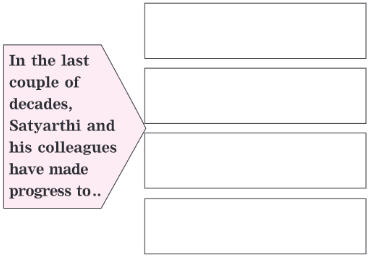
     We have made progress in the last couple of decades. We have reduced the number of out-ofschool children by half. We have reduced the number of child labourers by a third. We have reduced child mortality and malnutrition, and we have prevented millions of child deaths.
     But, let us make no mistake, great challenges still remain.
     Friends! The biggest challenge or biggest crisis knocking on the doors of humankind is fear and intolerance.
     We have utterly failed our children in imparting an education. An education that gives the meaning and objective of life. An education that gives a sense of global citizenship among the youth.
     I am afraid that the day is not very far away when the cumulative result of this failure, will culminate in an unprecedented violence, and that will be suicidal for humankind.
     Rights, security, hope can only be restored through education.
     Young people like Malala ... I’ve started calling her my daughter Malala not just Malala ... So my daughter Malala and other daughters including Kayanat.. in fact.. two Kayanats, and Shazia, and the daughters from Africa, and from all over the world. They are rising up and choosing peace over violence, tolerance over extremism, and courage over fear.
     The solutions are emerging. But these solutions cannot be found in the deliberations in conferences alone, and cannot be found in prescriptions from a distance.
     They lie in small groups and local organisations and individuals, who are confronting with the problem every day. Even if they remain unacknowledged, unrecognised and unknown to the world the solution are with them.

A2. Complex Factual Activities:
Complete the following web stating the sign of progress mentioned by Satyarthi :
Image
A3. Activities based on Vocabulary:

Find out the describing words used for the following nouns and make your own sentences by using any three combinations:
(1) challenges
(2) organisations
(3) citizenship
(4) groups
A4. Activities based on Contextual Grammar:

(1) Find out and write four sentences from the passage that are in Present Perfect Tense:
A5. Personal Response:
(1) What is the role of education in nation building? 
A1. Simple Factual Activities:
Who said to whom:
(1) "Come with me. I will take you to school."
(2) "What is your name, little one?"

     The next day Ramlal caught Bholi by the hand and said. ‘‘Come with me. I will take you to school.’’ Bholi was frightened. She did not know what a school was like. She remembered how a few days ago their old cow. Lakshmi had been turned out of
the house and sold.
     ‘‘N-n-n-n No. no-no-no’’ she shouted in terror and pulled her hand away from her father’s grip.
     ‘‘What’s the matter with you, you fool?’’ shouted Ramlal, ‘‘I am only taking you to school.’’ Then he told his wife. ‘‘Let her wear some decent clothes today. Or else what will the teachers and the other schoolgirls think of us when they see her?’’
      New clothes had never been made for Bholi. The old dresses of her sisters were passed on to her. No one cared to mend or wash her clothes. But today she was lucky to receive a clean dress which had shrunk after many washing and no longer fitted
Champa. She was even bathed and oil was rubbed into her dry and matted hair. Only then did she begin to believe that she was being taken to a place better than her home!
      When they reached the school, the children were already in their classrooms. Ramlal handed over his daughter to the headmistress. Left alone, the poor girl looked about her with fear laden eyes. There were several rooms. And in each room girls like her squatted on mats, reading from books or writing on slates. The headmistress asked        Bholi to sit down in a corner in one of the classrooms. Bholi did not know what exactly a school was like and what happened there. But she was glad to find so many girls almost of her own age present there. She hoped that one of these girls might become her friend.
      The lady teacher who was in the class was saying something to the girls but Bholi could understand nothing. She looked at the pictures on the wall. The colours fascinated her. The horse was brown just like the horse on which the Tehsildar had come to visit their village : the goat was black like the goat of their neighbour: the parrot was green like the parrots she had seen in the mango orchard : and the cow was just like their Lakshmi. And suddenly Bholi noticed that the teacher was standing by her
side, smiling at her.
      “What’s your name. little one?’’
      ‘‘Bh-Bho-Bho.’’ She could stammer no further than that.
       Then she began to cry and tears flowed from her eyes in a helpless flood. She kept her head down as she sat in her corner, not daring to look up at the girls who, she knew were still laughing at her.

A2. Complex Factual Activities:
(1) What shows that Bholi was unwilling to go to school? 
A3. Activities based on Vocabulary:
Complete the following sentences using words given in the brackets:
(disfigured, matted, fascinated)
(1) After the accident Juhi's face was _______________.
(2) It took a long time to straighten the _______________ bundle of wool.
A4. Activities based on Contextual Grammar:
(1) Change into indirect speech:
Ramlal's wife said to him, "I will tell you what to do."
(2) Rewrite as an exclamatory sentence:
The child was very fair and pretty.
A5. Personal Response:
(1) "If girls go to school, who will marry them?"-Why, do you think, that Bholi's mother thought so? 
A1. Simple Factual Activities:
Who said to whom-
(1) "Now tell me your name."
(2) "Didn't I tell you? Now take this book."

     When the school bell rang. All the girls scurried out of the classroom. But Bholi dared not leave her corner. Her head still lowered. She kept on sobbing.
    ‘‘Bholi.’’
     The teacher’s voice was so soft and soothing! In all her life she had never been called like that. It touched her heart.
    ‘‘Get up.’’ said the teacher. It was not a command, but just a friendly suggestion. Bholi got up.
    ‘‘Now tell me your name.’’
     Sweat broke out over her whole body. Would her stammering tongue again disgrace her? For the sake  of this kind woman. However she decided to make an effort. She had such a soothing voice : she would not laugh at her.
    ‘‘Bh-Bh-Bho-Bho-,’’ she began to stammer.
    ‘‘Well done, well done.’’ The teacher encouraged her. ‘‘Come on now- the full name?’’
    ‘‘Bh-Bh-Bho-Bholi.’’ At last she was able to say it and felt relieved as if it was a great achievement.
    ‘‘Well done.’’ The teacher patted her affectionately and said. ‘‘Put the fear out of your heart and you will be able to speak like everyone else.’’
     Bholi looked up as if to ask. ‘Really?’
    ‘‘Yes, yes, it will be very easy. You just come to school everyday, will you come?’’
     Bholi nodded.
    ‘‘No. say it aloud.’’
    ‘‘Ye-Ye-Yes.’’ And Bholi herself was astonished that she had been able to say it.
    ‘‘Didn’t I tell you? Now take this book.’’
     The book was full of nice pictures and the pictures were in colour dog, cat, goat, house, parrot, tiger and a cow just like Lakshmi. And with every picture was a word in big black letters.
     ‘‘In one month you will be able to read this book. Then I will give you a bigger book, then a still bigger one. In time you will be more learned than anyone else in the village. Then no one will ever be able to laugh at you. People will listen to you with respect and you will be able to speak without the slightest stammer. Understand? Now go
home, and come back early tomorrow morning”
      Bholi felt as if suddenly all the bells in the village temple were ringing and the trees in front of the school house had blossomed into big red flowers. Her heart was throbbing with a new hope and a new life. 

A2. Complex Factual Activities:
(1) How would you describe the teacher's attitude towards Bholi? Give 3 to 4 points.
A3. Activities based on Vocabulary:
Complete the following sentences using the words given in the brackets:
(scurried, affectionately, a great achievement)
(1) After class, the students _______________ out for their lunch-break.
(2) My father always tries to solve my problem _______________.
A4. Activities based on Contextual Grammar:
Change the voice:
(1) The teacher patted her affectionately. (Begin the sentence with "She....)
(2) The teacher encouraged her. (Begin the sentence with "She....)
A5. Personal Response:
(1) Why does positive encouragement work better than criticism? 
A1. Simple Factual Activity:
Who am I? (Identify the character)
(1) I am the washerman's son. - _______________
(2) I am the sweeper. - _______________

    Nathu grumbled to himself as he swept the steps of the Pipalnagar Bank, owned by Seth Govind Ram. He used the small broom hurriedly and carelessly, and the dust, after rising in a cloud above his head settled down again on the steps. As Nathu was
banging his pan against a dustbin, Sitaram, the washerman’s son, passed by.
    Sitaram was on his delivery round. He had a bundle of freshly pressed clothes balanced on his head.
    ‘Don’t raise such dust!’ he called out to Nathu. ‘Are you annoyed because they are still refusing to pay you an extra two rupees a month?’
    ‘I don’t wish to talk about it,’ complained the sweeper-boy. ‘I haven’t even received my regular pay. And this is the twentieth of the month. Who would think a bank would hold up a poor man’s salary? As soon as I get my money, I’m off! Not another week I work in this place.’ And Nathu banged the pan against the dustbin several times, just
to emphasize his point and giving himself confidence.
    ‘Well, I wish you luck,’ said Sitaram. ‘I’ll keep a lookout for any jobs that might suit you.’ And he plodded barefoot along the road, the big bundle ofclothes hiding most of his head and shoulders.
     At the fourth home he visited, Sitaram heard the lady of the house mention that she was in need of a sweeper. Tying his bundle together, he said; ‘I know of a sweeper boy who’s looking for work. He can start from next month. He’s with the bank just now but they aren’t giving him his pay, and he wants to leave.’
    ‘Is that so?’ said Mrs. Srivastava. ‘Well, tell him to come and see me tomorrow.’ 

A2. Complex Factual Activity:
Arrange the following sentences as per their sequence occurred in the passage:
(1) Nathu complained about his irregular pay.
(2) Nathu used the small broom hurriedly.
(3) Sitaram called out to Nathu.
(4) Nathu grumbled as he swept the steps of the bank.
A3. Activities based on Vocabulary:

Cross out the odd man:
(1) sweeper, hooligan, beggar, declare, locker
(2) hurriedly, carelessly, salary, definitely, suddenly
(3) imminent, latest, pavement, awful, shocking
(4) morning, scattering, raising, collecting, shouting
A4. Activities based on Contextual Grammar:
(1) He called out to Nathu. (Rewrite the sentence in Past Continuous Tense.)
(2) Mrs Srivastava said, "Tell him to come and see me tomorrow." (Change into indirect speech.)
A5. Personal Response:
(1) What qualities do you find in Sitaram?
A1. Simple Factual Activity:
(1) Dr Hawking is a very humble man, though he is considered _______________ .
(2) Dr Hawking expressed his thoughts with the help of his _______________.

    Though confined to a wheel chair with no control over his body save a finger and with
a computer to help him express his thoughts. Dr Hawking is an authority on profound subjects of science. Numerous honorary doctorates and awards have been bestowed
on him. He is a Fellow of The Royal Society and a Member of the US National Academy of Sciences.
     In spite of being considered Einstein’s equal in intelligence, Dr. Hawking is a very humble man. A simple, down to earth man, he has authored many books dealing with his awesome ideas keeping a layman in mind. His writing is full of wit and humour. His style is so lucid that non-scientists can also understand him. His book, “A Brief History of Time” is one of the best selling books of our times.
     On being asked, how he feels about having the dreadful ALS, Dr Hawking, the quintessence of optimism and hope, says, “Not very different from the rest. I try and lead as normal a life as possible, and not think about my condition or regret the things it prevents me from doing, which are not many.”
      Dr Hawking firmly believes that in the next millenium, science will discover the core secrets of the universe, its origin, its history and maybe even predict its ultimate demise.
      Like Dr Hawking, there are many people who display exemplary courage in their lives. Let us salute all those brave people, who in spite of being disabled strive to do their best.

A2. Complex Factual Activity:
(1) What does the writer say about the books authored by Dr Hawking? 
A3. Activities based on Vocabulary:
Match the words in Column 'A' with their meanings in Column 'B':

Column 'A'Column 'B'
 (1) profound (a) a person without any special skill
 (2) awesome (b) a perfect example
 (3) layman (c) showing very great (knowledge) 
 (4) quintessence (d) very impressive

A4. Activities based on Contextual Grammar:
Convert the following to Interrogative (Question) Form:
(1) The prognosis was bad.
(2) Stephen decided to continue his research.
A5. Personal Response:
(1) How do you know that Dr Hawking is a perfect example of optimism and hope?

A1. Simple Factual Activities:
Name the following: 
(1) The warrior mentioned in the passage -
(2) Native place of Mary Kom -
(3) Mary Kom's parents -
(4) The sportsperson who won gold medal in Asian games-

   There had to be one successful story if Indians were to survive in sports and we have that story now. Enough has been said about this great warrior who conquered the world. This warrior is none other than Mary Mangte Kom-the Komqueror and the Komrade. She is famed as a five times World Boxing Champion and the only boxer to win a medal in every one of the six world championships. In the 2012 Olympics, she became the first Indian woman boxer to qualify and win a bronze medal in the 51
kg flyweight category of Boxing.
     Kom was born in Kangthei village, Moirang Lamkhai in Churachandpur district of rural Manipur in eastern India. She came from a poor family. Her parents, Mangte Tonpa Kom and Mangte Akham Kom were tenant farmers who worked in jhum fields.
Kom grew up in humble surroundings, helping her parents with farm related chores, going to school and learning athletics initially and later boxing simultaneously. Her father was a keen wrestler in his younger age.
     She had an eager interest in athletics since childhood and the success of Dingko Singh a fellow Manipuri returned from the 1998 Bangkok Asian games with a gold medal, Kom recollects, had inspired many youngsters in Manipur to try boxing
and she too thought of giving it a try.
     Mary Kom’s career started in 2000 after her victory in the Manipur State women’s boxing championship and the regional championship in West Bengal. In 2001, she started competing at international level. She was only 18 years old when she made her international debut at the first AIBA Women’s World Boxing Championship in United States, winning a silver medal in the 48 kg weight category. Her greatness is reinforced by the way she apoligized to the whole nation for not being able to win the Gold. She is a legend for sure and an idol for all the sportswomen to look up to.

A2. Complex Factual Activities:
(1) Mary Kom's exceptional achievement is that _______________.
(2) Mary Kom's parents made their living by _______________.
A3. Activities based on Vocabulary:
Fill in the blanks by selecting words or phrases from the passage :
(1) My younger sister has so much _______________ in dancing and singing.
(2) Tanaji Malusare was a great _______________ in history.
A4. Activities based on Contextual Grammar:
Do as directed: 
(1) Mary Kom was a warrior. She was a boxer. (Use 'as well as')
(2) Her father was a keen wrestler in his younger age. (Pick out and rewrite two adjectives from the given sentence.)
A5. Personal Response:
(1) Describe your favourite sportswoman.
A1. Simple Factual Activities:
Who said to whom :
(1) "Yes, Aunty, you are right. You all thought I was a dumb-driven cow."
(2) "I will serve you and mother and I will teach in the same school where I learnt so much."

      Bholi turned violently on the old woman, “Yes, Aunty, you are right. You all thought I was a dumbdriven cow. That’s why you wanted to hand me over to this heartless creature. But now the dumb cow, the stammering fool, is speaking. Do you want to hear more ?”
     Bishamber Nath, the grocer, started to go back with his party. The confused bandsmen thought this was the end of the ceremony and struck up a closing song.
     Ramlal stood rooted to the ground, his head bowed low with the weight of grief and shame.
     The flames of the sacred fire slowly died down.Everyone was gone. Ramlal turned to Bholi and said, “But what about you, no one will ever marry you now. What shall we do with you ?”
     And Sulekha said in a voice that was calm and steady, “Don’t you worry, “Pitaji! In your old age I will serve you and mother and I will teach in the same school where I learnt so much. Isn’t that right, Ma’am ?”
    The teacher had all along stood in a corner, watching the drama. “Yes, Bholi, of course,” she replied. And in her smiling eyes was the light of a deep satisfaction that an artist feels when contemplating the completion of her masterpiece.

A2. Complex Factual Activities:
Complete the following:
(1) Beside the humiliation and grief, Ramlal was afraid of Bholi's marriage as he thought that no one would ever marry Bholi.
(2) Bholi told her father in a calm and steady voice that she would serve him and mother in their old age and she would teach in the same school where she learnt so much.
A3. Activities based on Vocabulary:
Complete the following sentences by choosing the words given in the brackets:
(1) We are _______________ seriously about buying a new apartment (completing/contemplating)
(2) She _______________ disagreed with what we said. (slowly/violently)
A4. Activities based on Contextual Grammar:
Correct the error in the following sentence.Focus on verb and subject:
(1) Do you wants to hear more?
(2) Aren't that right?
A5. Personal Response:
(1) 'The teacher is an artist. Do you agree with the statement? Justify your answer. 
A1. Simple Factual Activities:
Say whether the following statements are True or False:
(1) The baby langur sensed the presence of his mother.
(2) The mother langur was sitting on the floor of the coop.
(3) The writer cuddled the baby langur tightly in his bosom.
(4) The writer's attention was fixed on the revival of the baby langur.

    My attention was fixed on the revival of the baby langur. Suddenly, I had an uncanny feeling of being watched. I turned away from the coop and looked up. There sat the mother langur on our kitchen roof, watching every move I made. She simply sat there quietly, as if convinced that no harm was being done to her child.
   Meanwhile, the baby sensed the presence of his mother and started to sob and cry a little louder. I retreated from the door of the coop to allow the mother access to her baby.
    Immediately, the mother descended on the floor of the coop and picked up the baby in her arms. She gave the baby a thorough body inspection to check his injuries and then cuddled him tightly in her bosom. The baby found great solace in her caring arms. The mother sat still with the baby in her lap for a few minutes. It was almost as if she was pondering over her options and trying to figure out how she could keep the baby safe from further assault.

A2. Complex Factual Activities:
Complete the following:
(1) Mother langur simply sat quietly because _______________.
(2) The baby langur started to sob and cry because _______________.
 
A3. Activities based on Vocabulary:
Match the words in column 'A' with their meanings in column 'B':

 Column 'A'Column 'B'
 (1) to figure out (a) to find comfort and peace.
 (2) to ponder over (b) the act of checking with complete attention and care.
 (3) to find solace (c) to be able to think until you solve the problem.
 (4) thorough inspection (d) think over something deeply.

A4. Activities based on Contextual Grammar:
Do as directed:
(1) I turned away from the coop and looked up.
(Begin the sentence with - Turning ... and rewrite it.) 
(2) She gave the baby a thorough body inspection.
(Change the sentence into passive voice. Begin with The baby...)
A5. Personal Response:
(1) What is your mother's state of mind during your illness?