Question
✓
Answer
A1. Simple Factual Activity:
(1) True
(2) True
A2. Complex Factual Activity:
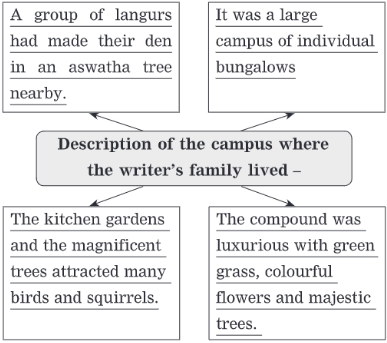
A3. Activities based on Vocabulary:
(1) folded × unfolded
(2) old × new
(3) outside × inside
(4) distracted × attracted
A4. Activities based on Contextual Grammar :
(1) (c) Squirrels and many species of birds were attracted by them.
(2) The compound was luxurious with green grass, was it?
A5. Personal Response :
(1) For me mysteries are best. Mysteries are wonderful. They are very exciting, given goose bumps. I get completely involved into it, even I forget my study & hunger. 'What will happen now?" is the continuous question coming into my mind. I start suspecting all the characters & become a hero-a detective & start solving a mystery by myself. Even my friends find me suspicious! Thus I like reading mysterious stories very much.
(1) True
(2) True
A2. Complex Factual Activity:
A3. Activities based on Vocabulary:
(1) folded × unfolded
(2) old × new
(3) outside × inside
(4) distracted × attracted
A4. Activities based on Contextual Grammar :
(1) (c) Squirrels and many species of birds were attracted by them.
(2) The compound was luxurious with green grass, was it?
A5. Personal Response :
(1) For me mysteries are best. Mysteries are wonderful. They are very exciting, given goose bumps. I get completely involved into it, even I forget my study & hunger. 'What will happen now?" is the continuous question coming into my mind. I start suspecting all the characters & become a hero-a detective & start solving a mystery by myself. Even my friends find me suspicious! Thus I like reading mysterious stories very much.
Need a full question paper?
Generate a complete, print-ready paper with questions like this in minutes — across 16+ boards, with answer keys.
Explore more
Similar questions
A1. Simple Factual Activities:
Complete the following web:
To see a world in a grain of sand
And a heaven in a wild flower,
Hold infinity in the palm of your hand
And eternity in an hour
We instinctively turn to outdoor activities and nature as a way of relaxing and enhancing our wellbeing. Nature soothes and nurtures. Nature fulfils and motivates. Nature whispers and commands.
Are you listening?
When I do, it leaves me in complete awe.
We have a hibiscus plant in our garden. Every fortnight a flower blooms on it big, bright and tender. Through the day it smiles with the sun and dances with the wind, but as evening approaches, it starts wilting. The morning after, it withers completely and by evening it falls and becomes one with the earth again. The flower comes to life only for a day, yet it does so in full splendour. What if we too lived our life, however short, to its fullest?
We went to a rocky beach and saw the spread of the majestic ocean and the rocks alongside, carved, sculpted and shaped by the water. Water is so gentle, rock so hard, yet, as the water flows over it every day, for years, the rock gives in. It takes the shape that the water commands. Our problems are so colossal and we are so small, yet if we persist....
A2. Complex Factual Activities:
The writer explains the contrast features of 'water' and 'rock' in the text. Write all the features of both water and rock in the given table:
A3. Activities based on Vocabulary:
Match the pairs of antonyms.
Complete the following web:
To see a world in a grain of sand
And a heaven in a wild flower,
Hold infinity in the palm of your hand
And eternity in an hour
We instinctively turn to outdoor activities and nature as a way of relaxing and enhancing our wellbeing. Nature soothes and nurtures. Nature fulfils and motivates. Nature whispers and commands.
Are you listening?
When I do, it leaves me in complete awe.
We have a hibiscus plant in our garden. Every fortnight a flower blooms on it big, bright and tender. Through the day it smiles with the sun and dances with the wind, but as evening approaches, it starts wilting. The morning after, it withers completely and by evening it falls and becomes one with the earth again. The flower comes to life only for a day, yet it does so in full splendour. What if we too lived our life, however short, to its fullest?
We went to a rocky beach and saw the spread of the majestic ocean and the rocks alongside, carved, sculpted and shaped by the water. Water is so gentle, rock so hard, yet, as the water flows over it every day, for years, the rock gives in. It takes the shape that the water commands. Our problems are so colossal and we are so small, yet if we persist....
A2. Complex Factual Activities:
The writer explains the contrast features of 'water' and 'rock' in the text. Write all the features of both water and rock in the given table:
A3. Activities based on Vocabulary:
Match the pairs of antonyms.
| Words | Antonyms |
| (1) gentle | (a) small |
| (2) colossal | (b) long |
| (3) short | (c) quit |
| (4) persist | (d) hard |
A4. Activities based on Contextual Grammar:
Frame Wh-questions to get the underlined parts as answers:
(1) The flower comes to life only for a day.
(2) We saw the spread of the majestic ocean.
A5. Personal Response:
(1) Explain the line Nature whispers and commands.'
A1. Simple Factual Activity:
Complete the following sentences:
(1) The role of World Heritage Committee is to list the sites as a UNESCO World Heritage Site.
(2) The tenure of World Heritage Committee is six years.
Shortly thereafter in 1965, a White House Conference in the United States called for a “World Heritage Trust” to protect historic and cultural sites but to also protect the world’s significant natural and scenic sites. Finally, in 1968, the International Union for Conservation of Nature developed similar goals and presented them at the United Nations conference on Human Environment in Stockholm, Sweden in 1972. Following the presentation of these goals, the Convention concerning the Protection of World Cultural and Natural Heritage was adopted by UNESCO’s General Conference on November 16,1972.
Today, the World Heritage Committee is the main group responsible for establishing which sites will be listed as a UNESCO World Heritage Site. The Committee meets once a year and consists of representatives from 21 State Parties that are elected for six year terms by the World Heritage Center’s General Assembly. The State Parties are then responsible for identifying and nominating new sites within their territory to be considered for inclusion on the World Heritage list.
A2. Complex Factual Activity:
(1) Why did a White House Conference in the United States call for a 'World Heritage Trust'?
A3. Activities based on Vocabulary:
Write from the passage nouns for the following:
(1) present (2) protect (3) conserve (4) include
A4. Activities based on Contextual Grammar:
Rewrite the sentences using 'not only....but also' and 'as well as' in two separate sentences:
(1) A White House Conference called for a World Heritage Trust' to protect historic cultural sites and the world's significant natural and scenic sites.
A5. Personal Response:
(1) Why do you like to visit tourist spots ?
Complete the following sentences:
(1) The role of World Heritage Committee is to list the sites as a UNESCO World Heritage Site.
(2) The tenure of World Heritage Committee is six years.
Shortly thereafter in 1965, a White House Conference in the United States called for a “World Heritage Trust” to protect historic and cultural sites but to also protect the world’s significant natural and scenic sites. Finally, in 1968, the International Union for Conservation of Nature developed similar goals and presented them at the United Nations conference on Human Environment in Stockholm, Sweden in 1972. Following the presentation of these goals, the Convention concerning the Protection of World Cultural and Natural Heritage was adopted by UNESCO’s General Conference on November 16,1972.
Today, the World Heritage Committee is the main group responsible for establishing which sites will be listed as a UNESCO World Heritage Site. The Committee meets once a year and consists of representatives from 21 State Parties that are elected for six year terms by the World Heritage Center’s General Assembly. The State Parties are then responsible for identifying and nominating new sites within their territory to be considered for inclusion on the World Heritage list.
A2. Complex Factual Activity:
(1) Why did a White House Conference in the United States call for a 'World Heritage Trust'?
A3. Activities based on Vocabulary:
Write from the passage nouns for the following:
(1) present (2) protect (3) conserve (4) include
A4. Activities based on Contextual Grammar:
Rewrite the sentences using 'not only....but also' and 'as well as' in two separate sentences:
(1) A White House Conference called for a World Heritage Trust' to protect historic cultural sites and the world's significant natural and scenic sites.
A5. Personal Response:
(1) Why do you like to visit tourist spots ?
A1. Simple Factual Activities:
Complete the following sentences:
(1) Meena stayed alone as _______________.
(2) Meena had the habit of _______________.
Meena is a good friend of mine. She is an LIC officer earning a good salary. But there was always something strange about her. She was forever unhappy. Whenever I met her, I would start to feel depressed. It was as though her gloom and cynicism had a way of spreading to others. She never had anything positive to say on any subject or about any person.
For instance, I might say to her, ‘Meena, did you know Rakesh has come first in his school ?’
Meena’s immediate response would be to belittle the achievement. ‘Naturally, his father is a school teacher’, she would say.
If I said, ‘Meena, Shwetha is a very beautiful girl, isn’t she ?’ Meena would be pessimistic. ‘When a pony is young, he looks handsome. It is age that matters. Wait for some time. Shwetha will be uglier than anyone you know.’
‘Meena, it’s a beautiful day. Let’s go for a walk’.
‘No, the sun is too hot and I get tired if I walk too much. Besides, who says walking is good for health ? There’s no proof.’
That was Meena. She stayed alone in an apartment as her parents lived in Delhi. She was an only child and had the habit of complaining about anything and everything. Naturally, she wasn’t a very pleasant company and nobody wanted to visit her. Then one day, Meena was transferred to Bombay and soon we all forgot about her.
Many years later, I found myself caught in the rain at Bombay’s Flora Fountain. It was pouring and I didn’t have an umbrella. I was standing near Akbarallys, a popular department store, waiting for the rain to subside. Suddenly, I spotted Meena. My first reaction was to run, even in that pouring rain. I was anxious to avoid being seen by her, having to listen to her never-ending complaints. However, I couldn’t escape. She had already seen me and caught hold of my hand warmly. What’s more, she was very cheerful.
‘Hey ! I am really excited. It’s nice to meet old friends. What are you doing here ?’
I explained that I was in Bombay on an official work.
A2. Complex Factual Activities:
(1) What was Meena's nature like?
A3. Activities based on Vocabulary:
Find similar words:
(1) pleasant -
(2) heavy rainfall -
(3) well known -
(4) noticed -
A4. Activities based on Contextual Grammar:
Make the following sentences negative:
(1) She was forever unhappy.
(2) Meena was a pessimistic girl.
A5. Personal Response:
(1) In your opinion, how should a friend be?
Complete the following sentences:
(1) Meena stayed alone as _______________.
(2) Meena had the habit of _______________.
Meena is a good friend of mine. She is an LIC officer earning a good salary. But there was always something strange about her. She was forever unhappy. Whenever I met her, I would start to feel depressed. It was as though her gloom and cynicism had a way of spreading to others. She never had anything positive to say on any subject or about any person.
For instance, I might say to her, ‘Meena, did you know Rakesh has come first in his school ?’
Meena’s immediate response would be to belittle the achievement. ‘Naturally, his father is a school teacher’, she would say.
If I said, ‘Meena, Shwetha is a very beautiful girl, isn’t she ?’ Meena would be pessimistic. ‘When a pony is young, he looks handsome. It is age that matters. Wait for some time. Shwetha will be uglier than anyone you know.’
‘Meena, it’s a beautiful day. Let’s go for a walk’.
‘No, the sun is too hot and I get tired if I walk too much. Besides, who says walking is good for health ? There’s no proof.’
That was Meena. She stayed alone in an apartment as her parents lived in Delhi. She was an only child and had the habit of complaining about anything and everything. Naturally, she wasn’t a very pleasant company and nobody wanted to visit her. Then one day, Meena was transferred to Bombay and soon we all forgot about her.
Many years later, I found myself caught in the rain at Bombay’s Flora Fountain. It was pouring and I didn’t have an umbrella. I was standing near Akbarallys, a popular department store, waiting for the rain to subside. Suddenly, I spotted Meena. My first reaction was to run, even in that pouring rain. I was anxious to avoid being seen by her, having to listen to her never-ending complaints. However, I couldn’t escape. She had already seen me and caught hold of my hand warmly. What’s more, she was very cheerful.
‘Hey ! I am really excited. It’s nice to meet old friends. What are you doing here ?’
I explained that I was in Bombay on an official work.
A2. Complex Factual Activities:
(1) What was Meena's nature like?
A3. Activities based on Vocabulary:
Find similar words:
(1) pleasant -
(2) heavy rainfall -
(3) well known -
(4) noticed -
A4. Activities based on Contextual Grammar:
Make the following sentences negative:
(1) She was forever unhappy.
(2) Meena was a pessimistic girl.
A5. Personal Response:
(1) In your opinion, how should a friend be?
A1. Simple Factual Activity:
(1) Dr Hawking is a very humble man, though he is considered _______________ .
(2) Dr Hawking expressed his thoughts with the help of his _______________.
Though confined to a wheel chair with no control over his body save a finger and with
a computer to help him express his thoughts. Dr Hawking is an authority on profound subjects of science. Numerous honorary doctorates and awards have been bestowed
on him. He is a Fellow of The Royal Society and a Member of the US National Academy of Sciences.
In spite of being considered Einstein’s equal in intelligence, Dr. Hawking is a very humble man. A simple, down to earth man, he has authored many books dealing with his awesome ideas keeping a layman in mind. His writing is full of wit and humour. His style is so lucid that non-scientists can also understand him. His book, “A Brief History of Time” is one of the best selling books of our times.
On being asked, how he feels about having the dreadful ALS, Dr Hawking, the quintessence of optimism and hope, says, “Not very different from the rest. I try and lead as normal a life as possible, and not think about my condition or regret the things it prevents me from doing, which are not many.”
Dr Hawking firmly believes that in the next millenium, science will discover the core secrets of the universe, its origin, its history and maybe even predict its ultimate demise.
Like Dr Hawking, there are many people who display exemplary courage in their lives. Let us salute all those brave people, who in spite of being disabled strive to do their best.
A2. Complex Factual Activity:
(1) What does the writer say about the books authored by Dr Hawking?
A3. Activities based on Vocabulary:
Match the words in Column 'A' with their meanings in Column 'B':
(1) Dr Hawking is a very humble man, though he is considered _______________ .
(2) Dr Hawking expressed his thoughts with the help of his _______________.
Though confined to a wheel chair with no control over his body save a finger and with
a computer to help him express his thoughts. Dr Hawking is an authority on profound subjects of science. Numerous honorary doctorates and awards have been bestowed
on him. He is a Fellow of The Royal Society and a Member of the US National Academy of Sciences.
In spite of being considered Einstein’s equal in intelligence, Dr. Hawking is a very humble man. A simple, down to earth man, he has authored many books dealing with his awesome ideas keeping a layman in mind. His writing is full of wit and humour. His style is so lucid that non-scientists can also understand him. His book, “A Brief History of Time” is one of the best selling books of our times.
On being asked, how he feels about having the dreadful ALS, Dr Hawking, the quintessence of optimism and hope, says, “Not very different from the rest. I try and lead as normal a life as possible, and not think about my condition or regret the things it prevents me from doing, which are not many.”
Dr Hawking firmly believes that in the next millenium, science will discover the core secrets of the universe, its origin, its history and maybe even predict its ultimate demise.
Like Dr Hawking, there are many people who display exemplary courage in their lives. Let us salute all those brave people, who in spite of being disabled strive to do their best.
A2. Complex Factual Activity:
(1) What does the writer say about the books authored by Dr Hawking?
A3. Activities based on Vocabulary:
Match the words in Column 'A' with their meanings in Column 'B':
| Column 'A' | Column 'B' |
| (1) profound | (a) a person without any special skill |
| (2) awesome | (b) a perfect example |
| (3) layman | (c) showing very great (knowledge) |
| (4) quintessence | (d) very impressive |
A4. Activities based on Contextual Grammar:
Convert the following to Interrogative (Question) Form:
(1) The prognosis was bad.
(2) Stephen decided to continue his research.
A5. Personal Response:
(1) How do you know that Dr Hawking is a perfect example of optimism and hope?
A1. Simple Factual Activities:
Write one sentence each, why the following years were landmarks in the lives of Pierre and Marie Curie:
(1) 1906 -
(2) 1911-
The Curies continued their work for four more years. Wearing an acid stained, dust covered mask, Marie toiled along stirring large pots of pitchblende ensuring that the fires beneath were active throughout the day and the night. Then in 1902, success finally came. On a September night the Curies, after a day’s tiresome work, went home. Then just as they were about to go to bed they went to the laboratory to have another look at the hundreds of small bowls into which they had poured filtered pitchblende. In the dark laboratory as they moved cautiously forward there were all around them rays of soft, bluish purple light coming from the small, glass covered bowls. Radium had been discovered ! Marie said to her husband, ‘Do you remember the day when you told me that you wanted radium to have a beautiful colour? Look …. look!’’
Actually, what they had produced was just a tiny pinch of white powder that looked like salt. But it was to become one of the wonders of the world. With its rays people would be able to see through the hardest of substances except lead.
The benefits of radium in the world of medicine are incalculable. It has been used with great effect in the treatment of cancer. The bacteria of such diseases as typhus, cholera and anthrax can also be killed by radium.
In 1903 the Curies along with Henry Becquesel, were awarded the Nobel Prize for physics for the discovery of Radium and Polonium. They wished, they could have patented their discovery and become rich, but this noble woman refused to do so and gave it free to the world to be used properly.
In 1906, Pierre was knocked down and killed by a horse-drawn wagon. Marie clung to his lifeless body and remained disconsolate.
In 1911, Marie was awarded the Nobel prize for the second time and this was for Chemistry. Madame Curie remained comparatively poor and when asked why she did not make money by her discoveries, she replied, ‘‘I am working for science. Radium belongs to the people, not to me.’’
In 1934, the health of Marie Curie failed and in the July of that year this great scientist, who had given her life for the cause of science and humanity, died. In every great man and woman there is a compulsive desire to discover the truth. Madame Curie, who pursued her life’s goal with great courage, endurance, dedication and strength of character, is a living example of this statement.
There are also men and women who show extreme courage when they are face to face with great danger. But greater is the courage of men and women who display a strength of mind that is not defeated by extremely hostile and unfavourable conditions of life. Madame Curie certainly belongs to this latter group.
A2. Complex Factual Activities:
(1) What makes Marie Curie an exceptional scientist?
A3. Activities based on Vocabulary:
Write down the describing words used for the following nouns :
(1) _______________ work
(2) _______________ pitchblende
(3) _______________ colour
(4) _______________ desire.
A4. Activities based on Contextual Grammar:
Change the voice:
(1) In 1906, Pierre was knocked down by a horse- drawn wagon.
(Begin the sentence with 'A horse-drawn wagon'.)'
(2) In 1911, Marie was awarded the Nobel Prize.
(Begin the sentence with 'They'.)
A5. Personal Response:
(1) Besides the uses of Radium and Polonium mentioned in the text, in what other way do you think, it is used in the field of medicine?
Write one sentence each, why the following years were landmarks in the lives of Pierre and Marie Curie:
(1) 1906 -
(2) 1911-
The Curies continued their work for four more years. Wearing an acid stained, dust covered mask, Marie toiled along stirring large pots of pitchblende ensuring that the fires beneath were active throughout the day and the night. Then in 1902, success finally came. On a September night the Curies, after a day’s tiresome work, went home. Then just as they were about to go to bed they went to the laboratory to have another look at the hundreds of small bowls into which they had poured filtered pitchblende. In the dark laboratory as they moved cautiously forward there were all around them rays of soft, bluish purple light coming from the small, glass covered bowls. Radium had been discovered ! Marie said to her husband, ‘Do you remember the day when you told me that you wanted radium to have a beautiful colour? Look …. look!’’
Actually, what they had produced was just a tiny pinch of white powder that looked like salt. But it was to become one of the wonders of the world. With its rays people would be able to see through the hardest of substances except lead.
The benefits of radium in the world of medicine are incalculable. It has been used with great effect in the treatment of cancer. The bacteria of such diseases as typhus, cholera and anthrax can also be killed by radium.
In 1903 the Curies along with Henry Becquesel, were awarded the Nobel Prize for physics for the discovery of Radium and Polonium. They wished, they could have patented their discovery and become rich, but this noble woman refused to do so and gave it free to the world to be used properly.
In 1906, Pierre was knocked down and killed by a horse-drawn wagon. Marie clung to his lifeless body and remained disconsolate.
In 1911, Marie was awarded the Nobel prize for the second time and this was for Chemistry. Madame Curie remained comparatively poor and when asked why she did not make money by her discoveries, she replied, ‘‘I am working for science. Radium belongs to the people, not to me.’’
In 1934, the health of Marie Curie failed and in the July of that year this great scientist, who had given her life for the cause of science and humanity, died. In every great man and woman there is a compulsive desire to discover the truth. Madame Curie, who pursued her life’s goal with great courage, endurance, dedication and strength of character, is a living example of this statement.
There are also men and women who show extreme courage when they are face to face with great danger. But greater is the courage of men and women who display a strength of mind that is not defeated by extremely hostile and unfavourable conditions of life. Madame Curie certainly belongs to this latter group.
A2. Complex Factual Activities:
(1) What makes Marie Curie an exceptional scientist?
A3. Activities based on Vocabulary:
Write down the describing words used for the following nouns :
(1) _______________ work
(2) _______________ pitchblende
(3) _______________ colour
(4) _______________ desire.
A4. Activities based on Contextual Grammar:
Change the voice:
(1) In 1906, Pierre was knocked down by a horse- drawn wagon.
(Begin the sentence with 'A horse-drawn wagon'.)'
(2) In 1911, Marie was awarded the Nobel Prize.
(Begin the sentence with 'They'.)
A5. Personal Response:
(1) Besides the uses of Radium and Polonium mentioned in the text, in what other way do you think, it is used in the field of medicine?
A1. Simple Factual Activities:
Who said to whom:
(1) "Come with me. I will take you to school."
(2) "What is your name, little one?"
The next day Ramlal caught Bholi by the hand and said. ‘‘Come with me. I will take you to school.’’ Bholi was frightened. She did not know what a school was like. She remembered how a few days ago their old cow. Lakshmi had been turned out of
the house and sold.
‘‘N-n-n-n No. no-no-no’’ she shouted in terror and pulled her hand away from her father’s grip.
‘‘What’s the matter with you, you fool?’’ shouted Ramlal, ‘‘I am only taking you to school.’’ Then he told his wife. ‘‘Let her wear some decent clothes today. Or else what will the teachers and the other schoolgirls think of us when they see her?’’
New clothes had never been made for Bholi. The old dresses of her sisters were passed on to her. No one cared to mend or wash her clothes. But today she was lucky to receive a clean dress which had shrunk after many washing and no longer fitted
Champa. She was even bathed and oil was rubbed into her dry and matted hair. Only then did she begin to believe that she was being taken to a place better than her home!
When they reached the school, the children were already in their classrooms. Ramlal handed over his daughter to the headmistress. Left alone, the poor girl looked about her with fear laden eyes. There were several rooms. And in each room girls like her squatted on mats, reading from books or writing on slates. The headmistress asked Bholi to sit down in a corner in one of the classrooms. Bholi did not know what exactly a school was like and what happened there. But she was glad to find so many girls almost of her own age present there. She hoped that one of these girls might become her friend.
The lady teacher who was in the class was saying something to the girls but Bholi could understand nothing. She looked at the pictures on the wall. The colours fascinated her. The horse was brown just like the horse on which the Tehsildar had come to visit their village : the goat was black like the goat of their neighbour: the parrot was green like the parrots she had seen in the mango orchard : and the cow was just like their Lakshmi. And suddenly Bholi noticed that the teacher was standing by her
side, smiling at her.
“What’s your name. little one?’’
‘‘Bh-Bho-Bho.’’ She could stammer no further than that.
Then she began to cry and tears flowed from her eyes in a helpless flood. She kept her head down as she sat in her corner, not daring to look up at the girls who, she knew were still laughing at her.
A2. Complex Factual Activities:
(1) What shows that Bholi was unwilling to go to school?
A3. Activities based on Vocabulary:
Complete the following sentences using words given in the brackets:
(disfigured, matted, fascinated)
(1) After the accident Juhi's face was _______________.
(2) It took a long time to straighten the _______________ bundle of wool.
A4. Activities based on Contextual Grammar:
(1) Change into indirect speech:
Ramlal's wife said to him, "I will tell you what to do."
(2) Rewrite as an exclamatory sentence:
The child was very fair and pretty.
A5. Personal Response:
(1) "If girls go to school, who will marry them?"-Why, do you think, that Bholi's mother thought so?
Who said to whom:
(1) "Come with me. I will take you to school."
(2) "What is your name, little one?"
The next day Ramlal caught Bholi by the hand and said. ‘‘Come with me. I will take you to school.’’ Bholi was frightened. She did not know what a school was like. She remembered how a few days ago their old cow. Lakshmi had been turned out of
the house and sold.
‘‘N-n-n-n No. no-no-no’’ she shouted in terror and pulled her hand away from her father’s grip.
‘‘What’s the matter with you, you fool?’’ shouted Ramlal, ‘‘I am only taking you to school.’’ Then he told his wife. ‘‘Let her wear some decent clothes today. Or else what will the teachers and the other schoolgirls think of us when they see her?’’
New clothes had never been made for Bholi. The old dresses of her sisters were passed on to her. No one cared to mend or wash her clothes. But today she was lucky to receive a clean dress which had shrunk after many washing and no longer fitted
Champa. She was even bathed and oil was rubbed into her dry and matted hair. Only then did she begin to believe that she was being taken to a place better than her home!
When they reached the school, the children were already in their classrooms. Ramlal handed over his daughter to the headmistress. Left alone, the poor girl looked about her with fear laden eyes. There were several rooms. And in each room girls like her squatted on mats, reading from books or writing on slates. The headmistress asked Bholi to sit down in a corner in one of the classrooms. Bholi did not know what exactly a school was like and what happened there. But she was glad to find so many girls almost of her own age present there. She hoped that one of these girls might become her friend.
The lady teacher who was in the class was saying something to the girls but Bholi could understand nothing. She looked at the pictures on the wall. The colours fascinated her. The horse was brown just like the horse on which the Tehsildar had come to visit their village : the goat was black like the goat of their neighbour: the parrot was green like the parrots she had seen in the mango orchard : and the cow was just like their Lakshmi. And suddenly Bholi noticed that the teacher was standing by her
side, smiling at her.
“What’s your name. little one?’’
‘‘Bh-Bho-Bho.’’ She could stammer no further than that.
Then she began to cry and tears flowed from her eyes in a helpless flood. She kept her head down as she sat in her corner, not daring to look up at the girls who, she knew were still laughing at her.
A2. Complex Factual Activities:
(1) What shows that Bholi was unwilling to go to school?
A3. Activities based on Vocabulary:
Complete the following sentences using words given in the brackets:
(disfigured, matted, fascinated)
(1) After the accident Juhi's face was _______________.
(2) It took a long time to straighten the _______________ bundle of wool.
A4. Activities based on Contextual Grammar:
(1) Change into indirect speech:
Ramlal's wife said to him, "I will tell you what to do."
(2) Rewrite as an exclamatory sentence:
The child was very fair and pretty.
A5. Personal Response:
(1) "If girls go to school, who will marry them?"-Why, do you think, that Bholi's mother thought so?
A1. Simple Factual Activities:
State whether the following statements are Right or Wrong. Correct the wrong ones:
(i) The beggar and the young girl were playing on the road because there was a lot of traffic.
(ii) The scene of the beggar and the girl made Meena peep into her own life.
(iii) The beggar became Meena's role model.
(iv) It took Meena almost two years to put the change into effect.
‘Yes, a beggar,’ she repeated, as if to reassure me. ‘He was old and used to stay in front of my house with his five-year old granddaughter. As you know, I was a chronic pessimist. I used to give my leftovers to this beggar every day. I never spoke to him. Nor did he speak to me. One monsoon day, I looked out of my bedroom window and started cursing the rain. I don’t know why I did that because I wasn’t even getting wet. That day I couldn’t give the beggar and his granddaughter their daily quota of leftovers. They went hungry, I am sure.
‘However, what I saw from my window surprised me. The beggar and the young girl were playing on the road because there was no traffic. They were laughing, clapping and screaming joyously, as if they were in paradise. Hunger and rain did not matter.They were totally drenched and totally happy. I envied their zest for life.
‘That scene forced me to look at my own life. I realized I had so many comforts, none of which they had. But they had the most important of all assets, one which I lacked. They knew how to be happy with life as it was. I felt ashamed of myself. I even started to make a list of what I had and what I did not have. I found I had more to be grateful for than most people could imagine. That day, I decided to change my attitude towards life, using the beggar as my role model.’
After a long pause, I asked Meena how long it had taken her to change.
‘Once this realization dawned’, she said, ‘it took me almost two years to put the change into effect. Now nothing matters. I am always happy. I find happiness in every small thing, in every situation and in every person.’
‘Did you give any gurudakshina to your guru ?’ I asked.
‘No. Unfortunately, by the time I understood things, he was dead. But I sponsored his granddaughter to a boarding school as a mark of respect to him.’
A2. Complex Factual Activities:
(1) Meena sponsored the granddaughter of the beggar because _______________.
(a) she was alone in her life after his death.
(b) it was a token of respect to the beggar.
(c) she was rich and so she wanted to help.
(2) _______________ was the most important of all assets, that the beggar and his granddaughter had but the writer was lacking.
(a) Attitude towards life
(b) So many comforts
(c) Hunger.
A3. Activities based on Vocabulary:
Match the synonyms:
State whether the following statements are Right or Wrong. Correct the wrong ones:
(i) The beggar and the young girl were playing on the road because there was a lot of traffic.
(ii) The scene of the beggar and the girl made Meena peep into her own life.
(iii) The beggar became Meena's role model.
(iv) It took Meena almost two years to put the change into effect.
‘Yes, a beggar,’ she repeated, as if to reassure me. ‘He was old and used to stay in front of my house with his five-year old granddaughter. As you know, I was a chronic pessimist. I used to give my leftovers to this beggar every day. I never spoke to him. Nor did he speak to me. One monsoon day, I looked out of my bedroom window and started cursing the rain. I don’t know why I did that because I wasn’t even getting wet. That day I couldn’t give the beggar and his granddaughter their daily quota of leftovers. They went hungry, I am sure.
‘However, what I saw from my window surprised me. The beggar and the young girl were playing on the road because there was no traffic. They were laughing, clapping and screaming joyously, as if they were in paradise. Hunger and rain did not matter.They were totally drenched and totally happy. I envied their zest for life.
‘That scene forced me to look at my own life. I realized I had so many comforts, none of which they had. But they had the most important of all assets, one which I lacked. They knew how to be happy with life as it was. I felt ashamed of myself. I even started to make a list of what I had and what I did not have. I found I had more to be grateful for than most people could imagine. That day, I decided to change my attitude towards life, using the beggar as my role model.’
After a long pause, I asked Meena how long it had taken her to change.
‘Once this realization dawned’, she said, ‘it took me almost two years to put the change into effect. Now nothing matters. I am always happy. I find happiness in every small thing, in every situation and in every person.’
‘Did you give any gurudakshina to your guru ?’ I asked.
‘No. Unfortunately, by the time I understood things, he was dead. But I sponsored his granddaughter to a boarding school as a mark of respect to him.’
A2. Complex Factual Activities:
(1) Meena sponsored the granddaughter of the beggar because _______________.
(a) she was alone in her life after his death.
(b) it was a token of respect to the beggar.
(c) she was rich and so she wanted to help.
(2) _______________ was the most important of all assets, that the beggar and his granddaughter had but the writer was lacking.
(a) Attitude towards life
(b) So many comforts
(c) Hunger.
A3. Activities based on Vocabulary:
Match the synonyms:
| Column 'A' | Column 'B' |
| (1) paradise | (a) enthusiasm |
| (2) zest | (b) valuable thing |
| (3) asset | (c) wet |
| (4) drenched | (d) heaven |
A4. Activities based on Contextual Grammar:
(1) Do as directed:
He used to stay in front of my house.
(Rewrite the sentence by using 'would'.)
(2) Change the voice:
That scene forced me to look at my own life.
(Begin the sentence with "I .....)
A5. Personal Response:
(1) According to you, how can we help beggars?
A1. Simple Factual Activities:
Complete the following sentences:
(1) Soldiers called Joan _______________.
(2) Joan wanted _______________.
(3) The shortest way to save your skin is to _______________.
(4) According to Joan, their soldiers are always beaten because they fight _______________.
Poulengey : (Going to the window) Yes! Joan, come up. (Joan enters.)
Poulengey : (Gravely) Be seated, Joan.
Robert : What is your name ?
Joan : They always called me Jenny, in Lorraine. Here in France, I am Joan. The soldiers call me the Maid.
Robert : How old are you ?
Joan : Seventeen, so they tell me. It might be nineteen. I don’t remember.
Robert : I suppose you think raising a siege is as easy as chasing a cow out of a meadow. You think soldiering is anybody’s job ?
Joan : I don’t think it can be very difficult if God is on your side.
Robert : (Grimly) Have you ever seen English soldiers fighting? Have you ever seen them plundering, burning, turning the countryside into a desert ? Have you heard no tales of their prince who is the devil himself, or of the English king’s father ?
Joan : You do not understand, squire. Our soldiers are always beaten because they are fighting only to save their skins and the shortest way to save your skin is to run away. But I will teach them all to fight for France. Then, they will drive the soldiers before them like sheep. You and Polly will live to see the day when there will not be a single English soldier on the soil of France.
Robert : (To Poulengey) This may all be nonsense, Polly. But the troops might just be inspired by it though nothing that we say seems to put any fire into them. Even the Dauphin might believe it. And if she can put some fire into him, she can put it into anybody.
Robert : (Turning to Joan) Now you, listen to me and don’t cut in before I have time to think. Your orders are that you are to go to Chinon under the escort of this gentleman and three of his friends.
Joan : (Radiant, clasping her hands) Oh, thank you, squire !
Poulengey : How is she to get into the royal presence ?
Robert : I don’t know. How did she get into my presence ? I will send her to Chinon and she can say I sent her. Then, let come what may. I can do no more.
Joan : And the dress ? I may have a soldier’s dress, squire ?
Robert : Take what you please. I wash my hands off it.
Joan : (Wildly excited by her success) Come, Polly. (She dashes out.)
Robert : (Shaking Poulengey’s hand) Goodbye, old man, I am taking a big chance. Few other men would have done it.
A2. Complex Factual Activities:
(1) What shows Joan was a person of immense faith?
A3. Activities based on Vocabulary:
Find out synonyms:
(1) looting -
(2) seriously -
(3) following -
(4) hayfield -
A4. Activities based on Contextual Grammar:
Rewrite as affirmative sentences:
(1) I don't remember.
(2) YYou do not understand Squire.
A5. Personal Response:
(1) Do you love your country? Why?
Complete the following sentences:
(1) Soldiers called Joan _______________.
(2) Joan wanted _______________.
(3) The shortest way to save your skin is to _______________.
(4) According to Joan, their soldiers are always beaten because they fight _______________.
Poulengey : (Going to the window) Yes! Joan, come up. (Joan enters.)
Poulengey : (Gravely) Be seated, Joan.
Robert : What is your name ?
Joan : They always called me Jenny, in Lorraine. Here in France, I am Joan. The soldiers call me the Maid.
Robert : How old are you ?
Joan : Seventeen, so they tell me. It might be nineteen. I don’t remember.
Robert : I suppose you think raising a siege is as easy as chasing a cow out of a meadow. You think soldiering is anybody’s job ?
Joan : I don’t think it can be very difficult if God is on your side.
Robert : (Grimly) Have you ever seen English soldiers fighting? Have you ever seen them plundering, burning, turning the countryside into a desert ? Have you heard no tales of their prince who is the devil himself, or of the English king’s father ?
Joan : You do not understand, squire. Our soldiers are always beaten because they are fighting only to save their skins and the shortest way to save your skin is to run away. But I will teach them all to fight for France. Then, they will drive the soldiers before them like sheep. You and Polly will live to see the day when there will not be a single English soldier on the soil of France.
Robert : (To Poulengey) This may all be nonsense, Polly. But the troops might just be inspired by it though nothing that we say seems to put any fire into them. Even the Dauphin might believe it. And if she can put some fire into him, she can put it into anybody.
Robert : (Turning to Joan) Now you, listen to me and don’t cut in before I have time to think. Your orders are that you are to go to Chinon under the escort of this gentleman and three of his friends.
Joan : (Radiant, clasping her hands) Oh, thank you, squire !
Poulengey : How is she to get into the royal presence ?
Robert : I don’t know. How did she get into my presence ? I will send her to Chinon and she can say I sent her. Then, let come what may. I can do no more.
Joan : And the dress ? I may have a soldier’s dress, squire ?
Robert : Take what you please. I wash my hands off it.
Joan : (Wildly excited by her success) Come, Polly. (She dashes out.)
Robert : (Shaking Poulengey’s hand) Goodbye, old man, I am taking a big chance. Few other men would have done it.
A2. Complex Factual Activities:
(1) What shows Joan was a person of immense faith?
A3. Activities based on Vocabulary:
Find out synonyms:
(1) looting -
(2) seriously -
(3) following -
(4) hayfield -
A4. Activities based on Contextual Grammar:
Rewrite as affirmative sentences:
(1) I don't remember.
(2) YYou do not understand Squire.
A5. Personal Response:
(1) Do you love your country? Why?
A1. Simple Factual Activities:
Choose the correct alternative for each of the following questions:
(1) What does the word 'Bholi' mean?
(a) angry (b) foolish (c) simpleton (d) sad.
(2) At what age Bholi had an attack of smallpox?
(a) six (b) two (c) ten (d) nine.
Her name was Sulekha but since her childhood everyone had been calling her Bholi the simpleton.
She was the fourth daughter of Numberdar Ramlal. When she was ten months old, she had fallen off the cot on her head and perhaps it had damaged some part of her brain. That was why she remained a backward child and came to be known
as Bholi, the simpleton.
At birth the child was very fair and pretty. But when she was two years old, she had an attack of small pox. Only the eyes were saved. But the entire body was permanently disfigured by deep black pockmarks. Little Sulekha could not speak till she was five and when at last she learnt to speak, she stammered. The other children often made fun of
her and mimicked her. As a result, she talked very little.
Ramlal had seven children, three sons and four daughters and the youngest of them was Bholi. It was a prosperous farmer’s household and there was plenty to eat and drink. All the children except Bholi were healthy and strong. The sons had been sent to
the city to study in schools and later in colleges. Of the daughters Radha, the eldest had already been married. The second daughter Mangla’s marriage had also been settled Ramlal would think of third Champa. They were good looking, healthy girls. And
it was not difficult to find bridegrooms for them.
But Ramlal was worried about Bholi. She had neither good looks nor intelligence.
Bholi was seven years old when Mangla was married. The same year a primary school for girls was opened in their village. The Tehsildar sahib came to perform its opening ceremony. He said to Ramlal, ‘‘As a revenue official you are the representative of the government in the village and so you must set an example to the villagers. You
must send your daughter to school.’’
That night when Ramlal consulted his wife. She cried, ‘‘Are you crazy? If girls go to school, who will marry them?’’
But Ramlal had not the courage to disobey the Tehsildar. At last his wife said, ‘‘I will tell you what to do. Send Bholi to school. As it is there is little chance of her getting married, with her ugly face and lack of sense. Let the teachers at school worry about her.’’
A2. Complex Factual Activities:
(i) Complete the reasons:
Ramlal decided to send Bholi to school because -
A3. Activities based on Vocabulary:
Use the following phrases in the following sentences by making certain changes:
(to shout in terror, to pass on, to look up at.)
(1) Ruta _______________ when she saw a cobra in front of her.
(2) The world _______________ Dr Kalam as a great visionary.
A4. Activities based on Contextual Grammar:
Correct the errors in the following sentences. Focus on verbs and subject:
(1) All children, except Bholi, was healthy and strong.
(2) Since childhood, everyone will have calling her Bholi.
A5. Personal Response:
(1) Explain the following statement:
Choose the correct alternative for each of the following questions:
(1) What does the word 'Bholi' mean?
(a) angry (b) foolish (c) simpleton (d) sad.
(2) At what age Bholi had an attack of smallpox?
(a) six (b) two (c) ten (d) nine.
Her name was Sulekha but since her childhood everyone had been calling her Bholi the simpleton.
She was the fourth daughter of Numberdar Ramlal. When she was ten months old, she had fallen off the cot on her head and perhaps it had damaged some part of her brain. That was why she remained a backward child and came to be known
as Bholi, the simpleton.
At birth the child was very fair and pretty. But when she was two years old, she had an attack of small pox. Only the eyes were saved. But the entire body was permanently disfigured by deep black pockmarks. Little Sulekha could not speak till she was five and when at last she learnt to speak, she stammered. The other children often made fun of
her and mimicked her. As a result, she talked very little.
Ramlal had seven children, three sons and four daughters and the youngest of them was Bholi. It was a prosperous farmer’s household and there was plenty to eat and drink. All the children except Bholi were healthy and strong. The sons had been sent to
the city to study in schools and later in colleges. Of the daughters Radha, the eldest had already been married. The second daughter Mangla’s marriage had also been settled Ramlal would think of third Champa. They were good looking, healthy girls. And
it was not difficult to find bridegrooms for them.
But Ramlal was worried about Bholi. She had neither good looks nor intelligence.
Bholi was seven years old when Mangla was married. The same year a primary school for girls was opened in their village. The Tehsildar sahib came to perform its opening ceremony. He said to Ramlal, ‘‘As a revenue official you are the representative of the government in the village and so you must set an example to the villagers. You
must send your daughter to school.’’
That night when Ramlal consulted his wife. She cried, ‘‘Are you crazy? If girls go to school, who will marry them?’’
But Ramlal had not the courage to disobey the Tehsildar. At last his wife said, ‘‘I will tell you what to do. Send Bholi to school. As it is there is little chance of her getting married, with her ugly face and lack of sense. Let the teachers at school worry about her.’’
A2. Complex Factual Activities:
(i) Complete the reasons:
Ramlal decided to send Bholi to school because -
A3. Activities based on Vocabulary:
Use the following phrases in the following sentences by making certain changes:
(to shout in terror, to pass on, to look up at.)
(1) Ruta _______________ when she saw a cobra in front of her.
(2) The world _______________ Dr Kalam as a great visionary.
A4. Activities based on Contextual Grammar:
Correct the errors in the following sentences. Focus on verbs and subject:
(1) All children, except Bholi, was healthy and strong.
(2) Since childhood, everyone will have calling her Bholi.
A5. Personal Response:
(1) Explain the following statement:
A1. Simple Factual Activity:
Who said to whom?
(1) "The bird has flown!"
(2) "The Pipalnagar Bank is about to collapse."
‘What’s that?’ said Kamal Kishore, sitting up suddenly. ‘Which bank?’
‘Why the Pipalnagar bank of course. I hear they have stopped paying employees. Don’t tell me you have an account there, Mr. Kishore?’
‘No, but my neighbour has!’ he exclaimed; and he called out over the low partition to the keeper of the barber shop next door. ‘Deep Chand, have you heard the latest? The Pipalnagar Bank is about to collapse. You’d better get your money out as soon as you can!’
Deep Chand who was cutting the hair of an elderly gentleman, was so startled that his hand shook and he nicked his customer’s right ear. The customer yelped with pain and distress: pain, because of the cut and distress because of the awful news he
had just heard. With one side of his neck still unshaven, he sped across the road to the general merchant’s store where there was a telephone. He dialled Seth Govind Ram’s number. The Seth was not at home. Where was he, then? The Seth was holidaying in Kashmir. Oh, was that so? The elderly gentleman did not believe it. He hurried back to the barber’s shop and told Deep Chand: ‘The bird has flown! Seth Govind Ram has left town. Definitely, it means a collapse.’ And then he dashed out of the shop, making a beeline for his office and chequebook.
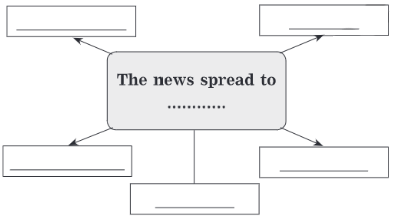
The news spread through the bazaar with the rapidity of forest fire. From the general merchant’s it travelled to the shop, circulated amongst the customers, and then spread with them in various directions, to the betel-seller, the tailor, the free vendor, the jeweller, the beggar sitting on the pavement.
A2. Complex Factual Activity:
Complete the web :
A3. Activities based on Vocabulary:
Match the column with their meanings:
Who said to whom?
(1) "The bird has flown!"
(2) "The Pipalnagar Bank is about to collapse."
‘What’s that?’ said Kamal Kishore, sitting up suddenly. ‘Which bank?’
‘Why the Pipalnagar bank of course. I hear they have stopped paying employees. Don’t tell me you have an account there, Mr. Kishore?’
‘No, but my neighbour has!’ he exclaimed; and he called out over the low partition to the keeper of the barber shop next door. ‘Deep Chand, have you heard the latest? The Pipalnagar Bank is about to collapse. You’d better get your money out as soon as you can!’
Deep Chand who was cutting the hair of an elderly gentleman, was so startled that his hand shook and he nicked his customer’s right ear. The customer yelped with pain and distress: pain, because of the cut and distress because of the awful news he
had just heard. With one side of his neck still unshaven, he sped across the road to the general merchant’s store where there was a telephone. He dialled Seth Govind Ram’s number. The Seth was not at home. Where was he, then? The Seth was holidaying in Kashmir. Oh, was that so? The elderly gentleman did not believe it. He hurried back to the barber’s shop and told Deep Chand: ‘The bird has flown! Seth Govind Ram has left town. Definitely, it means a collapse.’ And then he dashed out of the shop, making a beeline for his office and chequebook.
The news spread through the bazaar with the rapidity of forest fire. From the general merchant’s it travelled to the shop, circulated amongst the customers, and then spread with them in various directions, to the betel-seller, the tailor, the free vendor, the jeweller, the beggar sitting on the pavement.
A2. Complex Factual Activity:
Complete the web :
A3. Activities based on Vocabulary:
Match the column with their meanings:
| Words | Meanings |
| (1) beeline | (a) state of being upset |
| (2) pavement | (b) the direct route |
| (3) nicked | (c) the road for the people to walk |
| (4) distress | (d) cut slightly |
A4. Activities based on Contextual Grammar:
Do as directed:
(1) Mr Kishore said, "Deep Chand, have you heard the latest?" (Change into indirect speech.)
(2) The bird has flown. (Rewrite the sentence using Past Perfect Tense)
A5. Personal Response:
(1) Do you think that rumour spreads faster than fire? Support your answer in two to three lines.