MCQ
$A(6, 3), B(-3, 5), C(4, -2)$ and $D(x, 3x)$ are four points. If $\triangle\text{DBC} : \triangle\text{ABC}= 1 : 2,$ then $x$ is equal to:
  • $\frac{11}{8}$
  • B
    $\frac{8}{11}$
  • C
    $3$
  • D
    None of these

Answer

Correct option: A.
$\frac{11}{8}$
The area of a triangle with vertices $D(x, 3x), B(-3, 5)$ and $C(4, -2)$ is given below:
Area of $\triangle\text{DBC}=\frac{1}{2}\{\text{x}(5+2)-3(-2-3\text{x})+4(3\text{x}-5)\}$
$\Rightarrow$ Area of $\triangle\text{DBC}=(14\text{x}-7)\text{sq units}$
Similarly, the area of a triangle with vertices $A(6, 3), B(-3, 5)$ and $C(4, -2)$ is given below:
$\triangle\text{ABC}=\frac{1}{2}\{6(5+2)-3(-2-3)+4(3-5)\}$
$\triangle\text{ABC}=\frac{49}{2}\text{sq units}$
Given:
$\triangle\text{DBC}:\triangle\text{ABC}=1:2$
$\frac{2(14\text{x}-7)}{49}=\frac{1}{2}$
$\Rightarrow8\text{x}-4=7$
$\Rightarrow\text{x}=\frac{11}{8}$

Need a full question paper?

Generate a complete, print-ready paper with questions like this in minutes — across 16+ boards, with answer keys.
Start Generating Free

Similar questions

If the lines $3x - 4y - 7 = 0$ and $2x - 3y - 5 = 0$ are two diameters of a circle of area $49\pi $ square units , the equation of the cirlce is 
If $A=\left\{(x, y): x^2+y^2=25\right\}$ and $B=\left\{(x, y): x^2+9 y^2=144\right\}$ then $A \cap B$ contains
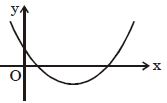
The graph of $y = ax^2 + bx + c$ is shown. Which of the following does $NOT$ hold good?
The probabilities that a student passes in Mathematics, Physics and Chemistry are $m, p$ and $c$ respectively. On these subjects, the student has a $75\%$ chance of passing in at least one, a $50\%$ chance of passing in at least two and a $40\%$ chance of passing in exactly two. Which of the following relations are true
A card is drawn at random from a pack of cards. What is the probability that the drawn card is neither a heart nor a king
Choose the correct answer. If $M$ and $N$ are any two events, the probability that at least one of them occurs is:
Let $3,7,11,15, \ldots, 403$ and $2,5,8,11, \ldots, 404$ be two arithmetic progressions. Then the sum, of the common terms in them, is equal to.....................
Choose the correct answer. The total number of terms in the expansion of $(x + a)^{100} + (x - a)^{100}$ after simplification is:
The equation of a circle that intersects the circle ${x^2} + {y^2} + 14x + 6y + 2 = 0$orthogonally and whose centre is $(0, 2)$ is
Let $\mathrm{n}$ denote the number of solutions of the equation $z^{2}+3 \bar{z}=0$, where $\mathrm{z}$ is a complex number. Then the value of $\sum_{k=0}^{\infty} \frac{1}{n^{k}}$ is equal to: