Question

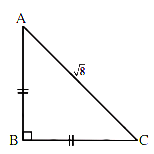
$AB = BC ...........\square$
$\therefore \angle BAC = \square$
$\therefore AB = BC =\square \times A C$
$=\square \times \sqrt{8}$
$=\square \times 2 \sqrt{2}$
$=\square$

Answer

$AB = BC .....[$पक्ष$]$
$\therefore \angle BAC = \angle BCA ....[$समद्विभुज त्रिकोणाचे प्रमेय$]$
समजा $, \angle BAC = \angle BCA = x .....(i)$
$\triangle ABC$ मध्ये,
$\angle A + \angle B + \angle C = 180^\circ ........[$त्रिकोणाच्या तिन्ही कोनांच्या मापांची बेरीज $180^\circ$ असते.$]$
$\therefore x + 90^\circ + x = 180^\circ .....[(i)$ वरून$]$
$\therefore 2x = 90^\circ$
$\therefore x=\frac{90^{\circ}}{2}.....[(i) $ वरून$]$
$\therefore x = 45^\circ$
$\therefore \angle BAC = \angle BCA = 45^\circ$
$\therefore \triangle ABC$ हा $45^\circ - 45^\circ - 90^\circ$ त्रिकोण आहे.
$\therefore A B=B C=\frac{1}{\sqrt{2}} \times A C...[45^\circ$ कोनासमोरील बाजू$]$
$=\frac{1}{\sqrt{2}} \times \sqrt{8}$
$=\frac{1}{\sqrt{2}} \times 2 \sqrt{2}$
$\therefore AB = BC = 2$ एकक

Need a full question paper?

Generate a complete, print-ready paper with questions like this in minutes — across 16+ boards, with answer keys.
Start Generating Free

Similar questions

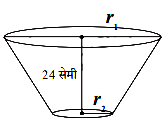
आकृती मध्ये एका शंकूछेदाच्या वर्तुळाकार पायांचे परीघ अनुक्रमे $132$ सेमी व $88$ सेमी आहेत व उंची $24$ सेमी आहे. तर त्या शंकूछेदाचे वक्रपृष्ठफळ काढण्यासाठी खालील कृती पूर्ण करा. $\left(\pi=\frac{22}{7}\right)$
परीघ$_1 = 2\pi r_1 = 132$
$r_1=\frac{132}{2 \pi}=\square$ सेमी
परीघ$_2 = 2\pi r_2 = 88$
$r_2=\frac{88}{2 \pi}=\square$ सेमी
शंकूछेदाची तिरकस उंची $= l$
$I=\sqrt{h^2+\left(r_1-r_2\right)^2}$
$I=\sqrt{\square^2+\square^2}$
$I = \square$ सेमी
शंकूछेदाचे वक्रपृष्ठफळ $=\pi\left(r_1+r_2\right) l$
$=\pi \times \square \times \square$
$= {\square}$ चौसेमी
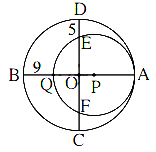
$O$ आणि $P$ केंद्र असलेली वर्तुळे बिंदू $A$ मध्ये आतून स्पर्श करतात. जर, $BQ = 9, DE = 5$, तर वर्तुळाच्या त्रिज्या शोधण्यासाठी खालील कृती करा.

उकल: मोठ्या वर्तुळाची त्रिज्या $R$ मानू.
लहान वर्तुळाची त्रिज्या $r$ मानू.
$OA, OB, OC$ आणि $OD$ या मोठ्या वर्तुळाच्या त्रिज्या
$\therefore OA = OB = OC = OD = R$
$PQ = PA = r$
$OQ = OB - BQ ={\square}$
$OE = OD - DE = {\square}$
$P$ केंद्र असलेल्या वर्तुळात दोन जीवांच्या आंतरविभाजनाच्या गुणधर्मानुसार
$OQ \times OA = OE \times OF$
${\square} xR = {\square} x{\square}(\because OE = OF)$
$R2 - 9R = R2 - 10R + 25$
$R = {\square}$
$AQ = 2r = AB - BQ$
$2r = 50 - 9 = 41$
$r ={\square}= {\square}$
खालील कृती पूर्ण करून एकसामयिक समीकरणे सोडवा.
5x + 3y = 9 ......(I)
2x - 3y = 12 ......(II)
समी. (I) व समी. (II) यांची बेरीज करू.
5x + 3y = 9
+ 2x - 3y = 12
${\square}$x =${\square}$
x = $\frac{\square}{\square}$ x = ${\square}$
x = 3 समी. (I) मध्ये ठेवू.
5 ×${\square}$+ 3y = 9
3y = 9-${\square}$
3y =${\square}$
$y=\frac{\square}{3}$
y =${\square}$
(x, y) =(${\square}$,${\square}$)ही समीकरणाची उकल आहे.
$5$ ने भाग जाणाऱ्या दोन अंकी संख्या किती आहेत?
कृती: $–5$ ने भाग जाणाऱ्या दोन अंकी संख्या $10, 15, 20 ......... 95.,$ ह्या आहेत.
$d = 5$ असल्याने दिलेली क्रमिका अंकगणिती श्रेढी आहे.
येथे, $, a = 10, d = 5, t_n = 95, n =$ ?
$t_n = a + (n - 1) {\square}$
$\square=10+(n-1) \times 5$
$\square=( n -1) \times 5$
$\square=( n -1)$
म्हणून,$ n = {\square}$
$5$ ने भाग जाणाऱ्या दोन अंकी संख्या ${\square}$ आहेत.
समलंब मध्ये $\square ABCD$ मध्ये $AB \| CD$ असून त्याचे क्षेत्रफळ $33$ चौसेमी आहे, तर आकृतीतील दिलेल्या माहितीवरून चौकोनाच्या चारही बाजूंची लांबी खालील कृती पूर्ण करून काढा.
उकल:
$▢ABCD$ समलंब चौकोन आहे. $AB \| CD$
$A (\square ABCD )=\frac{1}{2} \times( AB + CD ) \times$${\square}$
$\therefore 33=\frac{1}{2}(x+2 x+1) \times \square$
$\therefore \square=(3 x+1) \times \square$
$\therefore 3 x^2+\square-\square=0$
$\therefore 3 x(\square)+10(\square)=0$
$\therefore(3 x+10)(\square)=0$
$\therefore(3 x+10)=0$ किवा $\square=0$
$\therefore x =-\frac{10}{9}$ किंवा $x =\square$
परंतु, लांबी ऋण नसते.
$\therefore x \neq \frac{-10}{3} \therefore x =$${\square}$
$AB = \_\_\_\_\_\_\, CD = \_\_\_\_\_\_\, AD = BC = \_\_\_\_\_\_\_\ $
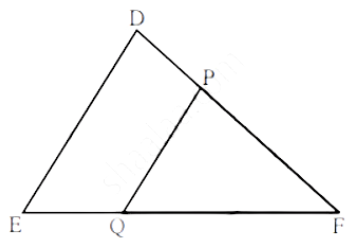
आकृती मध्ये रेख $PQ ||$ रेख $DE, A (\triangle PQF) = 20$ एकक, जर $PF = 2 DP$ आहे, तर $A(▢DPQE)$  काढण्यासाठी खालील कृती पूर्ण करा.
$A(\triangle PQF) = 20$ एकक, $PF = 2 DP, DP = x$ मानू. $\therefore PF = 2x$
$DF = DP +\square=\square+\square=3 x$
$\triangle FDE$ व $\triangle FPQ$ मध्ये
$\angle FDE \cong \angle \square ($संगत कोन$)$
$\angle FED \cong \angle \square ($संगत कोन$)$
$\therefore \triangle FDE \sim \triangle FPQ .............($कोको कसोटी$)$
$\therefore \frac{A(\Delta \text { FDE })}{ A (\Delta FPQ )}=\frac{\square}{\square}=\frac{(3 x )^2}{(2 x )^2}=\frac{9}{4}$
$A (\triangle FDE )=\frac{9}{4} \times A (\Delta FPQ )=\frac{9}{4} \times \square={\square}$
$A(▢DPQE) = A(\triangle FDE) - A(\triangle FPQ)$
$=\square-\square$
$=\square$
Image
3x - 2y = 18 या समीकरणाचा आलेख काढण्यासाठी खालील तक्ता पूर्ण करा.
X 0 4 2 -1
Y -9 -3 ______ ______
x, y (0, -9) (______, ______) (______, ______) (______, ______)
2x - 6y = 3 या समीकरणाचा आलेख काढण्यासाठी खालील सारणी पूर्ण करा.
x-5${\square}$
y${\square}$0
(x,y)${\square}$${\square}$
$301$ ही संख्या $5, 11, 17, 23,........$.या क्रमिकेचे पद असेल का ते तपासा.
कृती: येथे $5, 11, 17, 23, .........$या क्रमिकेत $d = {\square}$ आहे. म्हणून, दिलेली क्रमिका ही अंकगणिती श्रेढी आहे.
$a = 5$ आणि $d = {\square}$ असून समजा $301$ ही संख्या या अंकगणिती श्रेढीचे $n$ वे पद आहे.
$t_n = a + (n – 1) {\square}$
$301 = 5 + (n – 1) \times 6$
$301 = 6n – 1$
$n =\frac{302}{6}=\frac{\square}{\square}$
परंतु, $n$ हा धन पूर्णांक येत नाही. त्यामुळे, $301$ ही संख्या$ 5, 11, 17, 23,.........$या क्रमिकेचे पद ${\square}$ .
खालील शाब्दिक उदाहरण सोडवण्यासाठी कृती पूर्ण करा
दोन क्रमागत सम नैसर्गिक संख्यांच्या वर्गांची बेरीज $244$ आहे, तर त्या संख्या शोधा.
कृती: पहिली सम नैसर्गिक संख्या $x$ मानू.
दुसरी क्रमागत सम नैसर्गिक संख्या $= (...........)$
दिलेल्या अटीनुसार
$x^2 + (x + 2)^2 = 244$
$x^2 + x^2 + 4x + 4 – (.......) = 0$
$2x^2 + 4x – 240 = 0$
$x^2 + 2x – 120 = 0$
$x^2 + (.......) – (......) – 120 = 0$
$x (x + 12) – (......) (x + 12) = 0$
$(x + 12) (x – 10) = 0$
$x = (......) x = 10$
परंतु, नैसर्गिक संख्या ऋण नसते, म्हणून $x = -12$ शक्य नाही.
म्हणून, पहिली नैसर्गिक संख्या $x = 10$ असेल.
म्हणून, दुसरी नैसर्गिक संख्या $= x + 2 = 10 + 2 = 12$ असेल.