Question
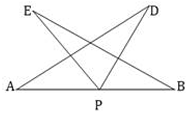
$AB$ is a line segment and $P$ is the mid$-$point. $D$ and $E$ are points on the same side of $AB$ such that $\angle BAD =\angle ABE $ and $\angle EPA =\angle DPB$. Show that:
$i. \Delta DAP \cong \Delta EBP$
$ii. AD = BE ($See figure$)$​​​​​​​
Image

Answer

Given that $\angle E P A=\angle D P B$
Adding $\angle EPD$ on both sides, we get
$\angle EPA+\angle EPD=\angle DPB+\angle EPD$
$\Rightarrow \angle A P D=\angle B P E......\text { (i) }$
Also given, $\angle B A D=\angle A B E$
$\Rightarrow \angle P A D=\angle P B E......\text{ (ii) }$
Now in $\Delta APD$ and $\Delta BPE$,
$\angle P A D=\angle P B E. [$from $(ii)]$
$AP = PB [ P$ is the mid$-$point of $AB ]$
$\angle A P D=\angle B P E [$From $(i)]$
Hence, by $\text{ASA}$ congruency criteria;
$\Delta D A P \cong \Delta E B P$
$\Rightarrow \text{AD=BE}[$ By $\text{C.P.C.T.}]$ Proved

Need a full question paper?

Generate a complete, print-ready paper with questions like this in minutes — across 16+ boards, with answer keys.

Start Generating Free

Similar questions

$AD$ is a median of the $\triangle\text{ABC}.$ Is it true that $AB + BC + CA > 2AD?$ Give reason for your answer.
The radius of the internal and external surfaces of a hollow spherical shell are $3\ cm$ and $5\ cm$ respectively. If it is melted and recast into a solid cylinder of height $2\frac{2}{3}$cm. Find the diameter of the cylinder.
It being given that $\sqrt{2}=1.414,\sqrt{3}=1.732,\sqrt{5}=2.236$ and $\sqrt{10}=3.162,$ find the value of three places of decimals, of the following:
$\frac{2}{\sqrt{5}}$
Look at several examples of rational numbers in the form $\frac{p}{q}(q \neq 0)$, where $p$ and $q$ are integers with no common factors other than $1$ and having terminating decimal representations (expansions). Can you guess what property $q$ must satisfy?
Construct a $\triangle ABC$ in which $BC = 5\ cm$, $\angle\text{B}=60^\circ$ and $AC + AB = 7.5\ cm.$
The lateral surface area of a cylinder is $94.2\ cm^2$ and its height is $5\ cm \big($Take$\ \pi=3.14\big)$. Find:
$i.$ The radius of its base.
$ii.$ Its volume.
You know that $\frac{1}{7}=0 . \overline{142857}$. Can you predict what the decimal expansions of $\frac{2}{7}, \frac{3}{7}, \frac{4}{7}, \frac{5}{7}, \frac{6}{7}$ are, without actually doing the long division? If so, how?
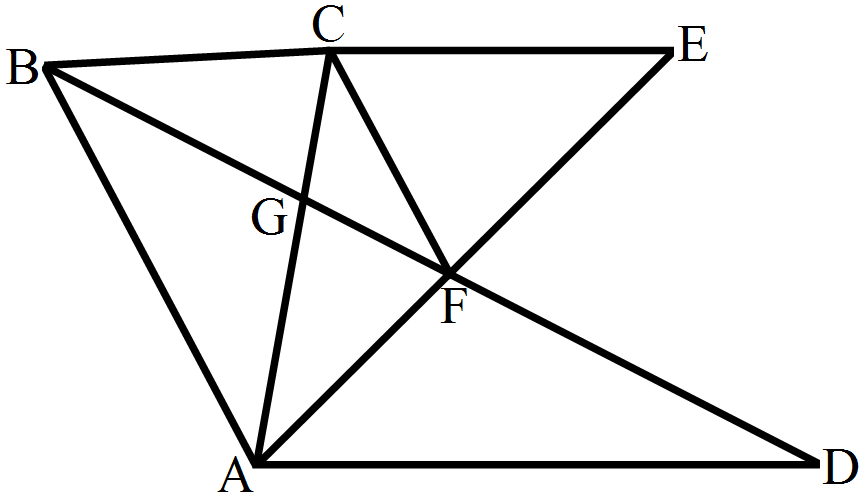
In the adjoining figure, $CE || AD$ and $CF || BA.$ Prove that $\text{ar}(\triangle\text{CBG})=\text{ar}(\triangle\text{AFG}).$
Factorize the following expressions: $(x + 2)^3 + (x - 2)^3$
Write two solutions of the form $x = 0, y = a$ and $x = b, y = 0$ for the following equations: $2x + 3y = 24$