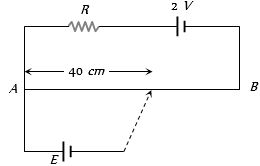
$AB$ is a potentiometer wire of length $100\, cm$ and its resistance is $10 \,\Omega$. It is connected in series with a resistance $R = 40 \,\Omega$ and a battery of $e.m.f.$ $2 \,V$ and negligible internal resistance. If a source of unknown $e.m.f.$ $E$ is balanced by $40\, cm$ length of the potentiometer wire, the value of $E$ is ................. $V$
Medium
Download our app for free and get started
(d) $E = \frac{e}{{(R + {R_h} + r)}}\,\frac{R}{L} \times l$$ = \frac{2}{{(10 + 40 + 0)}} \times \frac{{10}}{1} \times 0.4 = 0.16\,V$.

Download our appand get started for free
Experience the future of education. Simply download our apps or reach out to us for more information. Let's shape the future of learning together!No signup needed.*
Similar Questions
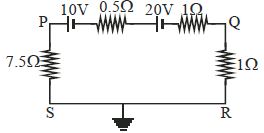
- 1The current in the given circuit is ................ $A$View Solution
- 2A certain wire has a resistance $R$. The resistance of another wire identical with the first except having twice its diameter isView Solution
- 3A steady current $I$ flows through a wire of radius $r$, length $L$ and resistivity $\rho$. The current produces heat in the wire. The rate of heat loss in a wire is proportional to its surface area. The steady temperature of the wire is independent ofView Solution
- 4A $6\,\,V$ battery is connected to the terminals of a $3\, m$ long uniform wire having resistance $100\,\Omega $. The difference in potential between two points on the wire separated by a distance of $50\, cm$ will be ............. $V$View Solution
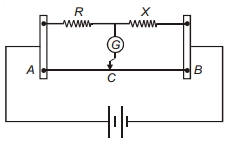
- 5In the meter bridge shown, the resistance $X$ has a negative temperature coefficient of resistance. Neglecting the variation in other resistors, when current is passed for some time, in the cirucit, balance point should shift towards.View Solution
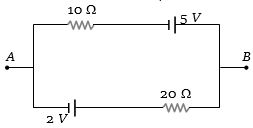
- 6Calculate the potential difference between, points $A$ and $B$ and current flowing in $10\,\Omega $ resistor in the part of network belowView Solution
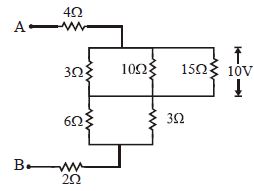
- 7One end of a Nichrome wire of length $2\,L$ and cross-sectional area $A$ is attatched to an end of another Nichrome wire of length $L$ and cross-sectional area $2\,A$. If the free end of the longer wire is at an electric potential of $8.0$ $\mathrm{volts}$, and the free end of the shorter wire is at an electric potential of $1.0$ $\mathrm{volt}$, the potential at the junction of the two wires is equal to ............. $V$View Solution
- 8Six equal resistances are connected between points $P, Q$ and $R$ as shown in figure. Then net resistance will be maximum betweenView Solution
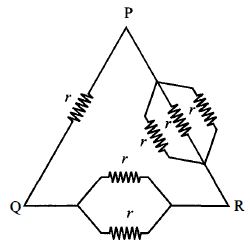
- 9In the circuit shown below, a student performing Ohm's law experiment accidently puts the voltmeter and the ammeter as shown in the circuit below. The reading in the voltmeter will be close to .......... $V$View Solution
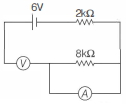
- 10View SolutionIn the circuit shown in figure, which of the statement is incorrect ?