Question
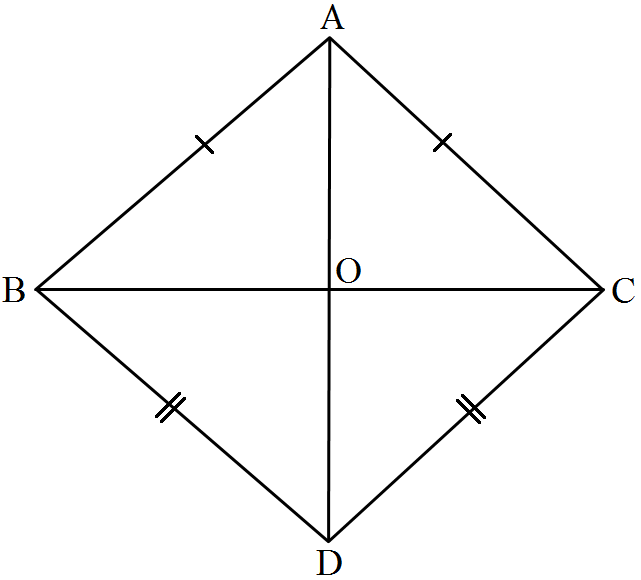
$ABC$ and $DBC$ are two triangles on the same base $BC$ such that $A and D$ lie on the opposite sides of $BC, AB = AC$ and $DB = DC.$ Show that $AD$ is the perpendicular bisector of $BC.$
Answer

Given two $\triangle\text{ABC}$ and $\angle\text{DBC}$ are formed on the same base $BC$ Such that $A$ and $D$ lie on the opposite side of $AB = AC$ and $DB = DC.$
In $\triangle\text{ABD}$ and $\triangle\text{ACD},$
$\text{AB}=\text{AC}$
$\angle\text{ABD}=\angle\text{ACD}$
$\angle\text{BAD}=\angle\text{CAD}$

In $\triangle\text{ABO},$
$\text{AB}=\text{AC}$
$\angle\text{AOB}+\angle\text{AOB}=180^{\circ}$
$2\angle\text{AOB}=180^{\circ}$
$\angle\text{AOB}=\frac{180^{\circ}}{2}=180^{\circ}$
Hence, $AD$ is the perpendicular of $BC.$

Need a full question paper?

Generate a complete, print-ready paper with questions like this in minutes — across 16+ boards, with answer keys.
Start Generating Free

Similar questions

Prove that the angle in a segment greater than a semi-circle is less than a right angle.
Show that the quadrilateral formed by joining the mid-points of the consecutive sides of a square is also a square.
P, Q, R and S are respectively the mid-points of the sides AB, BC, CD and DA of a quadrilateral ABCD in which AC = BD. Prove that PQRS is a rhombus.
A cuboidal vessel is 10m long and 8m wide. How high must it be made to hold 380 cubic metres of a liquid?
In a cyclic quadrilateral ABCD if AB || CD and $\angle\text{B}=70^\circ,$ find the remaining angles.
Three vertices of a rectangle $ABCD$ are $A(3, 1), B(-3, 1)$ and $C(-3, 3)$. plot these points on a graph paper and find the coordinates of the fourth vertex $D$. Also find the area of rectangle $ABCD$.
Duration of sunshine(in hours) in Amritsar for first $10$ days of August $1997$ as reported by the Meterological Department are given as follows: $9.6, 5.2, 3.5, 1.5, 1.6, 2.4, 2.6, 8.4, 10.3, 10.9$
$i.$ Find the mean $\overline{\text{X}}$
$ii.$ Verify that $\sum\limits_{\text{i}=1}^{10}\Big(\text{X}-\overline{\text{X}}\Big)=0$
If a line segment joining mid-points of two chords of a circle passes through the centre of the circle, prove that the two chords are parallel.