Question
ABCD is a parallelogram whose diagonals intersect at O .If P is any point on BO, prove that:
  1. $\text{ar}(\triangle\text{ADO})=\text{ar}(\triangle\text{CDO})$
  2. $\text{ar}(\triangle\text{ABP})=\text{ar}(\triangle\text{CBP})$
Answer

Given that ABCD is the parallelogram

To Prove:

  1. $\text{ar}(\triangle\text{ADO})=\text{ar}(\triangle\text{CDO}).$

  2. $\text{ar}(\triangle\text{ABP})=\text{ar}(\triangle\text{CBP}).$

Proof:

we know that diagonals of parallelogram bisect each other

$\therefore$ AO = OC and BO = OD

  1. In $\triangle\text{DAC},$ since DO is a median.

Then $\text{ar}(\triangle\text{ADO})=\text{ar}(\triangle\text{CDO}).$

  1. In $\triangle\text{BAC},$ since BO is a median.

Then $\text{ar}(\triangle\text{BAO})=\text{ar}(\triangle\text{BCO})\ ....(1)$

In $\triangle\text{PAC},$ since PO is a median.

Then $\text{ar}(\triangle\text{PAO})=\text{ar}(\triangle\text{PCO})\ .....(2)$

Subtract equation 2 from 1.

$\Rightarrow\text{ar}(\triangle\text{BAO})−\text{ar}(\triangle\text{PAO})\\ \ =\text{ar}(\triangle\text{BCO})−\text{ar}(\triangle\text{PCO})$

$\Rightarrow\text{ar}(\triangle\text{ABP})=2\text{ar}(\triangle\text{CBP}).$

Need a full question paper?

Generate a complete, print-ready paper with questions like this in minutes — across 16+ boards, with answer keys.

Start Generating Free

Similar questions

Show that the quadrilateral formed by joining the midpoints of the pairs of adjacent sides of a rhombus is a rectangle.
For what value of x is the mode of the data 24, 15, 40, 23, 27, 26, 22, 25, 20, x + 3 found 25? Using this value of x, find the median.
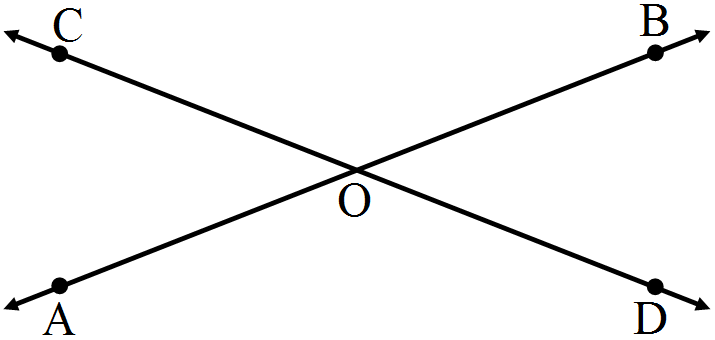
Two lines AB and CD intersect at a point O, such that $\angle\text{BOC}+\angle\text{AOD}=280^\circ,$ as shown in the figure. Find all the four angles.

The follwoing table shows the average daily earnings of 40 general stores in a market, during a certain week.
Daily wages (in Rs.)
700-750
750-800
800-850
850-900
900-950
950-1000
Number of stores
6
9
2
7
11
5
Draw a histogram to represent the above data.
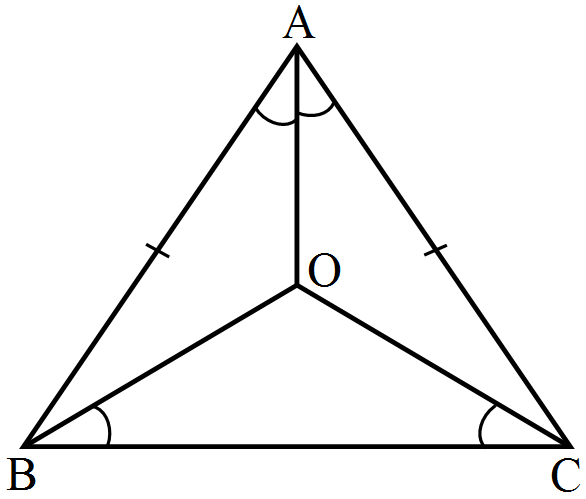
In $\triangle\text{ABC,}$ AB = AC and the bisectors of $\angle\text{B}$ and $\angle\text{C}$ meet at a point O. Prove that BO = CO and the ray AO is the bisector of $\angle\text{A}.$

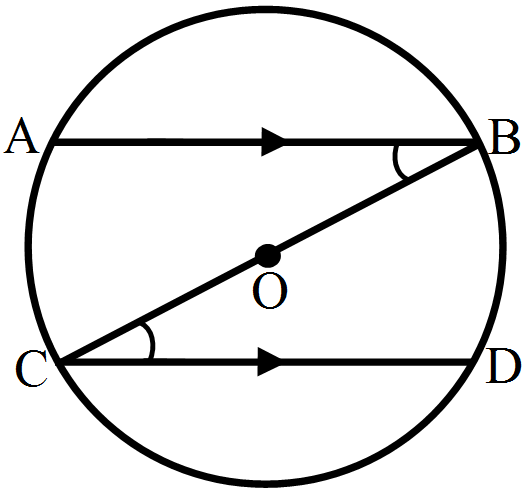
In the adjoining figure, BC is a diameter of a circle with centre O. If AB and CD are two chords such that AB || CD, prove that AB = CD.

The difference between the semiperimeter and the sides of a $\triangle\text{ABC}$ are 8cm, 7cm and 5cm respectively. Find the area of the triangle.
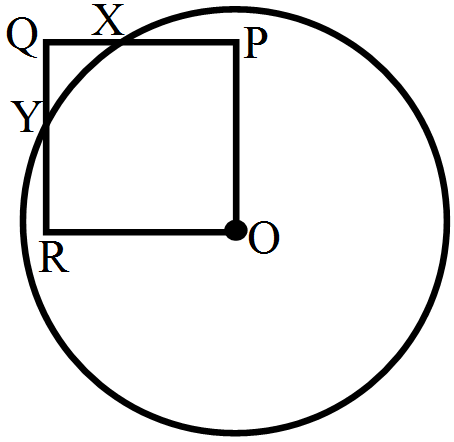
In the adjoining figure, OPQR is a square. A circle drawn with centre O cuts the square at X and Y. Prove that QX = QY.

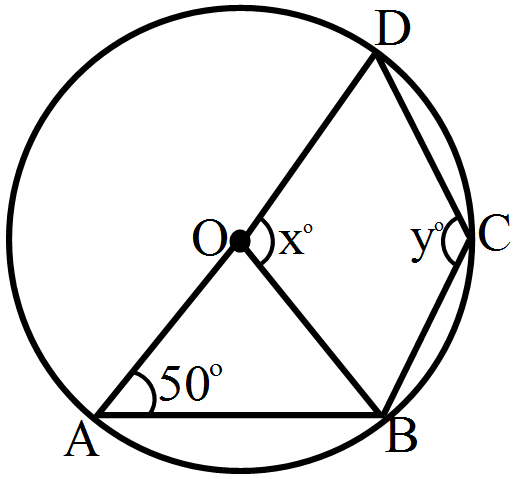
In the given figure, O is the centre of the circle and $\angle\text{DAB}=50^\circ.$Calculate the values of x and y.

The difference between inside and outside surfaces of a cylindrical tube 14cm long, is 88cm2. If the volume of the tube is 176cm3, find the inner and outer radii of the tube.