Question
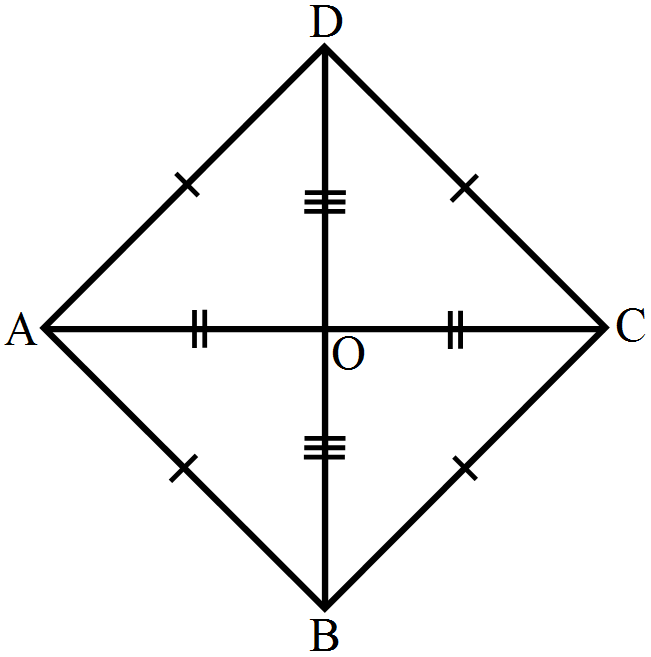
ABCD is a rhombus and its diagonals intersect at O.
  1. Is $\triangle\text{BOC}\cong\triangle\text{DOC}$? State the congruence condition used?
  2. Also state, if $\angle\text{BCO}=\angle\text{DCO}$
Answer


  1. Yes
In $\triangle\text{BCO}$ and $\triangle\text{DCO}$

$\text{OC}=\text{OC}$ (common)

$\text{BC}=\text{DC}$ (all sides of a rhombus are equal)

$\text{BO}=\text{OD}$ (diagonals of a rhomus bisect each other)

By SSS congruence:

$\triangle\text{BOC}\cong\triangle\text{DOC}$
  1. Yes
By c.p.c.t:

$\angle\text{BCO}=\angle\text{DCO}$

Need a full question paper?

Generate a complete, print-ready paper with questions like this in minutes — across 16+ boards, with answer keys.

Start Generating Free

Similar questions

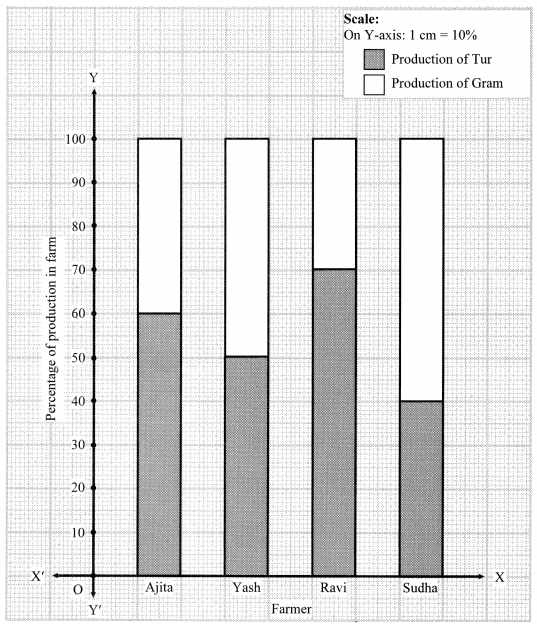
Observe the following graph and answer the questions.
Image
  1. State the type of the bar graph.
  2. How much percent is the Tur production to total production in Ajita’s farm?
  3. Compare the production of Gram in the farms of Yash and Ravi and state whose percentage of production is more and by how much?
  4. Whose percentage production of Tur is the least?
  5. State production percentages of Tur and Gram in Sudha’s farm.
Solve the following equation and verify your answer:
$\frac{7\text{x}-2}{5\text{x}-1}=\frac{7\text{x}+3}{5\text{x}+4}$
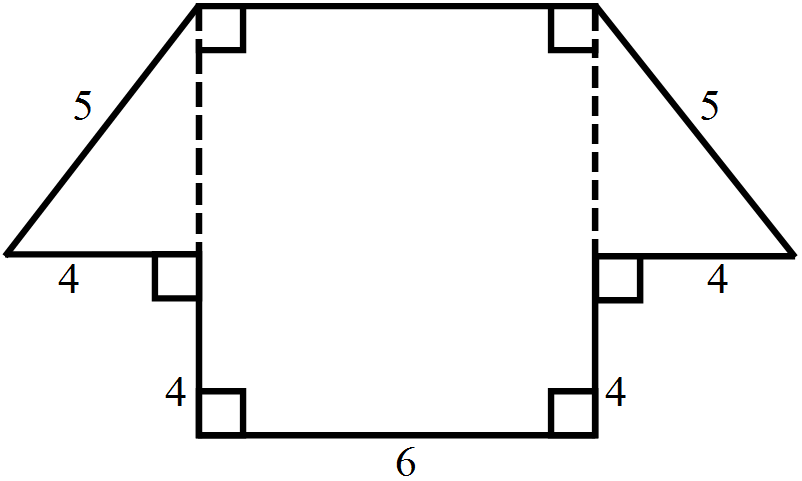
Find the area enclosed by the following figures as the sum of the areas of a rectangle and a trapezium:

Find the smallest number that must be subtracted from those of the numbers which are not perfect cubes, to make them perfect cubes. What are the corresponding cube roots?
  1. 130
  2. 345
  3. 792
  4. 1331
Solve the following equation and verify your answer:
$\frac{(2\text{x}+3)-(5\text{x}-7)}{6\text{x}+11}=\frac{-8}{3}$
Draw a line l. Take a point T outside the line. Through point T draw a line parallel to line l.
Construct a quadrilateral ABCD in which BC = 7.5cm, AC = AD = 6cm, CD = 5cm and BD = 10cm.
In the figure, the bisectors of $\angle\text{A}$ and $\angle\text{B}$ meet at a point P. If $\angle\text{C}=100^\circ$ and $\angle\text{D}=50^\circ$, find the measure of $\angle\text{APB}$.
Construct a parallelogram ABCD, in which diagonal AC = 3.8cm, diagonal BD = 4.6cm and the angle between AC and BD is 60°.
Show that each diagonal of a rhombus bisects the angle through which it passes.