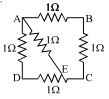
$ABCD$ is a square where each side is a uniform wire of resistance $1\,\Omega$ . $A$ point $E$ lies on $CD$ such that if a uniform wire of resistance $1\,\Omega$ is connected across $AE$ and constant potential difference is applied across $A$ and $C$ then $B$ and $E$ are equipotential.
Advanced
Download our app for free and get started
Let resistance $D E=x \Omega$ and that between $C E=(1-x) \Omega .$ The points $\mathrm{B}$ and $\mathrm{E}$ will be equipotential, when effective resistance acros $\mathrm{AE}=$ effective, resistance across $CE$
i.e., $\frac{(1+x) \times 1}{(1+x)+1}=(1-x)$ or $(1+x)=(1-x) \times(2+x)$
or $1+x=2+x-2 x 2 x-x^{2}$ or $x^{2}+2 x-1=0$
On solving it, we get, $x=\sqrt{2}-1$
Now, $1-x=2-(\sqrt{2}-1)=2-\sqrt{2}=(\sqrt{2}-1)$
$\therefore \frac{C E}{E D}=\frac{1-x}{x}=\frac{\sqrt{2}(\sqrt{2}-1)}{(\sqrt{2}-1)}=\sqrt{2}$

Download our appand get started for free
Experience the future of education. Simply download our apps or reach out to us for more information. Let's shape the future of learning together!No signup needed.*
Similar Questions
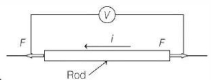
- 1As shown in the schematic below, a rod of uniform cross-sectional area $A$ and length $l$ is carrying a constant current $i$ through it and voltage across the rod is measured using an ideal voltmeter. The rod is stretched by the application of a force $F$. Which of the following graphs would show the variation in the voltage across the rod as function of the strain $\varepsilon$ when the strain is small. Neglect Joule heating.View Solution
- 2View SolutionThe maximum current that flows through a fuse wire before it blows out varies with its radius as
- 3$A$ wire of cross-section area $A$, length $L_1$, resistivity $\rho_1$ and temperature coefficient of resistivity $\alpha_1$ is connected to a second wire of length $L_2$, resistivity $\rho_2$ , temperature coefficient of resistivity $\alpha_1$ and the same area $A$, so that wire carries same current. Total resistance $R$ is independent of temperature for small temperature change if (Thermal expansion effect is negligible)View Solution
- 4A torch battery consisting of two cells of $1.45\, volts$ and an internal resistance $0.15\,\Omega $, each cell sending currents through the filament of the lamps having resistance $1.5\,ohms$. The value of current will be ....... $A$View Solution
- 5A wire of length $L$ and $3$ identical cells of negligible internal resistances are connected in series. Due to current, the temperature of the wire is raised by $\Delta T$ in a time $t$. A number $N$ of similar cells is now connected in series with a wire of the same material and cross-section but of length $2\, L$. The temperature of the wire is raised by the same amount $\Delta T$ in the same time $t$. the value of $N$ isView Solution
- 6In a neon discharge tube $2.9 \times {10^{18}}\,N{e^ + }$ ions move to the right each second while $1.2 \times {10^{18}}$ electrons move to the left per second. Electron charge is $1.6 \times {10^{ - 19}}\,C$. The current in the discharge tubeView Solution
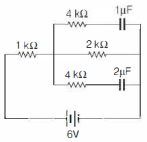
- 7What are the charges stored in the $1 \,\mu F$ and $2 \,\mu F$ capacitors in the circuit below, once the currents become steady?View Solution
- 8A cell, shunted by a $8 \; \Omega$ resistance, is balanced across a potentiometer wire of length $3 \; m$. The balancing length is $2 \; m$ when the cell is shunted by $4 \; \Omega$ resistance. The value of internal resistance of the cell will be $\dots \; \Omega .$View Solution
- 9Three resistors are connected to form the sides of a triangle $ABC$, the resistance of the sides $AB$, $BC$ and $CA$ are $40\,ohms$, $60\,ohms$ and $100\,ohms$ respectively. The effective resistance between the points $A$ and $B$ in $ohms$ will beView Solution
- 10View SolutionA steady current flows in a metallic conductor of non-uniform cross-section. The quantity/quantities constant along the length of the conductor is/are