Question
$ABCD$ is quadrilateral such that $AB = AD$ and $CB = CD.$ Prove that $AC$ is the perpendicular bisector of $BD.$
Answer

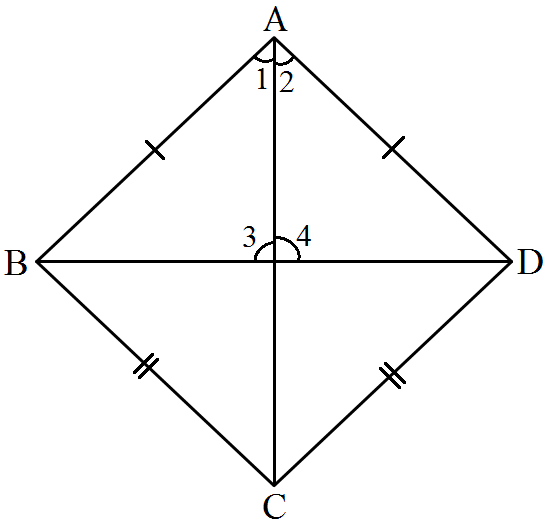
Given In quadrilateral $ABCD, AB = AD$ and $CB = CD$. constrion: To prove $AC$ is the petpendicular bisector of $BD.$ uction Join $AC$ and $BD.$

Proof In $\triangle\text{ABC}\text{ and }\triangle\text{ADC},$
$\text{AB}=\text{AD}$ [given] $\text{BC}=\text{CD}$ [given] $\text{and}\ \text{AC}=\text{AC}$ [common side]
$\therefore \triangle\text{ABC}\cong\triangle\text{ADC}[$ by $SSS$ congruence rule$]$
$\Rightarrow\ \angle1=\angle2[$ by $CPCT]$
now, in $\triangle\text{AOB}\text{ and }\triangle\text{AOD},\ \text{AB}=\text{AD}$ [given]
$\Rightarrow\ \angle1=\angle2[ $proved above$]$
$\text{and}\ \text{AO}=\text{AO} [$common side$]$
$\therefore\ \triangle\text{AOB}\cong\triangle\text{AOD}[$ by $SAS$ congruence rule$]$
$\Rightarrow\ \text{BO}=\text{DO} [$by $CPCT]$
$\text{and}\ \angle3=\angle4 [$by $CPCT]...(i) $
But $\angle3+\angle4=180^\circ$[linear pair axiom]
$\angle3+\angle3=180^\circ [$from Eq. $(i)]$
$\Rightarrow\ 2\angle3=180^\circ$
$\Rightarrow\ \angle3=\frac{180^\circ}{2}$
$\therefore\ \angle3=90^\circ$ i.e., $AC$ is perpendicular bisector of $BD.$

Need a full question paper?

Generate a complete, print-ready paper with questions like this in minutes — across 16+ boards, with answer keys.

Start Generating Free

Similar questions

The weights (in kg) of $15$ students are: $31, 35, 27, 29, 32, 43, 37, 41, 34, 28, 36, 44, 45, 42, 30$. Find the median. If the weight $44\ kg$ is replaced by $46\ kg$ and $27\ kg$ by $25\ kg$, find the new median.
In a rhombus $ABCD$ show that diagonal $AC$ bisects $\angle\text{A}$ as well as $\angle\text{C}$ and diagonal $BD$ bisects $\angle\text{B}$ as well as $\angle\text{D}.$
Write the class size and class limits in the following: $47, 52, 57, 62, 67, 72, 78, 82, 87, 92, 97, 102$.
The time taken, in seconds, to solve a problem by each of $25$ pupils is as follows:
$16, 20, 26, 27, 28, 30, 33, 37, 38, 40, 42, 43, 46, 46, 46, 48, 49, 50, 53, 58, 59, 60, 64, 52, 20$.
$a.$ Construct a frequency distribution for these data, using a class interval of $10$ seconds.
$b.$ Draw a histogram to represent the frequency distribution.
A patient in a hospital is given soup daily in a cylindrical bowl of diameter 7cm. If the bowl is filled with soup to a height of 4cm, how much soup the hospital has to prepare daily to serve 250 patients?
$\Big[$Hint: Assume $\pi=\frac{22}{7},$ unless stated otherwise$\Big]$
Draw the graph of the equations given below. Also, find the coordinates of the points where the graph cuts the coordinate axes: $3x + 2y + 6 = 0$
Represent $\sqrt{10.5}$ on the number line.
If the triangle ABC in the Question 7 above is revolved about the side 5cm, then find the volume of the solid so obtained. Find also the ratio of the volumes of the two solids obtained in Questions 7 and 8.

$\Big[$Hint: Assume $\pi=\frac{22}{7},$ unless stated otherwise$\Big]$

Prepare a continuous grouped frequency distribution from the following data:
Mid-point
Frequency
$5$
$15$
$25$
$35$
$45$
$4$
$8$
$13$
$12$
$6$
Also find the size of class intervals.