MCQ
Absolute temperature can be calculated by
  • Mean square velocity
  • B
    Motion of the molecule
  • C
    Both $(a)$ and $(b)$
  • D
    None of the above

Answer

Correct option: A.
Mean square velocity
a
(a) $\overline {{v^2}} \propto T$

Need a full question paper?

Generate a complete, print-ready paper with questions like this in minutes — across 16+ boards, with answer keys.
Start Generating Free

Similar questions

The time dependence of the position of a particle of mass $m = 2$ is given by $\vec r\,(t)\, = \,2t\,\hat i\, - 3{t^2}\hat j$ Its angular momentum with respect to the origin at time $t = 2$ is
The mass of the earth is $81$ times that of the moon and the radius of the earth is $3.5$ times that of the moon. The ratio of the acceleration due to gravity at the surface of the moon to that at the surface of the earth is
A body of mass $1\,kg$ is rotating in a vertical circle of radius $1\,m$. What will be the difference in its kinetic energy at the top and bottom of the circle : ............ $\mathrm{J}$ $(g = 10\,m/s^2)$
A point source of light is placed at a distance, of 2f from a converging lens of focal length f. The intensity on the other side of the lens is maximum at a distance:
  1. f
  2. between f and 2
  3. 2f
  4. more than 2f.
A tuning fork makes $256$ vibrations per second in air. When the velocity of sound is $330\, m/s$, then wavelength of the tone emitted is  ... $m$
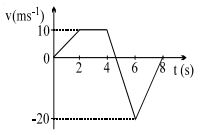
The figure shows a velocity-time graph of a particle moving along a straight line  The maximum displacement of the particle is  ........ $m$
A rigid bar of mass M is supported symmetrically by three wires each of length l . Those at each end are of copper and the middle one is of iron. The ratio of their diameters, if each is to have the same tension, is equal to

  1. $\text{Y}_\text{copper}/\text{Y}_\text{iron}.$

  2. $\sqrt{\frac{\text{Y}_\text{iron}}{\text{Y}_\text{copper}}}.$

  3. $\frac{\text{Y}^2_\text{iron}}{\text{Y}^2_\text{copper}}.$

  4. $\frac{\text{Y}_\text{iron}}{\text{Y}_\text{copper}}.$

A particle moves towards east with velocity $5\ m/s$ . After $10\ seconds$ its direction changes towards north with same velocity. The average acceleration of the particle is 
A satellite of mass $m$ revolves around the earth of radius $R$ at a height $x$ from its surface. If $g$ is the acceleration due to gravity on the surface of the earth, the orbital speed of the satellite is
A capacitor with no dielectric is connected to a battery at t = 0. Consider a point A in the connecting wires and a point B in between the plates.
  1. There is no current through A.
  2. There is no current through B.
  3. There is a current through A as long as the charging is not complete.
  4. There is a current through B as long as the charging is not complete.