MCQ
Absolute zero $(0 \mathrm{~K})$ is that temperature at which
  • A
    Matter ceases to exist
  • B
    lce melts and water freezes
  • Volume and pressure of a gas becomes zero
  • D
    None of these

Answer

Correct option: C.
Volume and pressure of a gas becomes zero
We know that $P=P_0(1+\gamma t)$ and $V=V_0(1+y t)$ and $v=\left(\frac{1}{273^{\circ}}{ }^{\circ} C\right).$ for $t=-273^{\circ} C$,
we have $P=0$ and $V=0$
Hence, at absolute zero, the volume and pressure of the gas become zero.

Need a full question paper?

Generate a complete, print-ready paper with questions like this in minutes — across 16+ boards, with answer keys.
Start Generating Free

Similar questions

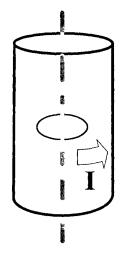
A long circular tube of length $10 \ m$ and radius $0.3 \ m$ carries a current $I$ along its curved surface as shown. A wire-loop of resistance $0.005$ ohm and of radius $0.1 \ m$ is placed inside the tube with its axis coinciding with the axis of the tube. The current varies as $I=I_0 \cos (300 t)$ where $I_0$ is constant. If the magnetic moment of the loop is $N \mu_0 I_0 \sin (300 t)$, then ' $N$ ' is
In a series $\text{LCR}$ circuit, resistance $R=10 \Omega$ and the impedance $Z=20 \Omega$. The phase difference between the current and the voltage is
The ratio of intensities of consecutive maxima in the diffraction pattern due to a single slit is
The difference between the apparent frequency of a source of sound as perceived by an observer during its approach and recession is $2 \%$ of the natural frequency of the source. If the velocity of sound in air is $300 \mathrm{~m} / \mathrm{sec}$, the velocity of the source is (lt is given that velocity of source $\ll$ velocity of sound)
Angular momentum is
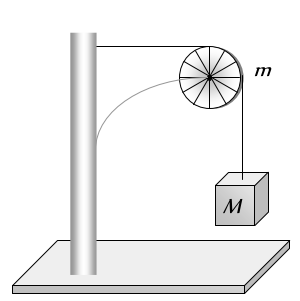
A string of negligible mass going over a clamped pulley of mass $m$ supports a block of mass $M$ as shown in the figure. The force on the pulley by the clamp is given by

Image

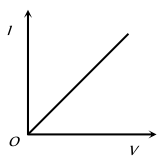
$L V$ characteristic of a copper wire of length $L$ and area of crosssection $A$ is shown in figure. The slope of the curve becomes
Image
When the object is self-luminous, the resolving power of a microscope is given by the expression
The $X$-ray wavelength of $L_\alpha$ line of platinum $(\mathrm{Z}=78)$ is $1.30 \mathrm{~A}$. The $X$-ray wavelength of $L_\alpha$ line of Molybdenum $(\mathrm{Z}=42)$ is
Two solids $A$ and $B$ float in water. It is observed that $A$ floats with half its volume immersed and $B$ floats with $2 / 3$ of its volume immersed. Compare the densities of $A$ and $B$