Question



✓
Answer
- (b) 0.825eV
Explanation:
$\text{K}_\text{max}=\text{h}\upsilon-\phi_0=\frac{\text{hc}}{\lambda}-\phi_0$
$=\frac{(6.6\times10^{-34})\times(3\times10^8)}{(300\times10^{-9})\times(1.6\times10^{-19})}-3.3$
$=4.125\times3.3=0.825\text{eV} $
Explanation:
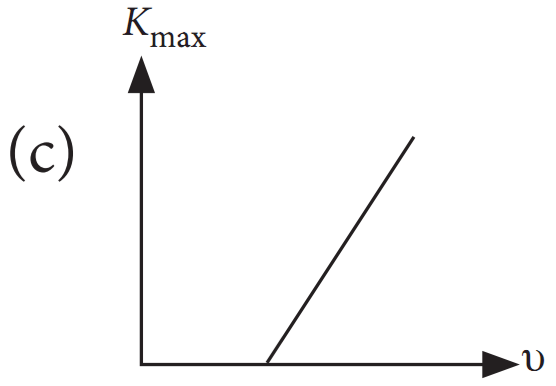
$\text{K}_\text{max}=\text{h}\upsilon-\phi_0$, when $\upsilon=\upsilon_0,\text{K}_\text{max}=0$
$\therefore0=\text{h}\upsilon_0$ or $\phi_0=\text{h}\upsilon_0$
If $\upsilon<\upsilon_0$, then Kmax is negative, i.e., no photoelectric emission takes place. Thus, graph (c) is possible.
Explanation:
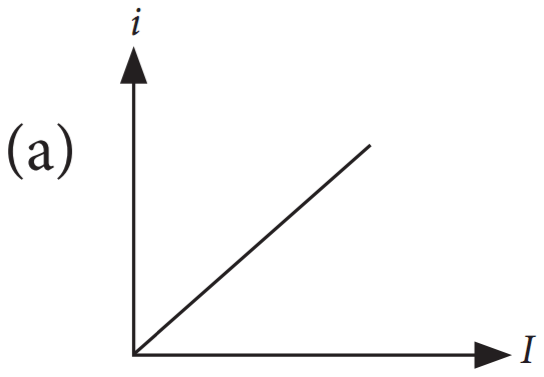
Photoelectric current (i) is proportional to the intensity of the emission light. Thus, graph (a) is possible.
-
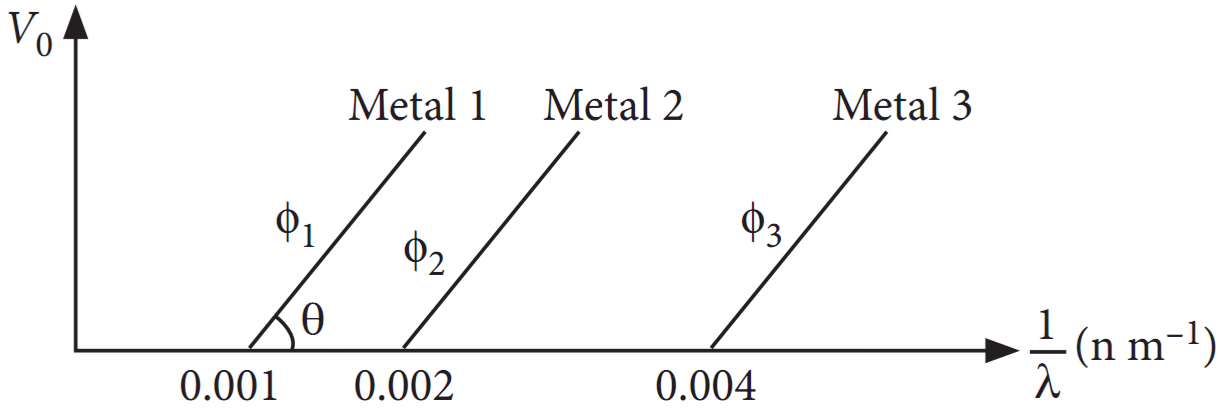
(c) $\phi_1:\phi_2:\phi_3=1:2:4$
Explanation:
From Einstein's photoelectric equation,
$\text{K}_\text{max}=\text{eV}_0=\frac{\text{hc}}{\lambda}-\phi$
or $\text{V}_0=\frac{\text{hc}}{\text{e}}\cdot\frac{1}{\lambda}-\frac{\phi}{\text{e}}$
Graph of V0 versus $\frac{1}{\lambda}$ s a straight line
Slope of straight line, $\tan\theta=\frac{\text{hc}}{\text{e}}$
At V0 = 0, we have
$\phi_1:\phi_2:\phi_3=\frac{\text{hc}}{\lambda_{01}}:\frac{\text{hc}}{\lambda_{02}}:\frac{\text{hc}}{\lambda_{03}}$
$0.001\text{hc}:0.002\text{hc}:0.004\text{hc}$
$\therefore1:2:4$
Explanation:
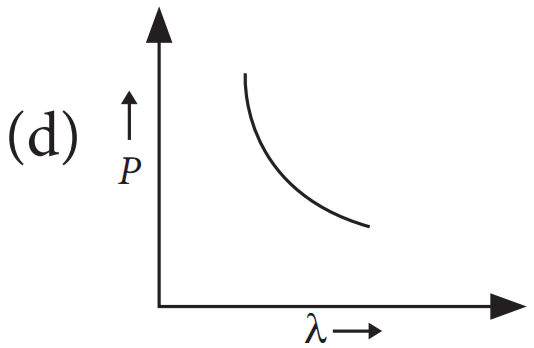
de-Broglie wavelength
$\lambda=\frac{\text{h}}{\text{P}}\text{i.e.,}\lambda\propto\frac{1}{\text{P}}$
So the graph between $\lambda$ and p is of the type shown is option (d).
Need a full question paper?
Generate a complete, print-ready paper with questions like this in minutes — across 16+ boards, with answer keys.
Explore more
Similar questions
Explain isotopes, isobar, isotones and isomers by giving examples.
A short magnet makes 40 oscillations per minute when used in an oscillation magnetometer at a place where the earth's horizontal magnetic field is $2\mu\text{T.}$ Another short magnet of magnetic moment 1.6A-m2 is placed 20cm east of the oscillating magnet. Find the new frequency of oscillation if the magnet has its north pole:
→- Towards north.
- Towards south.
A sample contains a mixture of 108Ag and 110Ag isotopes each having an activity of 8.0 × 10⁸ disintegration per second. 110Ag is known to have larger half-life than 108Ag. The activity A is measured as a function of time and the following data are obtained.
→→| Time (s) | Activity (A) (108 disinte- grations s-1) | Time (s) | Activity (A) (108 disinte-grations s-1) |
| 20 | 11.799 | 200 | 3.0828 |
| 40 | 9.1680 | 300 | 1.8899 |
| 60 | 7.4492 | 400 | 1.1671 |
| 80 | 6.2684 | 500 | 0.7212 |
| 100 | 5.4115 |
- Plot ln $\Big(\frac{\text{A}}{\text{A}_0}\Big)$ versus time.
- See that for large values of time, the plot is nearly linear. Deduce the half-life of 110Ag from this portion of the plot.
- Use the half-life of 110Ag to calculate the activity corresponding to 108Ag in the first 50s.
- Plot In $\Big(\frac{\text{A}}{\text{A}_0}\Big)$ versus time for 108Ag for the first 50s.
- Find the half-life of 108Ag.
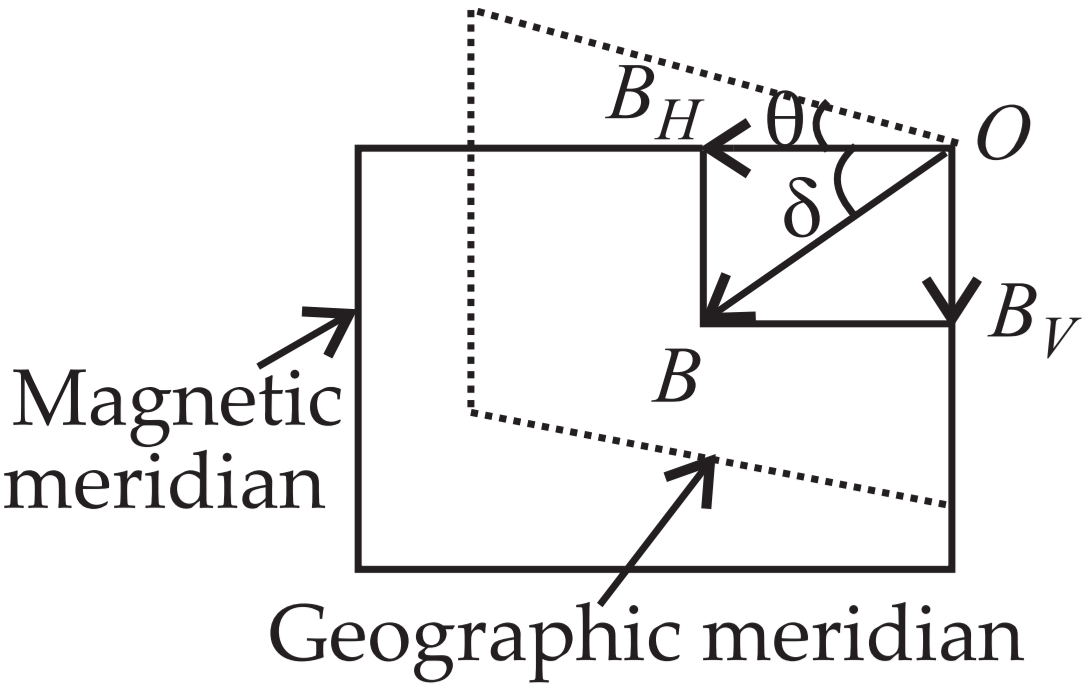
A child has near point at 10cm. What is the maximum angular magnification the child can have with a convex lens of focal length 10cm?
A lady cannot see objects closer than 40cm from the left eye and closer than 100cm from the right eye. While on a mountaineering trip, she is lost from her team. She tries to make an astronomical telscope from her reading glasses to look for her teammates.
- Which glass should she use as the eyepiece?
- What magnification can she get with relaxed eye?
If you are walking on the moon, can you hear the sound of stones cracking behind you? Can you hear the sound of your own footsteps?
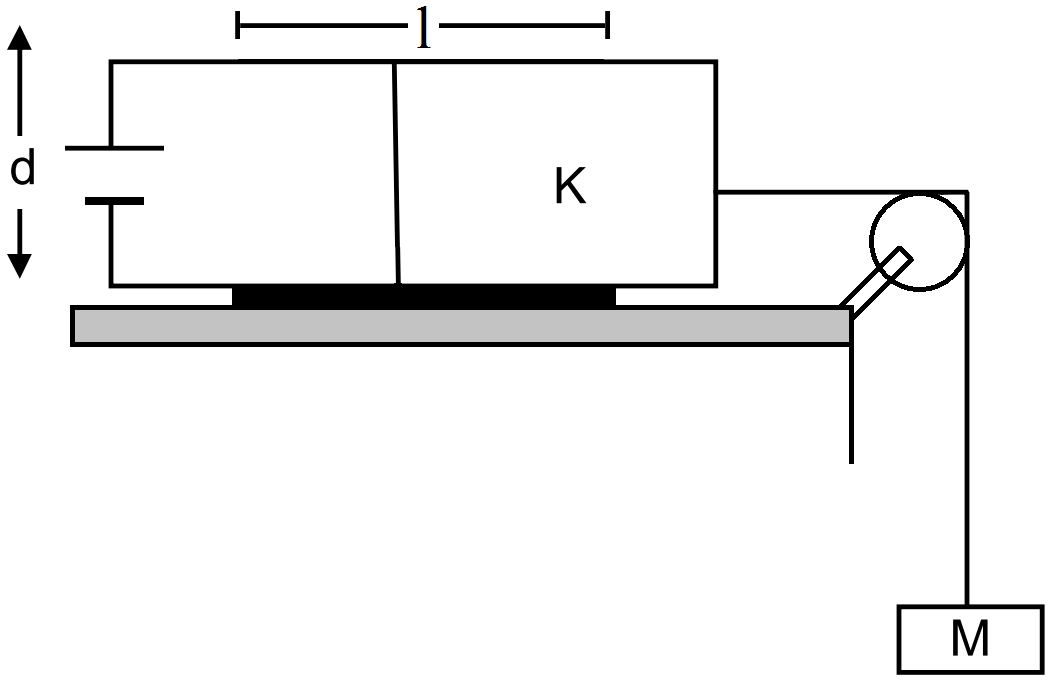
Consider the situation shown in figure. The width of each plate is b. The capacitor plates are rigidly clamped in the laboratory and connected to a battery of emf $\in.$ All surfaces are frictionless. Calculate the value of M for which the dielectric slab will stay in equilibrium.
→A plumb bob is hung from the ceiling of a train compartment. If the train moves with an acceleration 'a' along a straight horizontal track, the string supporting the bob makes an angle $\tan^{-1}\Big(\frac{\text{a}}{\text{g}}\Big)$ with the normal to the ceiling. Suppose the train moves on an inclined straight track with uniform velocity. If the angle of incline is $\tan^{-1}\Big(\frac{\text{a}}{\text{g}}\Big),$ the string again makes the same angle with the normal to the ceiling. Can a person sitting inside the compartment tell by looking at the plumb line whether the train is accelerated on a horizontal straight track or it is going on an incline? If yes, how? If no, suggest a method to do so.
→Show that the magnetic field at a point due to a magnetic dipole is perpendicular to the magnetic axis if the line joining the point with the centre of the dipole makes an angle of $\tan^{-1}(\sqrt{2})$ with the magnetic axis.
→