MCQ
According to first law of thermodynamics,
  • A
    Heat neither enters nor leaves the system.
  • B
    Heat is constant in isothermal system.
  • Energy is conserved.
  • D
    None of these.

Answer

Correct option: C.
Energy is conserved.
First law of ther modynamics is the principle of conservation of energy.

Need a full question paper?

Generate a complete, print-ready paper with questions like this in minutes — across 16+ boards, with answer keys.
Start Generating Free

Similar questions

Two springs $A$ and $B$ having spring constant $K_{A}$ and $K_{B}\left(K_{A}=2 K_{B}\right)$ are stretched by applying force of equal magnitude. If energy stored in spring $A$ is $E_{A}$ then energy stored in $B$ will be
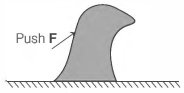
A small child tries to move a large rubber toy placed on the ground. The toy does not move but gets deformed under her pushing force $F$, which is obliquely upward as shown in the figure.Then, 
A constant torque acting on a uniform circular wheel changes its angular momentum from $L$ to $4L$ in $4$ seconds. The magnitude of this torque is:
In a two dimensional motion, instantaneous speed $v_0$ is a positive constant. Then which of the following are necessarily true?
A heavy particle is projected from a point on the horizontal at an angle $60^o$ with the horizontal with a speed of $10\ m/s$ . Then the radius of the curvature of its path at the instant of crossing the same horizontal will be    ......... $m$
A particle moves along an arc of a circle of radius $R$ . Its velocity depends on the distance covered as $v = a\sqrt s$ , where $a$ is a constant then the angle $\alpha $ between the vector of the total acceleration and the vector of velocity as a function of $s$ will be
A pendulum bob on a $2\, m$ string is displaced $60^{°}$ from the vertical and then released. What is the speed of the bob as it passes through the lowest point in its path .......... $m/s$
The angle between two vectors given by $6\hat i + 6\hat j - 3\hat k$ and $7\hat i + 4\hat j + 4\hat k$ is
The pressure $( P )$ and temperature $( T )$ relationship of an ideal gas obeys the equation $PT ^2=$ constant. The volume expansion coefficient of the gas will be:
An engine has an efficiency of $0.25$ when temperature of sink is reduced by $58\,^oC$, if its efficiency is doubled, then the temperature of the source is ..... $^oC$