Question
According to Newton's third law each team pulls the opposite team with equal force in a tug of war. Why then one team wins and the other loses?

Answer

The forces on the rope must be equal and opposite, according to Newton’s third law. But not all the forces acting on each team are equal. The friction between one team and the ground does not depend on the other team and can be larger on one side than on the other. In addition, the grips on the rope need not be equal and opposite. Thus, the net force acting on each team from all sources need not be equal.

Need a full question paper?

Generate a complete, print-ready paper with questions like this in minutes — across 16+ boards, with answer keys.
Start Generating Free

Similar questions

What is the nature of electrostatic force between two point electric charges $q_1$ and $q_2$ if:
  1. $q_1 + q_2 > 0?$
  2. $q_1 + q_2 < 0?$
Suppose while sitting in a parked car, you notice a jogger approaching towards you in the side view mirror of $R=2 m$. If the jogger is running at a speed of $5 m s ^{-1}$, how fast the image of the jogger appear to move when the jogger is (a) $39 m$, (b) $29 m$, (c) $19 m$, and (d) $9 m$ away.
Four point charges $q_A = 2 \mu C, q_B = –5 \mu C, q_C = 2 \mu C,$ and $q_D = –5 \mu C$ are located at the corners of a square $\text{ABCD}$ of side $10 \ cm$. What is the force on a charge of $1 \mu C$ placed at the centre of the square?
A uniform slab of dimension $10\ cm \times 10\ cm \times 1\ cm$ is kept between two heat reservoirs at temperatures $10^\circ C$ and $90^\circ C.$ The larger surface areas touch the reservoirs. The thermal conductivity of the material is $0.80\text{wm}^{-1}{^{\circ}}\text{C}^{-1}.$ Find the amount of heat flowing through the slab per minute.
  1. State the law of radioactive decay. Write the SI unit of ‘activity’.
  2. There are $4\sqrt{2}\times10^6$ radioactive nuclei in a given radioactive sample. If the half life of the sample is 20 s, how many nuclei will decay in 10 s?
A uniform magnetic field of magnitude $0.20T$ exists in space from east to west. With what speed should a particle of mass $0.010g$ and with charge $1.0 \times 10^{-5}C$ be projected from south to north so that it moves with uniform velocity?
  1. Deduce the expression,$ N = N_0 \text{e}^{-\lambda\text{t}},$ for the law of radioactive decay.
  2.  
  1. Write symbolically the process expressing the $B^+$ decay of $^{22}_{11}\text{Na},$ Also write the basic nuclear process underlying this decay.
  2. Is the nucleus formed in the decay of the nucleus $^{22}_{11}\text{Na},$ isotope or isobar?
Distinguish between nuclear fission and fusion. Show how in both these processes energy is released. Calculate the energy release in MeV in the deuterium-tritium fusion reaction:
$^{2}_{1}\text{H} + ^{3}_{1}\text{H}\rightarrow^{4}_{2}\text{H} +\text{n}$
Using the data:
$\text{m}(^{2}_{1}\text{H}) = 2.014102 \text{u}$
$\text{m}(^{3}_{1}\text{H}) = 3.016049\text{u}$
$\text{m}(^{4}_{2}\text{H}) = 4.002603 \text{u}$
$\text{m}_{n} = 1.008665 \text{n}$
$1\text{u} = 931.5\text{MeV/c}^{2}$.
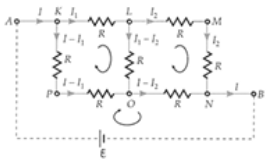
Find the equivalent resistance between the terminals $A$ and $B$ in the network shown in Figure. Given each resistor $R$ is $10 \Omega$.
Image
Consider the fusion in helium plasma. Find the temperature at which the average thermal energy 1.5kT equals the Coulomb potential energy at 2fm.