MCQ
According to Ohm's law, relation between current density $j$ and intensity of electric field $E$ is :
- A$j=\frac{ I }{\sigma E }$
- B$E =\sigma j$
- C$j=\frac{\sigma}{ E }$
- ✓$j=\sigma E$
Generate a complete, print-ready paper with questions like this in minutes — across 16+ boards, with answer keys.
Bragg’s law for X-rays is
| (a) d sin θ = 2n λ | (b) 2dsin θ = n λ |
(c) n sin θ = 2 λ d |
(d) None of these |
A metallic sheet is inserted between the plates of a parallel plate capacitor. The capacitance of the capacitor
|
(a) Increases |
|
(b) Is independent of the position of the sheet |
|
(c) Is maximum when the metal sheet in the middle |
|
(d) a, b |
In an electromagnetic wave, the electric and magnetising fields are 100  and
and  The maximum energy flow is
|
(a) |
(b) |
(c) |
(d) |
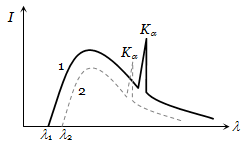
The intensity distribution of X-rays from two coolidge tubes operated on different voltages V1 and V2 and using different target materials of atomic numbers Z1 and Z2 is shown in the figure. Which one of the following inequalities is true?
|
(a) V1 > V2, Z1 < Z2 |
(b) V1 > V2, Z1 > Z2 |
(c) V1 < V2, Z1 > Z2 |
(d) V1 = V2, Z1 < Z2 |
Assertion : Owls can move freely during night.
Reason : They have large number of rods on their retina.
|
(a) If both assertion and reason are true and the reason is the correct explanation of the assertion. |
|
(b) If both assertion and reason are true but reason is not the correct explanation of the assertion. |
|
(c) If assertion is true but reason is false. |
|
(d) If the assertion and reason both are false. |
Which of the following will produce greater chromatic aberration?


