Question
According to the Rutherford’s atomic model, the electrons inside the atom are

Answer

According to Rutherford's model, an atom is mostly an empty space, with electrons orbiting a fixed positively charged nucleus in set of predictable paths.

Need a full question paper?

Generate a complete, print-ready paper with questions like this in minutes — across 16+ boards, with answer keys.

Start Generating Free

Similar questions

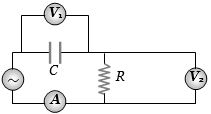
The diagram shows a capacitor $C$ and a resistor $R$ connected in series to an $ac$ source. ${V_1}$ and ${V_2}$ are voltmeters and $A$ is an ammeterConsider               now the following statements

             $I$.Readings in $A$ and $V_2$ are always in phase

             $II$.Reading in $V_1$ is ahead in phase with reading in $V_2$

             $III$.Readings in $A$ and $V_1$ are always in phase which of these statements are/is correct
If the deBroglie wavelength of an electron is equal to $10^{-3}$ times the wavelength of a photon of frequency $6\,\times 10^{14}\,Hz,$ then the speed of electron is equal to: (Speed of light $=3\times 10^8\,m/s\,;$ Planck’s constant $=6.63\times 10^{-34}\,J.s\,;$ Mass of electron $=9.1\times 10^{-31}\,kg$ )
A radioactive element $X$ emits six $\alpha$-particles and four $\beta$-particles leading to ond product ${ }_{82}^{208} Pb$. $X$ is
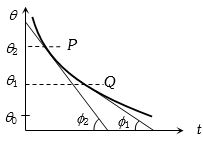
A body cools in a surrounding which is at a constant temperature of ${\theta _0}$. Assume that it obeys Newton's law of cooling. Its temperature $\theta $ is plotted against time $t$ . Tangents are drawn to the curve at the points $P(\theta = {\theta _1})$ and $Q(\theta = {\theta _2})$. These tangents meet the time axis at angles of ${\varphi _2}$and ${\varphi _1}$, as shown
A block of mass $M$ slides down on a rough inclined plane with constant velocity. The angle made by the incline plane with horizontal is $\theta$. The magnitude of the contact force will be.
$A$ body is in equilibrium under the influence of a number of forces. Each force has a different line of action. The minimum number of forces required is
A projectile is fired from the surface of the earth with a velocity of $5\, ms^{-1}$ and angle $\theta$ with the horizontal. Another projectile fired from another planet with a velocity of $3\, ms^{-1}$ at the same angle follows a trajectory which is identical with the trajectory of the projectile fired from the earth. The value of the acceleration due to gravity on the planet is (in $ms^{-2}$) is (given $g = 9.8\, m/s^2$)
A charged particle is moving with velocity $v$ in a magnetic field of induction $B$. The force on the particle will be maximum when
A charge $q$ $coulomb$ moves in a circle at $n$ revolutions per second and the radius of the circle is $r$ $metre$. Then magnetic field at the centre of the circle is
A point mass of $1 \mathrm{~kg}$ collides elastically with a stationary point mass of $5 \mathrm{~kg}$. After their collision, the $1 \mathrm{~kg}$ mass reverses its direction and moves with a speed of $2 \mathrm{~ms}^{-1}$. Which of the following statement(s) is (are) correct for the system of these two masses?

$(A)$ Total momentum of the system is $3 \mathrm{~kg} \mathrm{~ms}^{-1}$

$(B)$ Momentum of $5 \mathrm{~kg}$ mass after collision is $4 \mathrm{~kg} \mathrm{~ms}^{-1}$

$(C)$ Kinetic energy of the centre of mass is $0.75 \mathrm{~J}$

$(D)$ Total kinetic energy of the system is $4 \mathrm{~J}$