MCQ
According to Wien's displace law :
  • $\lambda_{ m } \propto T ^{-1}$
  • B
    $\lambda_{ m } \propto T ^{-2}$
  • C
    $\lambda_{ m } \propto T ^4$
  • D
    $\lambda_{ m } \propto T ^{-4}$

Answer

Correct option: A.
$\lambda_{ m } \propto T ^{-1}$
A

Need a full question paper?

Generate a complete, print-ready paper with questions like this in minutes — across 16+ boards, with answer keys.
Start Generating Free

Similar questions

The volume of a gas at $20°C$ is $100 \,cm^3$ at normal pressure. If it is heated to $100°C$, its volume becomes $125\, cm^3$ at the same pressure, then volume coefficient of the gas at normal pressure is
If temperature scale is changed from $°C$ to $°F$, the numerical value of specific heat will
A projectile has initially the same horizontal velocity as it would acquire if it had moved from rest with uniform acceleration of $3\, ms^{-2}$ for $ 0.5\, minutes$. If the maximum height reached by it is $80\, m$, then the angle of projection is (Take $g = 10\, ms^{-2}$)
A body of mass $m$ accelerates uniformly from rest to a speed $v_0$ in time $t_0$. The work done on the body till any time $t$ is 
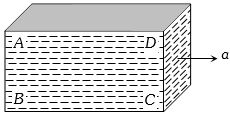
A closed rectangular tank is completely filled with water and is accelerated horizontally with an acceleration a towards right. Pressure is $(i)$ maximum at, and $ (ii) $ minimum at
A particle is executing simple harmonic motion with a period of $T$ seconds and amplitude a metre. The shortest time it takes to reach a point $\frac{a}{{\sqrt 2 }}\,m$ from its mean position in seconds is
A swimmer swims in still water at a speed $= 5\,\, km/hr$. He enters a $200\,\, m$ wide river, having river flow speed $= 4\,\, km/hr$ at point A and proceeds to swim at an angle of $127^o$ (sin $37^o = 0.6$) with the river flow direction.Another point $B$ is located directly across Aon the other side. The swimmer lands on the other bank at a point $C$, from which he walks the distance $CB$ with a speed $= 3\,\, km/hr.$ The total time in which he reachrs from $A$ to $B$ is..........$minutes$
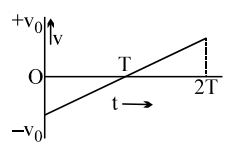
The figure shows the velocity $(v)$ of a particle plotted against time $(t)$
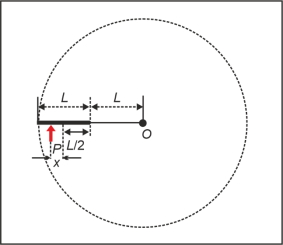
A thin uniform rod of length $L$ and certain mass is kept on a frictionless horizontal table with a massless string of length $L$ fixed to one end (top view is shown in the figure). The other end of the string is pivoted to a point $O$. If a horizontal impulse $P$ is imparted to the rod at a distance $x=L / n$ from the mid-point of the rod (see figure), then the rod and string revolve together around the point $O$, with the rod remaining aligned with the string. In such a case, the value of $n$ is. . . . . . 
A vibrating string of certain length $\ell$ under a tension $\mathrm{T}$ resonates with a mode corresponding to the first overtone (third harmonic) of an air column of length $75 \mathrm{~cm}$ inside a tube closed at one end. The string also generates $4$ beats per second when excited along with a tuning fork of frequency $\mathrm{n}$. Now when the tension of the string is slightly increased the number of beats reduces $2$ per second. Assuming the velocity of sound in air to be $340 \mathrm{~m} / \mathrm{s}$, the frequency $\mathrm{n}$ of the tuning fork in $\mathrm{Hz}$ is