Question
Account for the following:
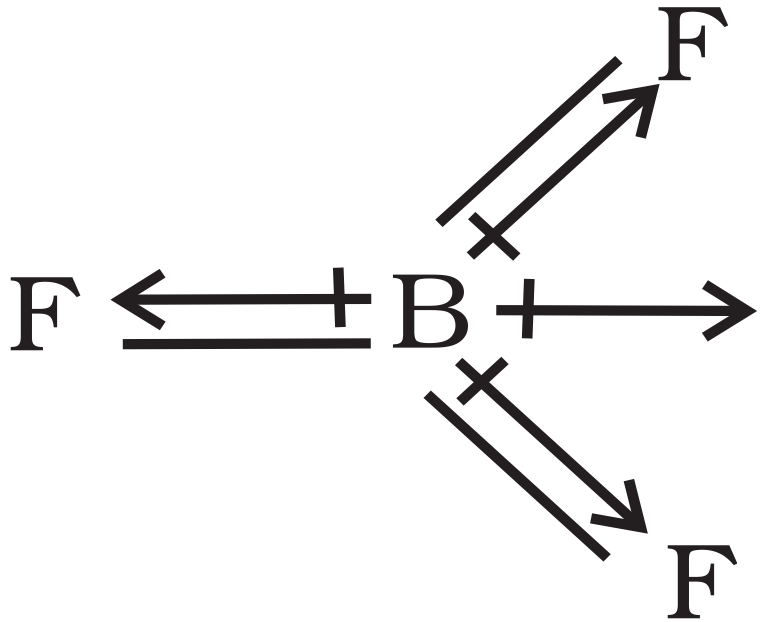
  1. BF, molecule has a zero dipole moment although $\text{B}-\text{F}$ bonds are polar.
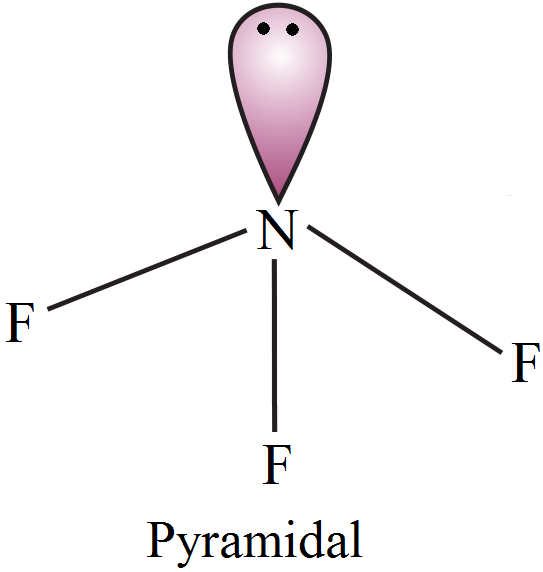
  2. The structure of $\mathrm{NH}_3$ molecule is pyramidal.
Answer

  1. Although $\text{B}-\text{F}$ bonds are polar but net dipole moment of $\mathrm{BF}_3$ molecule is zero because of the symmetry of the molecule, individual dipole moments cancel out as shown below.
  1. $\mathrm{NH}_3$ is pyramidal due to the presence of lone pair of electrons on nitrogen and 3 bonded pair of electrons.

Need a full question paper?

Generate a complete, print-ready paper with questions like this in minutes — across 16+ boards, with answer keys.

Start Generating Free

Similar questions

What will be the mass of one ${ }^{12} C$ atom in g ?
Account for the following:
Why $\mathrm{BF}_3$ is less acidic than $\mathrm{BCl}_3$ though fluorine is more electronegative than chlorine?
A factory was started near a village. Suddenly villagers started feeling the presence of irritating vapours in the village and cases of headache, chest pain, cough, dryness of throat and breathing problems increased.
  1. Explain what could have happened?
  2. Give chemical reactions for the support of your explanation.
Following cell is set up between copper and silver electrodes.$\text{Cu}|\text{Cu}^{2+}\text{(aq)}\|\text{Ag}^+\text{(aq)}|\text{Ag}$
If its two half cells work under standard conditions, calculate the emf of the cell.
$\Big[\text{Given E}^\circ_{\frac{\text{Cu}^{2+}}{\text{Cu}}}=+0.34\text{V},\text{E}^\circ_{\frac{\text{Ag}^+}{\text{Ag}}}=+0.80\text{V}\Big]$
What do you understand by the terms:
Hydrogen economy.
Will AgCl be more soluble in aqueous solution or NaCl solution and why?
Calculate the number of gram molecules of water in a beaker containing 576g of water.
In comparison to the atomic mass of an element, the atomic number is more capable of indicating the properties of that element. Confirm the statement.
In a reaction
$\mathrm{A}+\mathrm{B}_2 \rightarrow \mathrm{AB}_2$
Identify the limiting reagent, if any, in the following reaction mixtures.
$5 \mathrm{mol}\mathrm{~A}+2.5 \mathrm{~mol} \mathrm{~B}$.
Which of the following are isoelectronic species i.e., those having the same number of electrons?
$
Na^{+}, K^{+}, Mg^{2+}, Ca^{2+}, S^{2-}, Ar
$