MCQ
Acetic acid exists as a dimer in benzene solution. This is due to
- ACondensation
- BPresence of $ - COOH$ group
- CPresence of $\alpha - $hydrogen
- ✓Hydrogen bonding

Generate a complete, print-ready paper with questions like this in minutes — across 16+ boards, with answer keys.
$X \left| X ^{2+}(0.001 M ) \| Y ^{2+}(0.01 M )\right| Y$
is $.......\times 10^{-2} V$ (Nearest integer).
Given: $E _{ x ^{2+} \mid x }^0=-2.36\,V$
$E _{ Y ^{3+} \mid Y }^0=+0.36\,V$
$\frac{2.303\,RT }{ F }=0.06\,V$
$\begin{array}{*{20}{c}}
{C{H_2} - COOH} \\
{|\,\,\,\,\,\,\,\,\,\,\,\,\,\,\,\,\,\,\,\,\,\,\,\,\,\,\,\,\,\,\,\,} \\
{C{H_2} - COOH}
\end{array}\xrightarrow{\Delta }(A)\xrightarrow{{C{H_3} - C{H_2}N{H_2}/\Delta }}(B)$
$(B)$ will be :
(Given data : Molar mass and the molal freezing point depression constant of benzene are $78 g mol ^{-1}$ and $5.12 K kg mol ^{-1}$, respectively)
$\mathrm{Pt}(s) \mid \mathrm{H}_2(g, 1 \text { bar })\left|\mathrm{H}^{+}(a q, 1 \mathrm{M}) \| \mathrm{M}^{4+}(a q), \mathrm{M}^{2+}(a q)\right| \mathrm{Pt}(s)$
$E_{\text {cell }}=0.092 \mathrm{~V} \text { when } \frac{\left[\mathrm{M}^{2+}(a q)\right]}{\left[\mathrm{M}^{4+}(a q)\right]}=10^x$
Given : $ E_{\mathrm{M}^4 / \mathrm{M}^{2+}}^0=0.151 \mathrm{~V} ; 2.303 \frac{R T}{F}=0.059 \mathrm{~V}$
The value of $x$ is
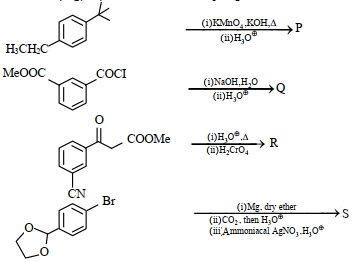
The correct statement ($s$) about $P, Q, R$, and $S$ is (are)
($A$) $P$ and $Q$ are monomers of polymers dacron and glyptal, respectively.
($B$) $P, Q$, and $R$ are dicarboxylic acids.
($C$) Compounds $Q$ and $R$ are the same.
($D$) $R$ does not undergo aldol condensation and $S$ does not undergo Cannizzaro reaction.