MCQ
Acetic acid will be obtained on oxidation of
  • Ethanol
  • B
    Propanal
  • C
    Methanal
  • D
    Glyoxal

Answer

Correct option: A.
Ethanol
a
(a) ${C_2}{H_5}OH\xrightarrow{{[O]}}C{H_3}COOH$

Need a full question paper?

Generate a complete, print-ready paper with questions like this in minutes — across 16+ boards, with answer keys.

Start Generating Free

Similar questions

A solution of $Ni(NO_3)_2$ is electrolysed between platinum electrodes using $0.1$ Faraday electricity. How many mole of $Ni$ will be deposited at the cathode?
A gaseous mixture contains oxygen and nitrogen in the ratio of $1: 4$ by weight. Therefore, the ratio of their number of molecules is
The $\mathrm{pH}$ of a solution obtained by mixing $50 \,\mathrm{~mL}$ of $1\, \mathrm{M}\, \mathrm{HCl}$ and $30 \,\mathrm{~mL}$ of $1\, \mathrm{M} \,\mathrm{NaOH}$ is $\mathrm{x} \times 10^{-4}$. The value of $\mathrm{x}$ is ...... . (Nearest integer) $[\log 2.5=0.3979]$
The $pH$ value of the solution in which a particular amino acid does not migrate under the influence of an electric field in called the
When a metal rod ${M}$ is dipped into an aqueous colourless concentrated solution of compound ${N}$, the solution turns light blue. Addition of aqueous $\mathrm{NaCl}$ to the blue solution gives a white precipitate ${O}$. Addition of aqueous $\mathrm{NH}_3$ dissolves ${O}$ and gives an intense blue solution.

$1.$ The metal rod ${M}$ is

$(A)$ $\mathrm{Fe}$ $(B)$ $\mathrm{Cu}$ $(C)$ $\mathrm{Ni}$ $(D)$ $\mathrm{Co}$

$2.$ The compound ${N}$ is

$(A)$ $\mathrm{AgNO}_3$ $(B)$ $\mathrm{Zn}\left(\mathrm{NO}_3\right)_2$

$(C)$ $\mathrm{Al}\left(\mathrm{NO}_3\right)_3$ $(D)$ $\mathrm{Pb}\left(\mathrm{NO}_3\right)_2$

$3.$ The final solution contains

$(A)$ $\left[\mathrm{Pb}\left(\mathrm{NH}_3\right)_4\right]^{2+}$ and $\left[\mathrm{CoCl}_4\right]^{2-}$

$(B)$ $\left[\mathrm{Al}\left(\mathrm{NH}_3\right)_4\right]^{3+}$ and $\left[\mathrm{Cu}\left(\mathrm{NH}_3\right)_4\right]^{2+}$

$(C)$ $\left[\mathrm{Ag}\left(\mathrm{NH}_3\right)_2\right]^{+}$and $\left[\mathrm{Cu}\left(\mathrm{NH}_3\right)_4\right]^{2+}$

$(D)$ $\left[\mathrm{Ag}\left(\mathrm{NH}_3\right)_2\right]^{+}$and $\left[\mathrm{Ni}\left(\mathrm{NH}_3\right)_6\right]^{2+}$

Give the answer question $1,2$ and $3.$

Given below are two statements:

Statement $(I)$ : $\mathrm{SiO}_2$ and $\mathrm{GeO}_2$ are acidic while $\mathrm{SnO}$ and $\mathrm{PbO}$ are amphoteric in nature.

Statement $(II)$ : Allotropic forms of carbon are due to property of catenation and $\mathrm{p} \pi-\mathrm{d} \pi$ bond formation.

In the light of the above statements, choose the most appropriate answer from the options given below:
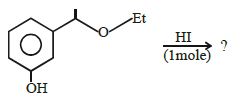
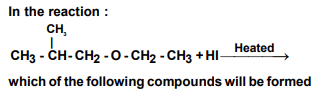
$pH$ of a $0.1\,M$ monobasic acid is found to be $2$. Hence its osmotic pressure at a given temperature $T\,K$ is
Major product of above reaction is
The $IUPAC$ name of ethylidene chloride is ..... .
Image