MCQ
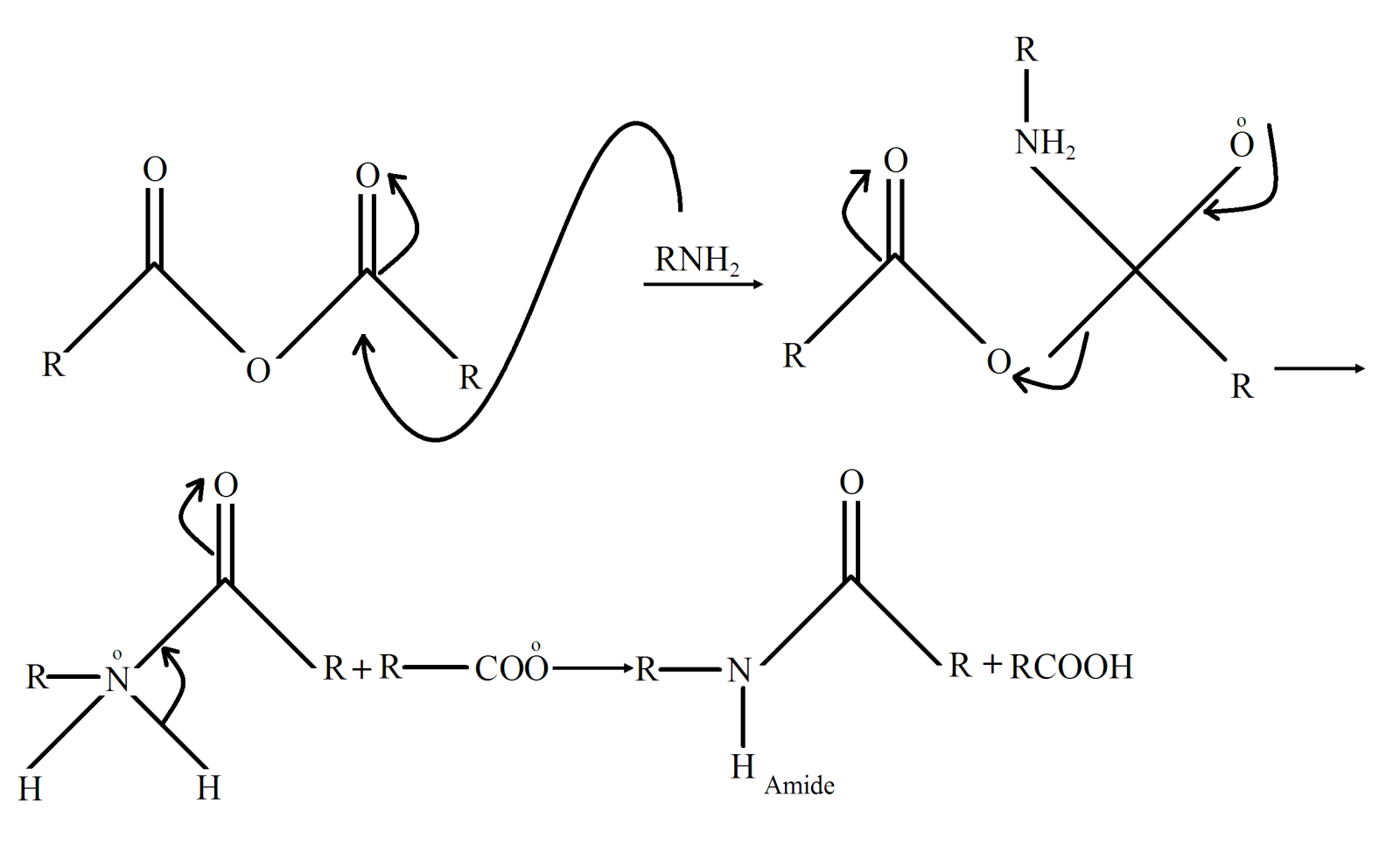
Acid anhydrides on reaction with primary amines give $.......$
  • Amide
  • B
    Imide
  • C
    Secondary amine
  • D
    Imine

Answer

Correct option: A.
Amide
Acid anhydride on reaction with primary amine produces amide as:

Need a full question paper?

Generate a complete, print-ready paper with questions like this in minutes — across 16+ boards, with answer keys.

Start Generating Free

Similar questions

The unit of ebulioscopic constant is $.......$
The limiting molar conductivity $\mathop \Lambda \limits^o $ for $NaCl, KBr$ and $KCl$ are $126, 152$ and $150 \,S\,cm^2  \,mol^{-1}$ respectively. The $\mathop \Lambda \limits^o $ for $NaBr$ is (in $S\, cm^2\, mol^{-1}$).
Milk is an example of water in oil emulsions.
Which of the following is incorrect
Which of the following reacts fastly with $Na?$
Which metal is used in  Wurtz  synthesis
Correct increasing order for the wavelength of absorption in the visible region for the complexes of $CO ^{3+}$ is :
In nitration of benzene by mixed acide the rate of reaction will be
Method by which lyophobic sol can be protected.
The reaction of $K _3\left[ Fe ( CN )_6\right]$ with freshly prepared $FeSO _4$ solution produces a dark blue precipitate called Turnbull's blue. Reaction of $K _4\left[ Fe ( CN )_6\right]$ with the $FeSO _4$ solution in complete absence of air produces a white precipitate $X$, which turns blue in air. Mixing the $FeSO _4$ solution with $NaNO _3$, followed by a slow addition of concentrated $H _2 SO _4$ through the side of the test tube produces a brown ring.

Precipitate $X$ is

$(A)$ $Fe _4\left[ Fe ( CN )_6\right]_3$

$(B)$ $Fe \left[ Fe ( CN )_6\right]$

$(C)$ $K _2 Fe \left[ Fe ( CN )_6\right]$

$(D)$ $KFe \left[ Fe ( CN )_6\right]$

Among the following, the brown ring is due to the formation of

$(A)$ $\left[ Fe ( NO )_2\left( SO _4\right)_2\right]^{2-}$

$(B)$ $\left[ Fe ( NO )_2\left( H _2 O \right)_4\right]^{3+}$

$(C)$ $\left[ Fe ( NO )_4\left( SO _4\right)_2\right]$

$(D)$ $\left[ Fe ( NO )\left( H _2 O \right)_5\right]^{2+}$