MCQ
Action and reaction:
  • A
    Act on two different objects.
  • B
    Have opposite directions.
  • C
    Have equal magnitude.
  • All of the above

Answer

Correct option: D.
All of the above
Forces of action and reaction are equal and opposite, acting on different objects and having zero resultant.

Need a full question paper?

Generate a complete, print-ready paper with questions like this in minutes — across 16+ boards, with answer keys.
Start Generating Free

Similar questions

A long cylindrical glass vessel has a small hole of radius $r$ at its bottom. The depth to which the vessel can be lowered vertically in a deep water bath $($surface tension $T)$ without any water entering inside is:
Three bodies $A, B$ and $C$ have equal kinetic energies and their masses are $400 \mathrm{~g}, 1.2 \mathrm{~kg}$ and $1.6 \mathrm{~kg}$ respectively. The ratio of their linear momenta is :
The Reynolds number of a flow is the ratio of
The kinetic energy $k$ of a particle moving along a circle of radius $R$ depends on the distance covered $s$ as $k = a{s^2}$ where $a$ is a constant. The force acting on the particle is
A black body at a temperature of $127°C$ radiates heat at the rate of $1 cal/cm^2 × sec$. At a temperature of $527°C$ the rate of heat radiation from the body in ($cal/cm^2 × sec$) will be
Which of the following is self adjusting in nature?
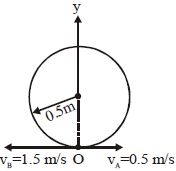
Two particles $A$ and $B$ start at the origin $O$ and travel in opposite directions along the circular path at constant speeds $0.5\,m/s$ and $1.5\,m/s$ , respectively. The time when they collide with each other ........ $\sec$
Which of the following is a dimensional constant?
A resistor of resistance $R$ is connected to an ideal battery. If the value of $R$ is decreased, the power dissipated in the resistor will:
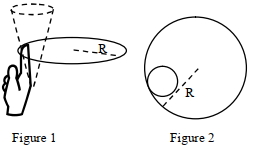
One twirls a circular ring (of mass $M$ and radius $R$ ) near the tip of one's finger as shown in Figure $1$ . In the process the finger never loses contact with the inner rim of the ring. The finger traces out the surface of a cone, shown by the dotted line. The radius of the path traced out by the point where the ring and the finger is in contact is $\mathrm{r}$. The finger rotates with an angular velocity $\omega_0$. The rotating ring rolls without slipping on the outside of a smaller circle described by the point where the ring and the finger is in contact (Figure $2$). The coefficient of friction between the ring and the finger is $\mu$ and the acceleration due to gravity is $g$.

(IMAGE)

($1$) The total kinetic energy of the ring is

$[A]$ $\mathrm{M} \omega_0^2 \mathrm{R}^2$   $[B]$ $\frac{1}{2} \mathrm{M} \omega_0^2(\mathrm{R}-\mathrm{r})^2$   $[C]$ $\mathrm{M \omega}_0^2(\mathrm{R}-\mathrm{r})^2$   $[D]$ $\frac{3}{2} \mathrm{M} \omega_0^2(\mathrm{R}-\mathrm{r})^2$

($2$) The minimum value of $\omega_0$ below which the ring will drop down is

$[A]$ $\sqrt{\frac{g}{\mu(R-r)}}$  $[B]$ $\sqrt{\frac{2 g}{\mu(R-r)}}$  $[C]$ $\sqrt{\frac{3 g}{2 \mu(R-r)}}$    $[D]$ $\sqrt{\frac{g}{2 \mu(R-r)}}$

Givin the answer quetion ($1$) and ($2$)