MCQ
$ADH$ controls water permeability of
  • A
    Collecting tube
  • Distal convolulated tubule and collecting duct
  • C
    Proximal convolulated tubule
  • D
    Bowman’s capsule

Answer

Correct option: B.
Distal convolulated tubule and collecting duct
b
(b) $ADH$ or vasopressine is effective in reabsorption of water by changing permeability of terminal part of $DCT$ $(distal\,\, convoluted \,\,tubules)$ and collecting ducts.

Need a full question paper?

Generate a complete, print-ready paper with questions like this in minutes — across 16+ boards, with answer keys.
Start Generating Free

Similar questions

Dinnosaurs originated in which era
The most abundant intracellular cation is
Somatostatin is secreted by
According to the Neo-Darwinian theory, which of the following is responsible for the origin of new species
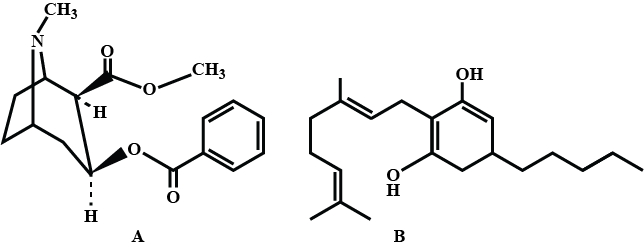
Identify the molecules $(A)$ and $(B)$ shown below and select the right option giving their source and use.
Root nodules for nitrogen fixation of a non-leguminous tree possess
Which of the following statement is/are true

$(1)$ Urine is hypertonic is distal convoluted tubule

$(2)$ When the urine passes into collecting tubule, it becomes hypotonic

$(3)$ Urine is isotonic in proximal convoluted tubule

$(4)$ Urine becomes more and more hypotonic as it passes through Henle’s loop

Assertion: After formation of hormone-receptor complex, biochemical changes in the target tissue occurs.
Reason: Hormones produce their effects upon target tissues only by binding to specific proteins called hormone receptors located in the target tissues.
Which of the following statements are correct for regulation of cardiac activity ?
(i) A special neural centre in the medulla oblongata can moderate the cardiac function through autonomic nervous system.
(ii) Neural signals through the sympathetic nerves can increase the rate of heart beat, the strength of ventricular contraction and thereby the cardiac output.
(iii) Parasympathetic neural signals decrease the rate of heart beat, speed of conduction of action potential and thereby the cardiac output.
(iv) Adrenal medullary hormones can also increase the cardiac output.
(v) Adrenalin or epinephrine increase heart beat.
(vi) Acetylcholine decrease heart beat.
Ovulation in mammals refers to