MCQ
Albert Einstein got a nobel prize in physics for his work on:
- ASpecial theory of relativity
- BGeneral theory of relativity
- CPhotoelectric effect
- DTheory of specific heats
Explanation:
In 1905, Albert Einstein extended Planck's hypothesis to explain the photoelectric effect, which is the emission of electrons by a metal surface when it is irradiated by light or more-energetic photons.
Generate a complete, print-ready paper with questions like this in minutes — across 16+ boards, with answer keys.
5 amperes of current is passed through a metallic conductor. The charge flowing in one minute in coulombs will be
|
(a) 5 |
(b) 12 |
(c) 1/12 |
(d) 300 |
Here, A refers to.
A beam of fast moving alpha particles were directed towards a thin film of gold. The parts  and
and  of the transmitted and reflected beams corresponding to the incident parts A, B and C of the beam, are shown in the adjoining diagram. The number of alpha particles in
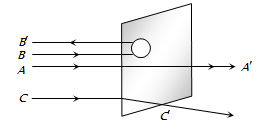
|
(a) |
(b) |
|
(c) |
(d) |
A transistor is used as an amplifier in CB mode with a load resistance of 5 k W the current gain of amplifier is 0.98 and the input resistance is 70 W, the voltage gain and power gain respectively are
|
(a) 70, 68.6 |
(b) 80, 75.6 |
(c) 60, 66.6 |
(d) 90, 96.6 |
The focal length of the field lens (which is an achromatic combination of two lenses) of telescope is 90 cm. The dispersive powers of the two lenses in the combination are 0.024 and 0.036. The focal lengths of two lenses are
|
(a) 30 cm and 60 cm |
(b) 30 cm and – 45 cm |
|
(c) 45 cm and 90 cm |
(d) 15 cm and 45 cm |

