Question
'Alcohols are versatile compounds' discuss exaction of this statement by giving suitable example.

Answer

→ Alcohols are versatile compounds. They react both as nucleophiles and electrophiles. The bond between O-H is broken when alcohols react as nucleophiles.
→ Alcohols as nucleophiles
(i)
Image
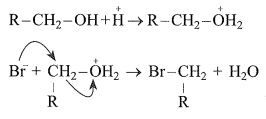
(ii) The bond between C O is broken when they react as electrophiles. Protonated alcohols react in this manner.
→ Protonated alcohols as electrophiles
Image

Need a full question paper?

Generate a complete, print-ready paper with questions like this in minutes — across 16+ boards, with answer keys.

Start Generating Free

Similar questions

Which alkyl halide from the following pairs would you expect to react more rapidly by an SN2 mechanism? Explain your answer.
$\text{CH}_3\text{CH}_2\text{CH}_2\text{CH}_2\text{Br}\ \text{or}\ \text{CH}_3\text{CH}_2\text{CH}\text{CH}_3\\\ \ \ \ \ \ \ \ \ \ \ \ \ \ \ \ \ \ \ \ \ \ \ \ \ \ \ \ \ \ \ \ \ \ \ \ \ \ \ \ \ \ \ \ \ \ \ \ \ \ \ \ \ \ \ \ \mid\\\ \ \ \ \ \ \ \ \ \ \ \ \ \ \ \ \ \ \ \ \ \ \ \ \ \ \ \ \ \ \ \ \ \ \ \ \ \ \ \ \ \ \ \ \ \ \ \ \ \ \ \ \ \ \ \text{Br}$
Explain classification of haloalkane and haloarene on the basis of number of halogen atoms.
a. Nitrogen gas is soluble in water. At temperature 293 K, the value of KH iS 76.48 kbar. How would the solubility of nitrogen vary (increase, decrease or remain the same) at a temperature above 293 KH if the value of K₁ rises to 88.8 kbar.
b. Chloroform (b.p. 61.2°C) and acetone (b.p. 56°C) are mixed to form an azeotrope. The mole fraction of acetone in this mixture is 0.339. Predict whether the boiling point of the azeotrope formed will be (i) 60°C (ii) 64.5°C or (iii)54 °C. Defend your answer with reason.
Propose the mechanism for the following reaction:
$\text{CH}_3\text{CHO}\ \ +\ \ \text{HCN}\xrightarrow{\ \ \text{a}+ }\ \ \text{CH}_3-\text{CH}-\text{CN}\\ \ \ \ \ \ \ \ \ \ \ \ \ \ \ \ \ \ \ \ \ \ \ \ \ \ \ \ \ \ \ \ \ \ \ \ \ \ \ \ \ \ \ \ \ \ \ \ \ \ \ \ \ \ \ \ \ \ \ | \\ \ \ \ \ \ \ \ \ \ \ \ \ \ \ \ \ \ \ \ \ \ \ \ \ \ \ \ \ \ \ \ \ \ \ \ \ \ \ \ \ \ \ \ \ \ \ \ \ \ \ \ \ \ \ \ \ \ \ \text{OH}$
Arrange the following in decreasing order of their acidic strength. Give explanation for the arrangement.
C6H5COOH, FCH2COOH, NO2CH2COOH
Account for the following:
  1. Phenol does not react with NaHCO3 whereas carboxylic acids react.
  2. Phenol is more easily nitrated than benzene.
Note: In the following questions a statement of assertion followed by a statement of reason is given. Choose the correct answer out of the following choices.
  1. Both assertion and reason are true and the reason is the correct explanation of assertion.
  2. Both assertion and reason are true and the reason is not the correct explanation of assertion.
  3. Assertion is true but the reason is false.
  4. Both assertion and reason are false.
  5. Assertion is false but reason is true.
Assertion: Λm for weak electrolytes shows a sharp increase when the electrolytic solution is diluted.
Reason: For weak electrolytes degree of dissociation increases with dilution of solution.
Enumerate the reactions of D - glucose which cannot be explained by its open chain structure.
Give reasons for the following:
a. The only oxidation state shown by Scandium is +3.
b. [Ti(H2O)6]4+ is colourless.
c. MnO is basic while Mn2O7 is acidic.
Name the products of hydrolysis of sucrose. Why is sucrose not a reducing sugar?