MCQ
Alcohols having molecular formula $C _3 H _8 O$, can be :
  • A
    Only primary
  • B
    Only secondary
  • Primary and secondary
  • D
    Primary, secondary and tertiary

Answer

Correct option: C.
Primary and secondary
c

Need a full question paper?

Generate a complete, print-ready paper with questions like this in minutes — across 16+ boards, with answer keys.

Start Generating Free

Similar questions

During the qualitative analysis of $SO _3^{2-}$ using dilute $H _2 SO _4, SO _2$ gas is evolved which turns $K _2 Cr _2 O _7$ solution (acidified with dilute $H _2 SO _4$ ):
In the electrochemical cell :

$Zn \,|\,ZnSO_4\,(0.01\,M)\,||\,CuSO_4\,(1.0\, M)\,|\,Cu,$

the $emf$ of this Daniell cell is $E_1.$ When the concentration of $ZnSO_4$ is changed to $1.0\, M$ and that of $CuSO_4$ changed to $0.01\, M,$ the $emf$ changes to $E_2.$ Fromthe followings, which one is the relationship between $E_1$ and $E_2$ ? (Given, $RT/F = 0.059$)
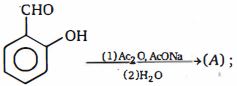
Identify product and name of reaction.
A first row transition metal with highest enthalpy of atomisation, upon reaction with oxygen at high temperature forms oxides of formula $\mathrm{M}_2 \mathrm{O}_{\mathrm{n}}$ (where $\mathrm{n}=3,4,5$ ). The 'spin-only' magnetic moment value of the amphoteric oxide from the above oxides is. . . . . . ..$\mathrm{BM}$ (near integer)

(Given atomic number: $\mathrm{Sc}: 21, \mathrm{Ti}: 22, \mathrm{~V}: 23$, $\mathrm{Cr}: 24, \mathrm{Mn}: 25, \mathrm{Fe}: 26, \mathrm{Co}: 27, \mathrm{Ni}: 28, \mathrm{Cu}: 29$, $\mathrm{Zn}: 30)$

$1\, \mathrm{~mol}$ of an octahedral metal complex with formula $\mathrm{MCl}_{3} \cdot 2 \mathrm{~L}$ on reaction with excess of $\mathrm{AgNO}_{3}$ gives $1\, mol$ of $\mathrm{AgCl}$. The denticity of Ligand $\mathrm{L}$ is ...... . (Integer answer)
When $S{O_2}$ is passed through acidic solution of potassium dichromate, then chromium sulphate is formed. Change in valency of chromium is
At what temperature rate becomes double than at $300 \,K$ ? Given $\ln k=10-\frac{69( KJ )}{ RT }$
Misch metal an alloy of
Glucose in blood can be quantitatively determined with
$\begin{array}{*{20}{c}}
  {{{(C{H_3})}_2}CH - C - N{H_2}\,\xrightarrow[{B{r_2}}]{{NaOH}}A\xrightarrow{{COC{l_2}}}B} \\ 
  {||\,\,\,\,\,\,\,\,\,\,\,\,\,\,\,\,\,\,\,\,\,\,\,\,\,\,\,\,\,\,\,\,\,\,\,} \\ 
  {O\,\,\,\,\,\,\,\,\,\,\,\,\,\,\,\,\,\,\,\,\,\,\,\,\,\,\,\,\,\,\,\,\,\,\,} 
\end{array}$ $B$ is