MCQ
Aldol condensation will not be observed in
- ✓Chloral
- BPhenyl acetaldehyde
- CHexanal
- DEthanal
Generate a complete, print-ready paper with questions like this in minutes — across 16+ boards, with answer keys.
In a thermodynamics process on an ideal monatomic gas, the infinitesimal heat absorbed by the gas is given by $T \Delta X$, where $T$ is temperature of the system and $\Delta X$ is the infinitesimal change in a thermodynamic quantity $X$ of the system. For a mole of monatomic ideal gas
$X=\frac{3}{2} R \ln \left(\frac{T}{T_A}\right)+R \ln \left(\frac{V}{V_A}\right)$. Here, $R$ is gas constant, $V$ is volume of gas, $T_A$ and $V_A$ are constants.
The $List-I$ below gives some quantities involved in a process and $List-II$ gives some possible values of these quantities.
| List-$I$ | List-$II$ |
| $(I)$ Work done by the system in process $1 \rightarrow 2 \rightarrow 3$ | $(P)$ $\frac{1}{3} R T_0 \ln 2$ |
| $(II)$ Change in internal energy in process $1 \rightarrow 2 \rightarrow 3$ | $(Q)$ $\frac{1}{3} RT _0$ |
| $(III)$ Heat absorbed by the system in process $1 \rightarrow 2 \rightarrow 3$ | $(R)$ $R T _0$ |
| $(IV)$ Heat absorbed by the system in process $1 \rightarrow 2$ | $(S)$ $\frac{4}{3} RT _0$ |
| $(T)$ $\frac{1}{3} RT _0(3+\ln 2)$ | |
| $(U)$ $\frac{5}{6} RT _0$ |
If the process carried out on one mole of monatomic ideal gas is as shown in figure in the PV-diagram with $P _0 V _0=\frac{1}{3} RT _0$, the correct match is,
$(1)$$I \rightarrow Q, II \rightarrow R , III \rightarrow P , IV \rightarrow U$
$(2)$ $I \rightarrow S , II \rightarrow R , III \rightarrow Q , IV \rightarrow T$
$(3)$ $I \rightarrow Q , II \rightarrow R , III \rightarrow S , IV \rightarrow U$
$(4)$ $I \rightarrow Q , II \rightarrow S , III \rightarrow R , IV \rightarrow U$
($2$) If the process on one mole of monatomic ideal gas is an shown is as shown in the $TV$-diagram with $P _0 V _0=\frac{1}{3} RT _0$, the correct match is
$(1)$ $I \rightarrow S, II \rightarrow T, III \rightarrow Q , IV \rightarrow U$
$(2)$ $I \rightarrow P , II \rightarrow R, III \rightarrow T , IV \rightarrow S$
$(3)$ $I \rightarrow P, II \rightarrow, III \rightarrow Q, IV \rightarrow T$
$(4)$ $I \rightarrow P, II \rightarrow R, III \rightarrow T, IV \rightarrow P$
Give the answer or quetion $(1)$ and $(2)$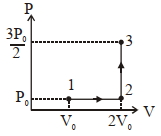

$I _{1}= M$. of thin circular ring about its diameter.
$I _{2}=$ $M.I.$ of circular disc about an axis perpendicular to the disc and going through the centre,
$I _{3}=$ $M.I.$ of solid cylinder about its axis and
$I _{4}= M . I.$ of solid sphere about its diameter. Then