MCQ
Alkali metals in each period have
  • A
    Smallest size
  • Lowest ionization potential
  • C
    Highest ionization potential
  • D
    Highest electronegativity

Answer

Correct option: B.
Lowest ionization potential
b
(b) Lowest ionisation energy due to largest size.

Need a full question paper?

Generate a complete, print-ready paper with questions like this in minutes — across 16+ boards, with answer keys.
Start Generating Free

Similar questions

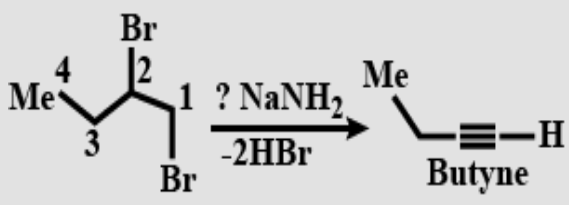
Vicinal dihalides undergo double dehydrohalogenation to give terminal alkyne. How many moles of $\ce{NaNH}_2$​ are used in the overall reaction?​​​​​​​
The phenomenon of splitting of spectral lines under the influence of the electric field is called :
${C_{{\rm{(graphite)}}}} + {O_2}(g)\, \to \,C{O_2}(g)$ $\Delta H = - 94.05\,k\,cal\,mo{l^{ - 1}}$${C_{{\rm{(diamond)}}}} + {O_2}(g)\, \to \,C{O_2}(g);\,$$\Delta H = - 94.50\,k\,cal\,mo{l^{ - 1}}$ therefore
An atom of an element has two electrons in the $M$ shell. Identify its atomic number.
$2 \mathrm{MnO}_4^{-}+\mathrm{bI}^{-}+\mathrm{cH}_2 \mathrm{O} \rightarrow \mathrm{xI}_2+\mathrm{yMnO}_2+\mathrm{zOH}^{-}$

If the above equation is balanced with integer coefficients, the value of $z$ is____

Hybridisation of central atom in $N{F_3}$ is
Given

$(i)$ $\begin{gathered}
  HCN\left( {aq} \right) + {H_2}O\left( l \right) \rightleftharpoons {H_3}{O^ + }\left( {aq} \right) + C{N^ - }\left( {aq} \right) \hfill \\
  {K_a} = 6.2 \times {10^{ - 10}} \hfill \\ 
\end{gathered} $

$(ii)$ $\begin{gathered}
  C{N^ - }\left( {aq} \right) + {H_2}O\left( l \right) \rightleftharpoons HCN\left( {aq} \right) + O{H^ - }\left( {aq} \right) \hfill \\
  {K_b} = 1.6 \times {10^{ - 5}} \hfill \\ 
\end{gathered} $

These equilibria show the following order of the relative base strength

Which of the following shows the correct order of decreasing acidity
Azimuthal quantum number for last electron of $Na$ atom is
For an ideal solution of two components $A$ and $B$, which of the following is true?